
Disclosure: Some links in this article are affiliate links. If you sign up through them, I may earn a commission at no extra cost to you. It does not change my opinions or the scores below, and I have described the product’s weaknesses as plainly as its strengths.
Most AI marketing tools do one job. They write the script, or generate the video, or schedule the post, and then they hand everything else back to you. Fastlane AI wants to do the whole loop. You give it your website, and an agent called Senna studies your brand and your competitors, makes the ads, launches them, reads the results and uses what it learns to make the next batch.
That is a big promise, and it is the reason this Fastlane AI review exists. Is Fastlane worth paying for in 2026, or is it one more tool that produces plenty of content and very little growth?
My verdict is that Fastlane AI is worth a trial if you are a founder, an e-commerce or app marketer, or a small growth team that lives on short-form video and Meta ads, and you need far more creative variations than you could ever produce by hand. It is a weaker fit if you need tight control over every asset, work in a regulated industry, or want a content engine for blogs and email.
The product only recently grew from a content generator into a full campaign agent, and the strongest proof of its results comes from the company itself. So I would treat it as a promising young product, not a proven one.
The rest of this review covers how Fastlane works, what it really costs once you do the credit math, where it falls short, and how it compares with the alternatives.
Fastlane AI at a Glance: The Quick Verdict
| Category | Summary |
|---|---|
| Overall rating | 3.7 out of 5 |
| Best for | Solo founders, app and SaaS marketers, e-commerce and DTC brands, and small teams that run short-form video and Meta ads |
| Not ideal for | Regulated industries, brands that need to approve every detail, and teams that want blogs, email or long-form content |
| Starting price | $29 per month (Starter) as listed, with a 7-day free trial |
| Biggest strength | One agent that handles research, creative, launch and learning in a single loop |
| Biggest weakness | Young product with vendor-supplied proof, credit-based costs, and output that still needs human judgment |
| Free trial | Yes, 7 days with 50 credits, and you can cancel anytime |
Want to see the output on your own product before you decide?
How I Evaluated Fastlane AI
A review is only useful if you know what it rests on, so here is the plain version. I did not run a paid campaign through Fastlane for this article, and I would rather say that than imply otherwise.
My assessment draws on Fastlane’s live website and pricing as published on October 31, 2026, its launch coverage, and independent write-ups from Kompozy, ChatGate and Product Hunt. The sources are listed at the end. One of them deserves a note: Kompozy sells a competing content platform, so I weighed its opinions with that in mind and leaned on it mainly for facts and for the limits it identified.
I judged Fastlane on the questions that matter to anyone considering it:
- Does it save real time across research, creative, launch and optimization?
- How good and how varied is the creative it produces?
- What does it cost once you account for credits and add-ons?
- Where does it need a human?
- Which claims can be verified, and which come only from the company?
- How does it compare with the main alternatives?
Where a figure comes from Fastlane itself, I label it a vendor claim. Treat those numbers as marketing until you see them in your own account.
What Is Fastlane AI?
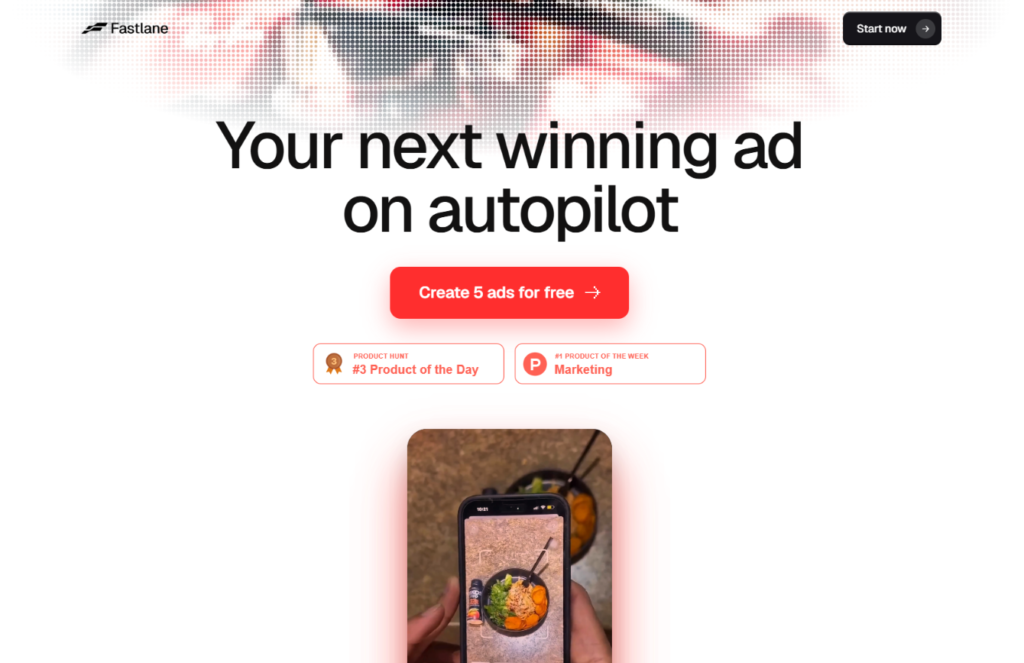
Fastlane (usefastlane.ai) is an AI marketing platform built around an agent named Senna. Independent coverage describes the company as Sydney-based. It began as a tool for generating and posting organic short-form content, such as AI videos, slideshows and memes for TikTok, Instagram and YouTube Shorts. On October 14, 2026, it relaunched as Fastlane 2.0, which adds paid ad execution and a performance-learning loop on top of the original content engine.
Fastlane markets itself to solopreneurs and fast-growing teams. Its homepage claims more than 70,000 businesses use it and shows a logo wall with names such as Coursera, Revolut and Hostinger. Treat both with caution. A Kompozy reviewer flagged the 70,000 figure as impossible to verify independently, a Japanese tech blog put the user count above 20,000 as of July 2026, and a logo on a homepage says nothing about how deeply or how recently a brand used the product.
One quick clarification, because it trips people up in search results. This Fastlane has nothing to do with the open-source fastlane tool that iOS developers use to automate app builds. Fastlane’s own FAQ addresses the mix-up.
How Fastlane AI Works: The Five-Step Loop
The core idea is a loop that repeats, with each pass feeding the next. Here is what each stage does, based on Fastlane’s own description and independent coverage.
1. It Learns Your Brand
You give Senna a URL. It pulls your product details, color palette and tone of voice, then scans the ads you have already run and reports what appears to be working. The homepage example shows patterns such as how many ads lean on discounts and how many run without captions. This is a useful starting point because it grounds the creative in your actual brand instead of a generic template.
2. It Studies Competitors and Customers
Senna reads competitor ads and organic posts, along with thousands of customer reviews from places like Reddit and Amazon, and then suggests audiences your rivals may be missing. In the homepage example, it proposes segments such as a science-minded biohacker or a busy professional. This research step is the part reviewers praise most, because it replaces hours of manual ad-library browsing.
3. It Creates the Ads
Each campaign produces dozens of new concepts: remakes of competitor ads, trending formats, AI-creator videos, statics and memes. The format library runs from chalkboard explainers and claymation to fake-podcast and news-style parodies. You review and approve, and Senna produces the final assets.
4. It Launches Paid and Organic
Approved ads go live in your own Meta Ads Manager, and AI creators post to Instagram, TikTok and YouTube Shorts from a single calendar. You keep control of your ad account and your budget, which matters because media-buying judgment stays with you.
5. It Reads Results and Doubles Down
Fastlane tracks metrics such as thumbstop rate, hold rate, cost per acquisition and return on ad spend for each creative. Winners are saved, losers are cut, and a winning ad becomes the seed for new variations. The idea is that every lap makes the next batch smarter. The design is sound, but how well the optimization performs at scale is hard to verify this early in the product’s life.
Reading about the loop is one thing, and watching Senna work on your own website is another. Paste in your URL and see what Fastlane builds for your brand using the free trial credits.
Fastlane AI Features: What You Actually Get
Radar: Competitor and Trend Research
Radar is a searchable library that gathers brands’ organic and paid content in one place, so you can see what is working in your niche before you create anything. Instead of scrolling through ad libraries by hand, you browse real examples from competitors and adjacent brands and pick the ones worth learning from.
It also gives you a rough signal of what deserves attention. In Fastlane’s homepage example, a rival’s top ad had been running for 214 days. Advertisers rarely keep paying for ads that lose money, so a long-running ad is a reasonable hint that the angle works. That is a rule of thumb, not proof, but it is a far better starting point than guessing.
For many marketers, Radar is the most practical feature in the product. It feeds the competitor-remix tool below, and it is useful on its own as a research habit.
Remix: Rebuild Any Winning Ad for Your Brand
Remix takes an existing image or video and rebuilds it for your brand. You can pick the source from Radar, paste a link, or upload your own file, and Senna recreates the concept with your product, colors and tone. Fastlane’s homepage demonstrates this by turning a competitor’s static ad into a version for a different brand, and notes that the example brands are not affiliated with Fastlane.
The value is speed. If a format is already working for someone else, you can test your own take on it within minutes instead of briefing a designer. It also pairs well with the learning loop, because a winning ad of your own can be remixed into new variations.
The risk is closeness. Borrowing a structure, such as a hook or layout, is standard practice. Copying a rival’s wording, imagery or distinctive style too closely can cause brand and legal problems. Have a person review any remix that looks too similar to the original before it goes live.
AI Influencers and UGC Libraries
Fastlane gives you two ways to put a face on your videos. The first is a ready-made library of more than 1,000 AI creators across different niches, angles and settings, plus more than 2,000 licensed clips of real human creators that you can remix with your product. The second is the option to create your own AI influencer, a consistent character that appears across all your videos so your audience sees the same face each time.
Plan limits matter here. Starter includes 25 AI characters, Growth and above include unlimited AI characters, and the Growth plan includes 100 real-person characters, which Pro makes unlimited.
One point to verify during your trial: an independent reviewer reported that Fastlane’s separate influencer tool draws on a stock character library instead of building a persona from your own face. Fastlane’s own wording describes creators built for your brand, so test exactly how much customization you get before you rely on it.
Synthetic creators can look convincing, which is exactly why you should check each platform’s rules on AI-generated content and labeling before you publish.
Bulk Launch on Meta
Once you approve a batch of ads, Fastlane launches them directly in your own Meta Ads Manager. You choose the budget, and dozens of ads can go live at the same time. Fastlane’s examples show a batch of 24 ads being launched at once and a campaign with 30 ads running on a $5,000 daily budget, though those are illustrations of scale, not typical results.
This is where the product moves from a creative tool to an advertising tool. You do need to connect your ad account first, and your spend, audiences and billing stay with you and Meta. Fastlane operates inside your account instead of taking it over, which many marketers will prefer.
Independent coverage describes paid execution on Meta as the most mature part of the product. If your growth depends on Facebook and Instagram ads, this is the feature to test first.
Organic Posting and Scheduling
Alongside paid ads, Fastlane runs organic posting from one calendar. AI creators post to Instagram, TikTok and YouTube Shorts, and the homepage example shows a 30-day schedule across those three platforms. Every plan includes direct TikTok posting and unlimited scheduling, and your plan sets how many social accounts you can connect: one on Starter, ten per workspace on Growth and up to 500 per workspace on Pro.
Fastlane promotes an organic-first approach. You post content at volume, watch which pieces earn attention for free, and then put ad spend behind the proven winners. That can lower the cost of discovering what works.
The trade-off is breadth. Reviewers treat organic posting as the secondary lane behind paid ads, and its platform coverage is narrower than a dedicated scheduler like Buffer. If you publish to many channels, you may still want a separate scheduling tool.
Swipe-Style Approval
Reviewing dozens of generated assets could easily become a chore, so Fastlane uses a fast approval mode, called Blitz Mode in third-party descriptions. You flip through the generated content and keep or reject each piece, much like swiping through cards on a phone. Fastlane’s Product Hunt launch even earned a Tinder-for-marketing tagline.
This step is your quality gate. Approving only what fits your brand, claims and tone is the difference between a useful batch and a pile of generic content. It also gives Senna a signal about your taste.
Because swiping is quick, it is easy to approve too fast. The overall product leans toward speed and delegation, so slow down on anything involving product claims, pricing or regulated topics.
Warmed Accounts
Warmed accounts are a paid add-on, separate from the core subscription. Fastlane says it creates real TikTok and Instagram accounts for US and EU audiences from scratch, warms them up in your niche, and manages them inside the platform so they post from day one. The price is $100 per month per account plus $1.50 for every post upload, and you need an active Fastlane subscription.
The appeal is a head start. A brand-new account with no history can be slow to gain reach, and a warmed one skips part of that ramp-up.
The catch is ownership and platform rules. Posting from accounts someone else created is a different model from posting to your own, and social platforms have their own terms about account creation and automation. Read those terms, ask what happens to the account if you cancel, and test with one account before you commit.
API, MCP and Free Tools
Fastlane publishes API and MCP documentation for developers, which lets outside AI agents and tools trigger content creation and posting without opening the dashboard. For technical teams and agencies, that means Fastlane can become one step inside a larger automated workflow.
The site also hosts free tools that work as a low-pressure preview of the product, including an AI influencer generator, an AI UGC video generator, a TikTok scheduler, an AI meme generator and a hook generator. Try a few with your own product before you start the trial. If the output feels generic, that is useful information before you spend any credits.
Does Fastlane AI Deliver Results? How to Read the Proof
Fastlane’s homepage leads with a story about a TikTok creator who reached 36.2 million views from a single video made and posted through the platform. It also features a wall of enthusiastic posts from X, with users praising speed, cost savings and volume.
These are worth reading, and they are also worth reading carefully. A single viral video is an outlier, and the homepage shows only the winner. Testimonials chosen by the vendor tell you what the product can do at its best, not what the average user should expect. The company also states that its team has run more than $1 billion in ad spend, which is a claim about the founders’ experience, not a guarantee about your results.
The fair reading is this. Fastlane clearly lowers the cost and time of producing many creative variations, and that is a real advantage in short-form advertising, where finding a winner usually takes volume. What it cannot promise is that any given variation will perform. Your offer, your audience and your budget still decide that. For a wider view than the homepage offers, check what users say on Fastlane’s Product Hunt page, keeping in mind that it held only a small number of reviews when I looked.
Fastlane AI Pricing in 2026: Plans, Credits and Hidden Costs
Fastlane uses credit-based pricing. According to its pricing page, a static image costs 5 credits and a 5-second video costs 80 credits, and you can mix them as you like. The page offers monthly and yearly billing, with yearly saving 30 percent, so check which price you are looking at before you pay. The figures below are the prices listed when I checked.
| Plan | Listed price | Credits per month | Roughly equals | Campaigns at a time | Seats | Social accounts |
|---|---|---|---|---|---|---|
| Starter | $29 per month | 500 | Up to 100 statics or 6 videos | 1 | 1 | 1 |
| Growth | $79 per month | 2,000 | Up to 400 statics or 25 videos | 5 | 3 (extra seats $10) | 10 per workspace, 3 workspaces |
| Pro | $199 per month | 7,500 | Up to 1,500 statics or 93 videos | 20 | 10 (extra seats $10) | 500 per workspace, 10 workspaces |
| Enterprise | $999 per month | 40,000 | Up to 8,000 statics or 500 videos | 20 | 25 | 500 per workspace, 10 workspaces |
Enterprise can scale up to $2,999 per month in $50 steps, and each step adds 2,000 credits. Growth and Pro add analytics, remix, auto captions and priority support, and Growth and above include unlimited AI characters. The Growth plan includes 100 real-person characters, and Pro makes those unlimited.
What Each Asset Really Costs
The sticker price hides how fast credits disappear on video. Here is the cost per asset, calculated from the listed prices and credit allowances. These are my own derived figures, not numbers Fastlane publishes.
| Plan | Cost per static | Cost per 5-second video |
|---|---|---|
| Starter | About $0.29 | About $4.60 to $4.80 |
| Growth | About $0.20 | About $3.16 |
| Pro | About $0.13 | About $2.14 |
| Enterprise | About $0.13 | About $2.00 |
The lesson is that a video-heavy workflow burns through Starter quickly. Six videos is the whole month’s allowance. Fastlane lists the credit cost for a 5-second clip, so check the in-app price for longer videos before you plan around them.
What the Pricing Page Doesn’t Make Obvious
- Your ad budget is separate. Fastlane creates and launches the ads, but you still pay Meta for the spend.
- Warmed accounts cost extra. Each one is $100 per month, plus $1.50 for every post upload, and you need an active subscription.
- Extra seats add up. Additional seats on Growth and Pro cost $10 per month each.
- Tiers are still moving. One third-party overview listed a different credit total for Pro than the current official page does, and independent reviewers warn that pricing is still in flux at this stage. Confirm the details at checkout.
To make this concrete, here are two illustrative scenarios built from the published prices. They are not quotes.
- Small DTC brand: 30 statics and 12 short videos per month uses 1,110 credits (150 plus 960). That fits the Growth plan at $79, or $89 with one extra seat for a freelancer.
- Brand with managed accounts: Growth at $79, plus two warmed accounts ($200) and 40 post uploads ($60), comes to $339 per month before any ad spend.
Is There a Free Trial?
Yes. Fastlane offers a 7-day free trial with 50 credits and lets you cancel anytime, and the homepage also invites you to create five ads for free. That is enough to judge output quality on your own product, which is the test that matters. Claim the free trial here and run it on a real product before you choose a plan.
Fastlane AI Pros and Cons
What I Like
- A genuinely complete loop. Research, creative, launch and optimization live in one product, instead of stopping at a draft.
- Competitor research built into creation. You start from what is working in your niche instead of guessing.
- Volume at a low cost. The per-asset math, especially on Growth and Pro, undercuts most freelancers and agencies for testing volume.
- A mature paid path. Launching through your own Meta Ads Manager keeps spend and audiences under your control.
- Low-risk to test. The free trial and free tools let you judge quality before paying.
- Developer options. API and MCP access let technical teams plug it into other workflows.
What Holds It Back
- A young, recently pivoted product. Several public claims cannot be verified independently yet.
- Meta-first paid advertising. Organic posting covers fewer platforms than a dedicated scheduler.
- Volume is not the same as quality. Brand fit and factual accuracy still need a human.
- Credits drain fast on video. The entry plan covers only a handful of videos per month.
- Warmed accounts raise questions. They are a different ownership model that deserves its own due diligence.
- Not a full content engine. It does not produce blog posts, newsletters or clips from long recordings.
Where Fastlane AI Falls Short
The lists above are the summary. These are the limits I would think hardest about before committing.
A young product with vendor-supplied proof. Fastlane moved from a content generator to an end-to-end agent only in October 2026. The loop is well designed, but there is little independent, long-term evidence of how well it optimizes real campaigns. That is not a reason to avoid it, only a reason to test with a small budget first.
Human judgment still matters. Reviewers consistently warn that AI-generated creative at volume needs a person checking brand voice, claims and accuracy. If you work in health, finance or another regulated area, AI likenesses and product claims need especially careful review before anything goes live.
AI influencers and disclosure. Synthetic creators can look convincing, and that is exactly why you should check the current policies of Meta, TikTok and YouTube on AI-generated content and labeling, along with advertising disclosure rules where you operate. If you advertise in the US, the FTC’s plain-language guide, Disclosures 101 for Social Media Influencers, is a short place to start. Audiences who feel tricked can also turn on a brand, so consider how comfortable you are with the approach.
Attribution needs your own analytics. Fastlane reads performance from the ad platforms, but you still need your own analytics connected to see what actually drives revenue.
Warmed accounts need scrutiny. Renting accounts that someone else created and warmed is different from posting to your own. Before you rely on this, read the terms of each platform and think about what happens to the account if you cancel.
Less control by design. There is an approval step, but the product is built around speed and delegation. If you want to craft every asset by hand, you will feel that friction.
Fastlane AI vs. the Alternatives
Fastlane rarely competes alone. Here is how it compares with the main categories of tools. I describe competitors in general terms, because their features and prices change often.
| Option | Where it beats Fastlane | Where Fastlane wins | Pick it if |
|---|---|---|---|
| AI UGC video tools (such as Arcads, Creatify and MakeUGC) | Tend to focus deeply on the video-generation step | Adds competitor research, Meta launching and a learning loop | You only need videos and plan to run everything else yourself |
| Social schedulers (such as Buffer) | Mature scheduling, broader platform coverage | Creates the content as well as posting it | Your content already exists and you need reliable publishing |
| Meta’s built-in ad tools | Native to Ads Manager, no extra subscription | Generates and tests large volumes of creative outside Meta | Your buying lives entirely inside Meta |
| Marketing agencies | Human strategy, judgment and accountability | Far faster to start and typically much cheaper to test | You need strategic guidance and can afford the cost |
| General AI chatbots | Flexible and cheap for scripts, ideas and copy | Launches ads and closes the performance loop | You only need help with writing and brainstorming |
Fastlane’s own site publishes comparison pages against several of these tools, and its homepage table claims large savings over agencies and UGC marketplaces. Those are useful for feature checklists, but they come from the vendor, so check the numbers against your own situation.
Who Should Use Fastlane AI?
Fastlane is a good fit if you are:
- A founder or solo marketer who needs steady short-form content without hiring a team.
- An app, SaaS or e-commerce marketer who tests many hooks and formats on Meta.
- A small growth team that is limited by creative volume, not by media budget.
- An agency or freelancer who wants to speed up concept testing for clients.
- Someone comfortable reviewing AI output and keeping a hand on the controls.
If that sounds like you, try Fastlane free for 7 days and judge the output yourself.
Look elsewhere if you:
- Work in a heavily regulated industry with strict claim rules.
- Need to approve and craft every asset by hand.
- Want blogs, newsletters or clips from long recordings.
- Are uncomfortable with synthetic creators or rented accounts.
- Have no budget to test, since results depend on real ad spend.
How to Get the Most Out of Fastlane AI
- Start with the free trial on your real product. Judge the output on your own brand, not on the polished homepage examples.
- Test organically first. Fastlane’s own approach is to let organic posts show what resonates, then put paid spend behind proven winners.
- Connect your own analytics. Do not rely on platform metrics alone.
- Review every asset before launch. Check claims, brand voice and any close copies of competitor ads.
- Watch credits closely. Statics are cheap and videos are not, so plan your mix.
- Scale slowly. Add campaigns and accounts only after one batch has produced a clear winner.
My Scorecard
These scores are my editorial judgment, based on the evidence available, and they weigh Fastlane against its intended use.
| Category | Score |
|---|---|
| End-to-end automation | 4.3 / 5 |
| Competitor and market research | 4.0 / 5 |
| Paid campaign execution | 3.9 / 5 |
| Creative variety and output | 3.8 / 5 |
| Value for money | 3.7 / 5 |
| Organic posting and scheduling | 3.5 / 5 |
| Brand control and safety | 3.3 / 5 |
| Maturity and transparency | 3.2 / 5 |
| Overall | 3.7 / 5 |
Final Verdict: Is Fastlane AI Worth It?
Yes, for the right user, and with realistic expectations.
Fastlane earns that recommendation because it tackles the most expensive problem in short-form advertising: producing enough creative variety to find a winner. Folding research, creation, launching and learning into one agent is a smarter design than most single-step tools, and the entry price plus the free trial make a test cheap.
It loses points for the things a young product cannot yet prove. Some of its biggest claims come only from the company, video credits run out fast, and the output still needs a person who understands your brand. The warmed-account add-on is the piece I would examine most closely before spending on it.
My practical advice is to start with Fastlane’s free trial, build a small batch for one real product, and check the results against your own analytics. If it produces a winner you could not have found as cheaply by hand, move to Growth. If it does not, you have lost a week and not much else.
Fastlane AI FAQ
Is Fastlane AI worth it in 2026?
For founders and small teams that run short-form video and Meta ads, it is worth a trial. It combines research, creative, launching and optimization in one product. It is a weaker fit for regulated industries, brands that need full manual control, and teams that want long-form content.
How much does Fastlane AI cost?
Listed plans are Starter at $29 per month, Growth at $79, Pro at $199 and Enterprise at $999, with credit allowances that rise at each level. Extra seats cost $10 per month, and warmed accounts cost $100 per month each plus $1.50 per upload. Your Meta ad spend is separate. Confirm current prices and the monthly or yearly billing toggle on Fastlane’s site.
Does Fastlane AI have a free trial?
Yes. It offers a 7-day free trial with 50 credits and lets you cancel anytime. Start your free trial here.
What is Senna in Fastlane?
Senna is Fastlane’s AI agent. It learns your brand from your website, researches competitors, creates ads and organic content, launches them, reads the results and feeds those lessons into the next batch.
Does Fastlane run Meta ads for me?
It launches approved ads in your own Meta Ads Manager. You connect your account and pay for your own ad spend, and you keep control of audiences and budgets.
Which platforms does Fastlane post to?
It posts organically to Instagram, TikTok and YouTube Shorts, and runs paid ads on Meta. Independent reviewers note that its organic coverage is narrower than a dedicated scheduler.
What are credits in Fastlane?
Credits are the single meter for everything you generate. According to Fastlane’s pricing page, a static image costs 5 credits and a 5-second video costs 80. Your plan includes a monthly allowance.
Is Fastlane the same as the fastlane iOS tool?
No. Fastlane AI at usefastlane.ai is an AI marketing platform. The fastlane tool for iOS developers automates app builds and releases, and the two are unrelated.
Does Fastlane replace a marketing agency?
It can replace much of the production and testing work, but not strategy, brand judgment or accountability. Many teams use it to increase creative volume and keep a human in charge of direction.
Are the AI influencers safe to use in ads?
They can be effective, but you should review the policies of each ad and social platform on AI-generated content, follow any advertising disclosure rules where you operate, and review product claims carefully, especially in regulated categories.
Are Fastlane’s warmed accounts a good idea?
They are a convenience for some marketers, but they work differently from posting to your own accounts. Read the platform terms and think about ownership before relying on them.
Does Fastlane have an API?
Yes. Fastlane publishes API and MCP documentation for developers who want to connect outside tools and agents.
