
If you’re running a direct-to-consumer (DTC) brand, you already know the drill. Your inbox is drowning in support tickets. Your social media comments are a mix of genuine questions, spam, and the occasional troll. Your marketing team is still manually pulling reports from Meta, Google, and Shopify every Monday morning.
And your operations team? They’re buried in recurring tasks that eat hours without delivering much strategic value.
That’s the reality of scaling an online brand in 2026, and it’s precisely the problem Brandwise AI was built to solve.
In this detailed Brandwise review, I’m going to walk you through exactly what this AI agent does, how its core features perform in the real world, what the pricing looks like, who it’s the right fit for, and where it falls short.
I’ve spent considerable time studying the platform thoroughly, examining every product page, feature set, use case, and pricing tier, so you don’t have to guess whether it’s the right investment for your brand.
Let’s get into it.
What Is Brandwise AI?
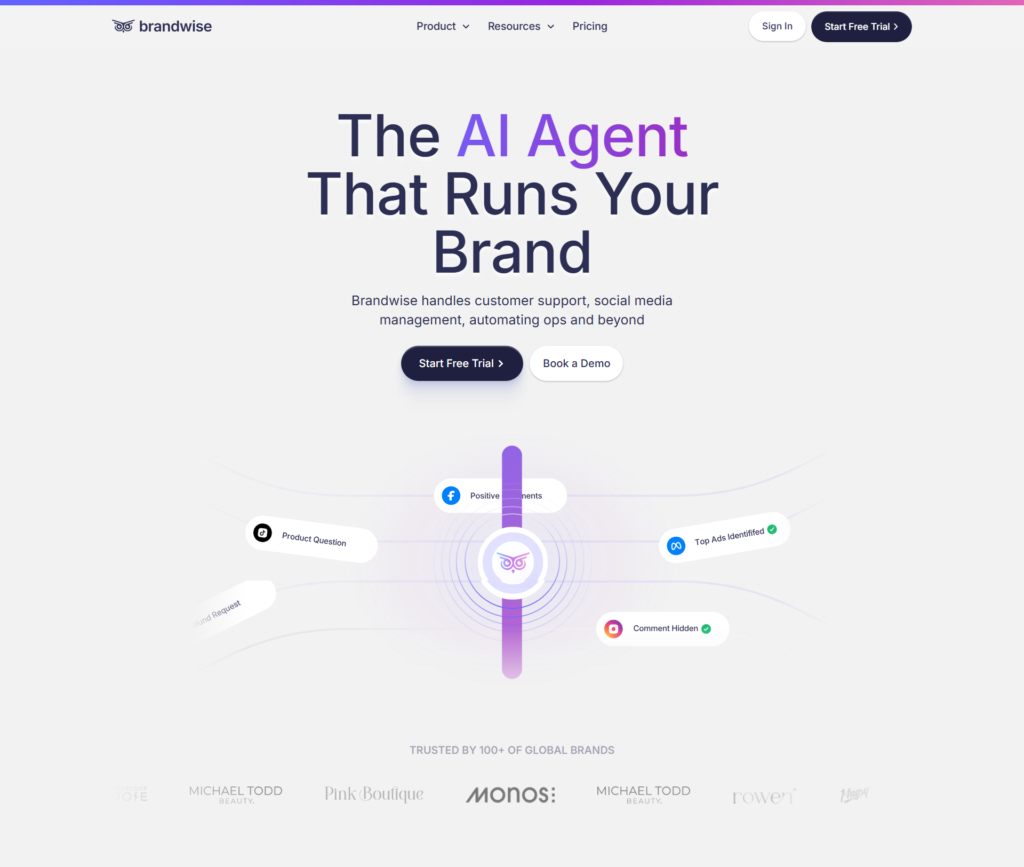
Brandwise is an AI-powered business agent built specifically for online and direct-to-consumer brands. At the center of the platform is an AI agent named Obie, which handles customer support, social media management, marketing analysis, and operations automation, all from a single platform.
Unlike general-purpose AI tools that can technically do anything but aren’t optimized for any specific business context, Brandwise was designed from the ground up for the operational realities of DTC and e-commerce brands. That specialization matters more than it might sound.
Obie doesn’t just generate replies or summarize text. It integrates directly into your entire tech stack, Shopify, Meta, Google Ads, email, live chat, Slack, and social platforms — and takes action across all of them. We’re talking about fully resolving support tickets, moderating ad comments in real time, generating new ad creatives from your best-performing campaigns, and automatically delivering operations reports to your team on a schedule.
Put simply: Brandwise isn’t a chatbot. It’s closer to a digital team member that gets smarter the longer it works with your brand.
Who Is Brandwise AI Built For?
Before jumping into features, it’s worth being clear about who this product actually serves. Brandwise is purpose-built for:
- DTC and e-commerce brands selling physical or digital products online
- Customer support teams that are spending too much time on repetitive, low-complexity tickets
- Social media managers who need to moderate comment sections and manage DMs at scale without losing their minds
- Marketing teams that want data-driven insights and automated reporting instead of manual spreadsheet work
- Operations and brand managers who want to automate recurring workflows and catch business issues before they become costly problems
If you’re running a bootstrapped Shopify store, a growing DTC brand with a small team, or a multi-million-dollar e-commerce operation with separate customer support, marketing, and ops functions, Brandwise has a relevant use case for you. The platform currently serves 100+ global brands, including recognizable names like Michael Todd Beauty, Monos, and Obvi.
If you’re a B2B SaaS company, a local services business, or a brick-and-mortar retailer with no significant e-commerce presence, Brandwise is probably not your best fit — it’s too narrowly tailored to online brand workflows.
Brandwise AI Core Features: An In-Depth Look
This is where the review gets substantive. Brandwise is organized around four core product pillars: Help Desk (Customer Support), Social Inbox (Social Media Management), Marketing, and Operations. Let me break down what each one actually does.
1. AI Help Desk — Customer Support Built for Resolution, Not Just Replies
Most AI customer support tools on the market do one thing: they draft a reply and hand it to a human agent to send. Brandwise’s approach is fundamentally different. Obie is designed to fully resolve tickets end-to-end, not just generate text for a human to rubber-stamp.
Here’s how that works in practice.
Obie is trained on your specific brand data, your help documentation, product information, brand guidelines, past conversation history, and approved workflows. When a customer submits a ticket asking about their order status, Obie doesn’t just write “Your order is being processed.”
It pulls the actual order data from Shopify, checks the shipment status, and sends a complete, accurate, on-brand response. It can handle address update requests, process return inquiries, and respond to product questions, all within the guardrails your team sets.
The key distinction here is resolution versus reply. Brandwise explicitly frames its help desk as a tool for automating resolutions, not automating drafts. That’s a meaningful upgrade over most AI-assisted helpdesks in the market today.
What makes the help desk stand out:
Self-Improving Knowledge Base — This is genuinely clever. Obie doesn’t just use your knowledge base; it actively identifies gaps in it. When a customer asks something Obie isn’t confident answering, it flags the gap and suggests an update to the knowledge base. Over time, your support infrastructure gets smarter without you having to manually maintain every article.
Smart Handoff — Not every ticket should be handled by AI. Brandwise acknowledges this honestly. When Obie encounters a complex, sensitive, or policy-edge scenario, it hands off to a human agent, notifies the right person, and flags what additional knowledge would help it handle similar situations in the future. This is AI operating within responsible boundaries — a huge point of trust for brands that have been burned by AI giving customers wrong answers.
Smart Labels — Conversations are automatically tagged using AI-driven context analysis. This means your team doesn’t have to manually categorize every ticket. Labels get applied intelligently based on what the conversation is actually about — shipping issues, product questions, refund requests, and so on.
Detailed Analytics — You get organization-level and team-member-level reporting on support performance. This matters a lot for managers who need to understand where ticket volume is coming from, how quickly issues are being resolved, and where gaps in the knowledge base are concentrated.
Always-Improving AI — Obie learns from every interaction. This isn’t marketing language; it’s a structural feature of the platform. The more your team uses Brandwise, corrects Obie’s responses, and adds to the knowledge base, the more accurate and on-brand Obie’s responses become.
The practical benefit for support teams is significant. Instead of hiring additional headcount to handle repetitive tickets during a product launch, a seasonal surge, or a PR crisis, you’re scaling with AI — and that AI is trained specifically on how your brand communicates.
2. Social Inbox — Smarter Comment Moderation and Social Engagement
Social media management for DTC brands is deceptively labor-intensive. A single Facebook or Instagram ad campaign can generate hundreds of comments per day — a mix of genuine purchase questions, competitors dropping links, bots, spam, and customers complaining publicly. Managing all of that manually while also running the business is simply not sustainable.
Brandwise’s Social Inbox tackles this with a combination of AI moderation, automated replies, and a unified inbox for every social platform.
AI Comment Moderation — Obie can automatically identify and hide negative, spam, off-brand, or harmful comments across both your paid ads and your organic social posts in real time. This has a direct business impact: negative comment sections on ads hurt your click-through rates and conversion rates. Protecting the comment environment around your paid spend protects your ROAS (Return on Ad Spend). Brandwise frames this explicitly — they position AI moderation as a tool for boosting ROAS, which is exactly the right frame for a paid-heavy DTC brand.
AI Replies at Scale — Obie can automatically respond to comments and direct messages across every connected platform with accuracy that reflects your brand voice. This isn’t a generic auto-reply bot. Because Obie is trained on your product information, brand tone, and past conversations, its replies are contextually appropriate — not the kind of robotic “Thanks for reaching out! We’ll get back to you!” responses that customers have learned to ignore.
2-Way Translation — This is a powerful feature for brands with international audiences. Obie can automatically translate incoming comments and outbound replies into any language, enabling your team to engage with customers worldwide without needing a multilingual support staff.
Unified Inbox — Email, live chat, and social engagement (Facebook, Instagram, TikTok) are all managed from a single interface. This is hugely practical for small teams where one person is handling multiple channels. Instead of bouncing between five different tabs and platforms, everything is centralized.
Influencer Comment Management — DTC brands running influencer marketing campaigns often whitelist creator accounts for paid promotion. Managing the comment sections of those whitelisted influencer ads is a real operational challenge. Brandwise handles it — you can manage comments across all your whitelisted influencer ads within the same Social Inbox workflow.
Shopify + DMs Integration — This is a genuinely useful commerce feature. When customers send DMs that reference orders, your team can view and manage Shopify orders directly inside the DM inbox. No more toggling between Shopify and Instagram to find an order number. The customer interaction and the transactional context are side-by-side.
Bulk Actions — For teams dealing with high-volume comment situations (think a viral post or a controversial ad), you can select multiple comments or DMs and perform actions in bulk. This alone can save hours during high-traffic periods.
3. Marketing — Data-Driven Creatives and Automated Campaign Reporting
The marketing module is where Brandwise starts to feel genuinely ambitious. Most platforms in this space either help you manage social engagement or help you run marketing analytics. Brandwise is trying to do both — and it adds creative generation on top.
Generate Creatives From Real Performance Data — This is the headline feature of the marketing module. Obie analyzes your top-performing ads and engagement patterns and uses that data to generate new ad creatives using advanced AI image models. The logic is sound: instead of guessing what will perform well, you’re generating new creatives from the patterns of what has already worked. Obie can identify the hooks and formats that convert, then produce dozens of new ad image variations in seconds — no graphic designer required.
For DTC brands running paid acquisition at scale, creative fatigue is a constant problem. You need a steady stream of fresh ad variants. Generating them from real performance data rather than creative intuition is a genuinely smarter approach.
Campaign Performance Analysis — Obie has full access to your ad data from Meta and Google, your Shopify store data, and your engagement data across social. You can ask Obie natural-language questions like “Which creatives drove the most purchases last month?” or “What’s the sentiment trend in our TikTok comments this week?” and get clear, data-backed answers — instead of spending an hour manually pulling reports.
This is a big deal for marketing teams that are still doing manual performance analysis. The time savings compound significantly over a month or quarter.
Automated Campaign Reporting — Teams can schedule recurring campaign analyses and receive fully formatted reports — with charts, tables, and takeaways — automatically. Reports can pull data from Meta, Google, Shopify, and other connected sources into a single unified document and deliver them to your team on whatever cadence you set.
The practical implication: your Monday morning marketing review no longer requires anyone to spend Friday afternoon building a deck. Obie builds it for you and delivers it to Slack or email.
4. Operations Automation — The Work That Never Stops, Running on Autopilot
The operations module is designed for the category of work that every brand has to do, but that doesn’t require human judgment for most of it. Think recurring reports, scheduled checks across your tech stack, automated alerts when something unusual happens, and turning raw data into actionable team notifications.
Recurring Tasks and Scheduled Automation — You can configure Obie to run specific tasks on a schedule. Weekly report on top-performing creatives? Done. Daily check on your ad spend versus revenue? Done. Automatic Slack notification when a product’s return rate crosses a threshold? Done. You set the logic once, and Obie executes it indefinitely without requiring manual initiation.
Stack-Wide Data Intelligence — Because Obie is connected to your entire tech stack — Shopify, Meta, Google, email, social, Slack — it can pull from every data source simultaneously and synthesize it into a coherent summary. The use case Brandwise highlights is striking: “This SKU has a 12% return rate. Summarize complaints from tickets, ads, and DMs.” That kind of cross-source analysis would take a skilled analyst hours to compile manually. Obie does it in seconds.
Automated Alerts and Notifications — Rather than requiring your team to monitor dashboards constantly, Obie monitors your key metrics and notifies the right people when something needs attention. This is the difference between reactive problem-solving (finding out a campaign tanked after reviewing Friday’s report) and proactive operations management (getting a Slack alert Tuesday when the ROAS on a specific ad set drops below your threshold).
Prompt Library — Brandwise includes a prompt library where teams can save and share their most effective Obie prompts. This is a small but genuinely useful feature for teams — it prevents everyone from having to reinvent the wheel when asking Obie for recurring analysis types, and it builds institutional knowledge around how to get the most out of the platform.
Key Platform Capabilities Worth Highlighting
Beyond the four core modules, several platform-level capabilities define the overall Brandwise experience and are worth understanding before you evaluate the product.
No Code Required — There are no complex flow-builders, no drag-and-drop automation sequences, no technical configuration. You interact with Obie through natural language. You type what you want; Obie does it. This makes the platform genuinely accessible to non-technical team members — a social media manager, a support rep, or a brand manager can use it on day one without any training in automation logic.
Self-Improving AI Over Time — Obie learns from your brand’s interactions, correction history, and knowledge base continuously. The platform gets more accurate and more on-brand the more your team uses it. This is a structural feature that distinguishes Brandwise from tools that perform identically on day one as they do on day 300.
Chat With Your Data — The “Chat with your data” capability runs through every module. At any point, you can ask Obie questions about your entire tech stack in plain English. “What are the biggest customer experience issues driving refunds this month?” “Which email subjects got the highest open rates?” “What did customers complain about most in our Black Friday ad comments?” These are questions that require data analysis — and Obie handles them conversationally.
Multilingual Support — For brands with international audiences, Brandwise supports multiple languages natively, including automatic translation in both directions.
AI Handoff — The human-in-the-loop design philosophy is baked into the platform. For complex, urgent, or sensitive scenarios that AI should not handle alone, Obie escalates to the right human and provides context about why the handoff is happening. This is responsible AI design — and it’s something customers and brand managers both benefit from.
Unified Inboxes — Email, social engagement, and live chat in one place. For growing brands where team members wear multiple hats, centralized inbox management is a meaningful time saver.
Organization and Team Analytics — In-depth analytics track activity and performance at both the organizational level and the individual team member level. This gives managers visibility into how the team is using the platform and where performance bottlenecks exist.
Brandwise AI Integrations
Brandwise connects to the core tools that DTC brands actually use. The integration list includes:
- Shopify — For order management, product data, and store analytics
- Meta (Facebook and Instagram) — For ad management, comment moderation, and social engagement
- Google Ads — For campaign analysis and performance reporting
- Email Inbox — For customer support and CRM communication
- Live Chat — For real-time customer support
- TikTok — For social engagement and comment moderation
- Slack — For team alerts, notifications, and report delivery
The Shopify and Meta integrations are particularly well-developed, which makes sense given that they’re the most critical infrastructure for most DTC brands. The fact that you can view and manage Shopify orders directly inside a DM inbox conversation is a genuinely useful commerce-native feature that most social management tools don’t offer.
Brandwise Pricing Plans (2026)
Brandwise keeps its pricing structure clean and relatively approachable, with two primary tiers:
Standard Plan — $49/month
The Standard plan is priced at $49 per month on a monthly billing cycle, which includes 3,000 AI credits per month. Every feature on the platform is included — there’s no feature gating between tiers. That means the AI Help Desk, Social Inbox, Marketing module, Operations automation, Obie AI Agent, recurring tasks, workflow automations, Shopify integration, Meta and Google Ads integrations, creative generation, scheduled reports, Slack alerts, multilingual support, team collaboration, and unlimited team members are all available on the Standard plan.
Enterprise Plan — Starting at $402/month
The Enterprise plan starts at $402 per month when billed annually and includes 32,000+ AI credits. It’s designed for brands with higher volume needs, custom feature requirements, and more complex operational workflows. Pricing is based on usage and custom requirements, so brands at this tier typically go through a direct sales conversation.
Free Trial
Brandwise offers a 7-day free trial with full access to every feature included in your chosen plan. No credit card is required to start the trial. This is a genuinely risk-free way to evaluate the platform with real data from your actual brand before committing to a subscription.
Is the Pricing Fair?
At $49/month for the Standard plan with 3,000 credits and full feature access, Brandwise is priced competitively relative to the category. For context: comparable AI-assisted customer support or social management tools often charge $100–$300/month for significantly fewer capabilities. The fact that all features are available on every plan — including the lowest tier — is a refreshing contrast to tools that lock core functionality behind premium tiers.
The credit-based model means high-volume brands will naturally move toward the Enterprise tier, but for a small-to-mid-size DTC brand managing a reasonable volume of support tickets and social engagement, 3,000 monthly AI credits at $49 is a genuinely accessible entry point.
What Brandwise AI Does Well — Real Strengths
Having examined the product in depth, these are the areas where Brandwise genuinely earns its value:
1. It’s built for one vertical and builds that specialization into every feature. Brandwise isn’t a general-purpose AI tool retrofitted for e-commerce. It’s designed from the ground up for DTC and online brands. That shows up in details like the Shopify-inside-DM capability, the ROAS-focused ad comment moderation, and the creative generation workflow that pulls from actual campaign performance data. Vertical-specific AI tools almost always outperform general-purpose ones for the audience they serve.
2. The resolution-versus-reply distinction is genuinely meaningful. Most AI helpdesks generate drafts for humans to approve. Brandwise handles end-to-end resolution for a defined set of ticket types. That’s a different category of productivity impact — and it’s one that compounds as your support volume grows.
3. The self-improving nature of the platform creates compounding ROI. The longer you use Brandwise, the better it gets. A platform that learns from your interactions and continuously improves its accuracy is fundamentally different from a static SaaS tool. The ROI curve actually improves over time rather than plateauing.
4. The no-code, conversational interface makes it accessible. You don’t need a developer or an automation expert to get value from Obie. The natural language interface puts the full capability of the platform within reach of anyone on your team.
5. Cross-source data analysis is genuinely powerful. The ability to ask Obie to pull insights from tickets, ads, DMs, and Shopify simultaneously — in a single natural-language query — is a capability that would require a dedicated analyst and multiple tools otherwise. That’s a real competitive advantage for lean teams.
6. The AI handoff design is responsible and trust-building. Many AI tools create risk by trying to handle everything and occasionally giving wrong, embarrassing, or harmful answers. Brandwise explicitly designs for human oversight on complex or sensitive scenarios. That’s the right approach — and it makes the tool more trustworthy for brands where customer relationships are a core asset.
Honest Limitations to Know About
No product review worth reading pretends a tool has no shortcomings. Here are the honest limitations to factor into your evaluation:
1. It’s narrowly focused on DTC and online brands. If you’re in B2B, professional services, local business, or any industry other than e-commerce and direct-to-consumer retail, Brandwise is not built for you. The integrations, features, and use cases assume an online brand workflow.
2. The credit-based model can add unpredictability for high-volume users. While 3,000 credits/month at $49 is reasonable for moderate usage, brands running high volumes of support tickets, active ad campaigns, and heavy social engagement may find they need to scale toward the Enterprise tier more quickly than expected. It’s worth asking the Brandwise team about your expected usage during the trial period.
3. The platform is primarily reactive to your integrations’ data. Obie is powerful, but it’s only as good as the data sources you connect. If your Shopify data is messy, your Meta ad account isn’t organized, or your knowledge base is sparse, Obie will have less to work with. Getting the most out of Brandwise requires some upfront investment in data hygiene and knowledge base setup.
4. Creative generation is only as strong as your existing creative library. The ad creative generation feature derives new concepts from your best-performing historical creatives. If you’re a very new brand with limited creative history, you’ll have less signal for Obie to work from. The feature becomes more powerful as your brand accumulates performance data.
5. No publicly documented API for custom integrations. While Brandwise connects to Shopify, Meta, Google, Slack, and several other major platforms, brands with highly custom tech stacks or proprietary tools may find integration coverage limited. Enterprise customers should raise custom integration requirements during the sales conversation.
Brandwise vs. Alternatives: How Does It Compare?
It’s worth briefly contextualizing Brandwise against the broader category of tools it competes with.
Versus Gorgias — Gorgias is the dominant helpdesk for Shopify brands and is deeply integrated with e-commerce workflows. Brandwise and Gorgias overlap on the help desk side. The key difference is that Brandwise is trying to be a broader operational AI agent across support, social, marketing, and ops — while Gorgias remains focused on customer support. Brands that need deep support functionality with complex rule sets may still prefer Gorgias, but brands looking for a single platform that covers multiple operational areas will find Brandwise’s scope more compelling.
Versus Tidio or Freshdesk — These are more general-purpose customer support and chat platforms. Neither is purpose-built for DTC brands the way Brandwise is, and neither offers the marketing analysis or creative generation capabilities that round out the Brandwise platform.
Versus Social Media Management Tools (Sprout Social, Buffer, Hootsuite) — Traditional social media management tools are focused on scheduling, publishing, and basic engagement. None of them offer the AI-powered comment moderation, the cross-platform unified inbox with Shopify integration, or the ad creative generation that Brandwise provides. There’s meaningful overlap in inbox management, but Brandwise goes substantially further.
Versus Custom AI Stacks — Some sophisticated DTC brands are building their own AI workflows using GPT-4o, Claude, or similar foundation models stitched together with Zapier or Make. This can work, but it requires technical expertise, ongoing maintenance, and lacks the pre-built DTC-specific integrations that Brandwise ships with. For most brands, Brandwise’s out-of-the-box functionality is faster to deploy and more reliable than a DIY AI stack.
Who Should Buy Brandwise?
Based on a thorough evaluation, here’s a direct take on who should seriously consider Brandwise:
You’re a strong fit if:
- You run a DTC or online brand on Shopify with meaningful volume in customer support, social engagement, or paid advertising
- Your support team is spending significant time on repetitive, low-complexity tickets that follow predictable patterns
- Your social media team is manually moderating ad comments and DMs and struggling to keep up with volume
- Your marketing team is still doing manual campaign reporting and creative briefing
- You want a single platform covering support, social, marketing, and operations instead of four separate point solutions
- You want AI that learns your specific brand voice over time rather than a generic AI reply tool
You’re probably not the right fit if:
- You’re a B2B company, a local services business, or a brand with no significant e-commerce presence
- You have extremely complex support workflows with many exception-heavy edge cases that require nuanced human judgment across the board
- You’re in the very early stage of your brand with minimal historical data, tickets, or creative assets to train Obie on
- You want a social media publishing and scheduling tool (Brandwise focuses on engagement management, not content scheduling)
Final Verdict: Brandwise Review 2026
Here’s the bottom line, stated plainly: Brandwise is one of the most thoughtfully designed AI platforms for DTC and online brands available today.
It solves a real problem — the operational overload of running a growing e-commerce brand — with a focused, vertically-specific AI agent that actually integrates into the tools you’re already using. Rather than being another generic AI assistant that can theoretically do anything and actually excels at nothing specific, Brandwise has made clear choices about who it serves and built every feature around that audience.
The combination of end-to-end support ticket resolution, AI-powered social comment moderation, data-driven ad creative generation, and fully automated operational reporting all accessible through a conversational interface with no code required, represents genuine, compounding value for the brands it serves.
At $49/month for the Standard plan with a 7-day free trial and no credit card required, the barrier to evaluation is extremely low. If you’re running a DTC or online brand and spending meaningful time on repetitive support, social management, or operations tasks, there’s no good reason not to spend a week testing it with your real data.
The brands that win in e-commerce over the next few years will be the ones that deploy AI as a genuine operational layer, not just a drafting assistant, but an agent that handles real work end-to-end. Brandwise is built for exactly that role.
Overall Rating: 4.5 / 5
Quick-Reference Summary
| Product Name | Brandwise (AI Agent: Obie) |
| Best For | DTC brands, Shopify brands, online retailers |
| Core Use Cases | Customer support, social media management, marketing analysis, operations automation |
| Key Integrations | Shopify, Meta, Google Ads, Slack, Email, TikTok, Live Chat |
| Standard Pricing | $49/month (3,000 AI credits) |
| Enterprise Pricing | From $402/month (32,000+ credits, billed annually) |
| Free Trial | 7 days, full access, no credit card required |
| No-Code Interface | Yes — conversational, no flow-builders needed |
| Official Website | brandwise.ai |
Frequently Asked Questions About Brandwise AI
What exactly does Brandwise AI do?
Brandwise is an AI agent platform built for online and DTC brands. Its AI agent, Obie, automates customer support (ticket resolution, not just replies), social media management (comment moderation, DM management, AI replies), marketing (campaign analysis, ad creative generation, automated reporting), and operations (recurring reports, alerts, workflow automation), all from a single unified platform.
Is Brandwise AI worth it for small DTC brands?
Yes, particularly at the Standard tier. At $49/month with full feature access and a 7-day free trial, even a small brand with modest ticket and social comment volume can quickly recoup the subscription cost in time savings alone. The platform is built to scale with you — so it remains relevant as your brand grows.
How is Brandwise different from a regular chatbot?
Traditional chatbots answer pre-set questions from a script. Obie is trained on your specific brand data, integrates with your entire tech stack, and takes action — resolving tickets, pulling order data, generating creatives, automating reports. It’s closer to a capable employee than a FAQ widget.
Does Brandwise work with platforms other than Shopify?
Shopify is the primary e-commerce integration, but Brandwise also connects to Meta, Google Ads, email inboxes, live chat, TikTok, and Slack. The Enterprise plan supports custom integrations and additional platform connections.
Can I try Brandwise before paying?
Yes. Brandwise offers a 7-day free trial with full access to all features on your chosen plan. No credit card is required to start.
How does Obie learn my brand’s voice?
Obie absorbs your help documentation, product information, brand guidelines, and past conversation history. Over time, it continues learning from your team’s interactions and corrections, making its responses increasingly accurate and on-brand the more you use the platform.
What is the AI credit system in Brandwise?
AI credits represent the consumption of AI-powered actions, automated replies, analyses, report generation, creative output, and so on. The Standard plan includes 3,000 credits per month; the Enterprise plan starts at 32,000+ credits. High-volume brands will want to discuss expected credit usage with the Brandwise team before committing to a plan.
Disclosure: This review is based on thorough research of Brandwise’s publicly available product information, feature documentation, and pricing.
