You’ve imported products from AliExpress. You’ve watched customers wait three weeks for orders. You’ve dealt with the angry emails, the refund requests, and the one-star reviews about “cheap quality.” Sound familiar?
There’s a reason thousands of dropshippers are switching to Spocket, and it’s not just marketing hype. When shipping times drop from 30 days to 3 days, and product quality actually matches the listing photos, everything changes.
Your customers are happier. Your reviews improve. Your business feels less like damage control and more like, well, an actual business.
But here’s the real question: Is Spocket worth the premium price tag, or is it better to stick with what you know? This guide provides the unfiltered truth about what Spocket delivers in 2026, from pricing breakdowns to supplier quality, to whether it’ll genuinely grow your dropshipping revenue.
No affiliate fluff, just the facts you need to decide if this platform deserves your money.
What Is Spocket?
Spocket is a dropshipping platform that connects online store owners with vetted suppliers, primarily based in the United States and the European Union.
Founded in 2017 by Saba Mohebpour and Tom Hansen in Vancouver, Spocket emerged from a simple frustration: traditional dropshipping meant dealing with inconsistent suppliers, long shipping times, and quality concerns.

Unlike traditional dropshipping platforms that source mainly from China, Spocket focuses on local suppliers in the US and EU. This means faster shipping times, higher product quality, and better customer satisfaction for your store.
As of 2025, Spocket serves over 60,000 merchants and offers access to nearly a million products across categories like fashion, jewelry, accessories, home goods, tech, and beauty products. The platform integrates seamlessly with major e-commerce platforms, including Shopify, WooCommerce, BigCommerce, Wix, Squarespace, and Ecwid.
What sets Spocket apart is its strict supplier vetting process. Only about 5% of supplier applications are accepted, ensuring that the products you source meet higher quality standards than what you’d typically find on platforms like AliExpress.
How Spocket Works: The Complete Process
Understanding how Spocket operates helps you see whether it fits your business model. Here’s the step-by-step breakdown:
1. Sign Up and Connect Your Store
You start by creating a free Spocket account and connecting it to your existing e-commerce store. The integration process takes just a few minutes. Spocket provides straightforward instructions for each platform.
If you don’t have a store yet, Spocket can help you set one up. In 2025, they introduced an AI-powered store builder that creates a Shopify store with trending products pre-loaded, getting you to market faster.
2. Browse and Select Products
Once connected, you gain access to Spocket’s product catalog. You can filter products by:
- Supplier location (US, EU, or global)
- Shipping time
- Product category
- Price range
- Premium vs. standard products
The platform displays retail prices, shipping costs, and estimated delivery times upfront, so there are no surprises. You can also see supplier ratings and reviews from other dropshippers.
3. Import Products to Your Store
When you find products you want to sell, you add them to your import list. Spocket lets you customize product titles, descriptions, images, and pricing before pushing them to your store. This customization capability helps you maintain a consistent brand voice.
With one click, selected products sync directly to your connected store, complete with all the details you’ve customized.
4. Set Your Prices and Margins
Spocket shows you the supplier’s price, and you determine your retail price. The platform even includes a profit calculator that shows your potential margins after factoring in costs and shipping.
On higher-tier plans, you can set automated pricing rules—for instance, marking up all products by 40% automatically.
5. Customers Place Orders
When someone buys from your store, the order appears in your Spocket dashboard. From there, the process is largely automated.
6. Automated Order Fulfillment
This is where Spocket shines. Once an order comes in, Spocket automatically forwards it to the supplier along with payment. The supplier then packages and ships the product directly to your customer.
You receive tracking information that you can share with your customer, keeping everyone in the loop. On premium plans, you can even include branded invoices in the package, making the unboxing experience feel more professional.
7. Monitor and Manage
Spocket provides real-time inventory updates, so your store never shows out-of-stock items as available. You can track orders, handle customer service issues, and monitor your overall performance through the dashboard.
Key Features That Make Spocket Stand Out
Premium US and EU Suppliers
Spocket’s biggest selling point is its supplier network. With the majority of suppliers based in the US and EU, you can offer shipping times of 2-7 days instead of the 15-45 days typical with Asian suppliers. Faster shipping means happier customers, fewer refund requests, and better reviews.
Branded Invoicing and White Labeling
On Pro plans and above, Spocket allows you to include custom-branded invoices with orders. This means your business name appears on the paperwork, not the supplier’s. It creates a more cohesive brand experience and helps build customer loyalty.
Product Customization Before Import
Unlike some platforms where you’re stuck with supplier descriptions, Spocket lets you edit everything before importing. You can rewrite product descriptions, adjust pricing, select which images to use, and optimize listings for SEO, all within the Spocket interface.
AliExpress Integration via AliScraper
While Spocket focuses on US/EU suppliers, they recognize that AliExpress still has value for certain products. Through their AliScraper Chrome extension, you can import products from AliExpress directly into your store. This gives you the best of both worlds: quality local suppliers for core products and AliExpress for items that are harder to source domestically.
AI-Powered Tools (2025 Update)
In 2025, Spocket introduced several AI-driven features that have changed the game:
Smart Dropshipping Bot: This tool analyzes category performance, location-based trends, and historical sales data to recommend profitable products. It takes the guesswork out of product selection.
Automated Inventory Monitoring: AI-driven inventory syncing ensures your listings stay current. The system predicts when suppliers might run low on stock and alerts you before items sell out.
Delivery Time Estimations: Machine learning algorithms analyze carrier data to provide more accurate shipping estimates, reducing customer service inquiries about order status.
Trending Product Discovery: The AI identifies products gaining momentum before they peak, giving you a first-mover advantage in your niche.
Spy Tool for Competitive Research
Spocket’s Spy Tool helps you see what products are trending and what competitors are selling. It analyzes market trends and shows you real-time data on product performance, helping you make smarter sourcing decisions.
Real-Time Inventory and Price Sync
Nothing frustrates customers more than ordering something only to be told it’s out of stock. Spocket automatically monitors supplier inventory and updates your store in real-time. The same goes for pricing—if a supplier adjusts their wholesale price, you’re notified immediately.
Multiple Store Management
Higher-tier plans allow you to manage multiple storefronts from a single Spocket account. This is perfect for entrepreneurs running several niche stores or agencies managing client accounts.
24/7 Customer Support
Spocket offers email support on all plans, with VIP chat support on the Unicorn plan. Their average response time is under one minute, though some users report longer wait times for complex issues.
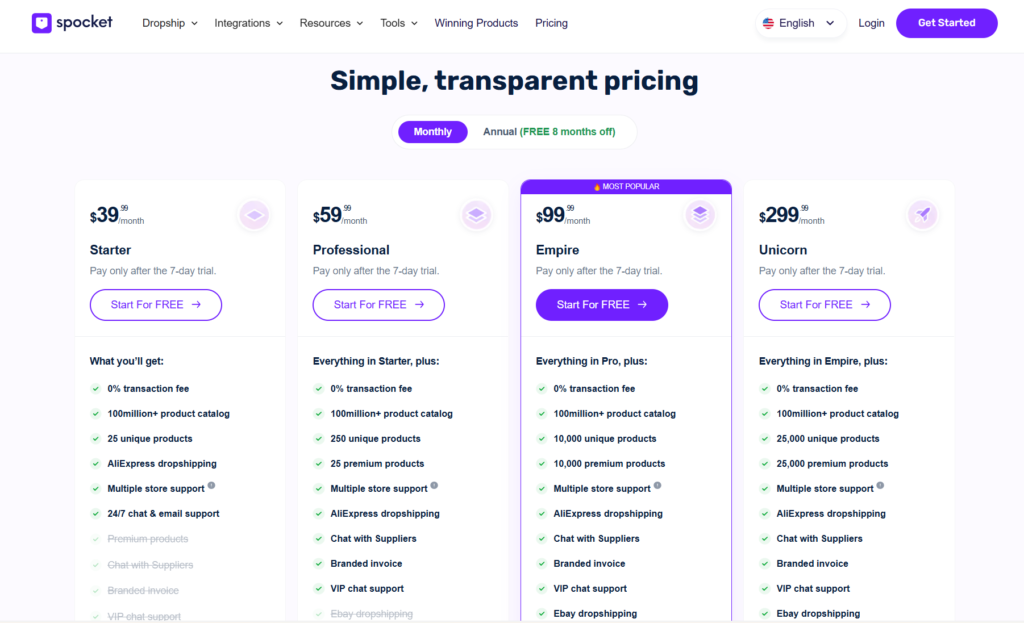
Spocket Pricing: Breaking Down the Plans
Spocket offers four main pricing tiers, plus a free plan for those just exploring. Understanding what each plan includes helps you avoid paying for features you don’t need or missing out on capabilities that could grow your business.
Free Plan
Cost: $0/month
What You Get:
- Unlimited unique products to browse (but not import)
- AliExpress dropshipping via AliScraper extension
- Email support
Limitations: You can browse the entire catalog but can’t actually import products or process orders. This plan is strictly for research and exploration.
Best For: Complete beginners who want to see what Spocket offers before committing financially.
Starter Plan
Cost: $39.99/month (monthly billing only)
What You Get:
- 25 unique products
- Premium products access (limited)
- AliScraper Chrome extension
- Email support
- Real-time inventory and price updates
Limitations: No branded invoicing, limited to 25 products, and no annual discount available.
Best For: Solo entrepreneurs just starting out who want to test a small product selection without major investment.
Pro Plan
Cost:
- $59.99/month (monthly)
- $24/month ($288/year – saves 60%)
What You Get:
- 250 unique products
- 25 premium products
- Branded invoicing
- Automated pricing rules
- Priority email support
- All Starter features
Limitations: Still limited to one store.
Best For: Small to medium businesses ready to scale. The branded invoicing feature alone makes this plan worthwhile for anyone serious about building a recognizable brand. The annual plan offers massive savings, making it the most popular monthly option.
Empire Plan
Cost:
- $99.99/month (monthly)
- $57/month ($684/year – saves 43%)
What You Get:
- 10,000 unique products
- 1,000 premium products
- Multiple store management
- Bulk checkout capabilities
- All Pro features
- Enhanced support
Limitations: Price point may be high for solo operators.
Best For: Growing businesses with extensive product catalogs or entrepreneurs managing multiple niche stores. Spocket identifies this as their most popular annual plan because it balances cost with comprehensive features.
Unicorn Plan
Cost:
- $299.99/month (monthly)
- $79/month ($948/year – saves 74%)
What You Get:
- 25,000 unique products
- 25,000 premium products
- Supplier sourcing assistance
- Product request services
- VIP chat and email support
- All Empire features
- Dedicated account manager
Limitations: Expensive for most small businesses.
Best For: Large-scale operations, enterprises, or dropshipping agencies managing dozens of stores. The supplier sourcing and product request services are game-changers at this level, Spocket’s team will actively help you find specific products to match your niche.
14-Day Free Trial
All paid plans include a 14-day free trial with full access to features. Credit card users pay a small $1.99 trial fee (refundable upon request), while PayPal users get the trial completely free.
After 14 days, your subscription automatically renews at the regular rate unless you cancel.
Spocket vs. AliExpress: The Head-to-Head Comparison
This is the comparison most dropshippers want to see. Both platforms have their place, but they serve different needs.
Shipping Speed
Spocket: 2-7 days for US/EU suppliers AliExpress: 15-45 days (typically 20-30 days)
Winner: Spocket. Fast shipping is non-negotiable in 2026. Customers expect Amazon-like delivery times, and Spocket gets you much closer to that standard.
Product Quality
Spocket: Vetted suppliers with quality control, higher standards AliExpress: Highly variable, depends entirely on individual sellers
Winner: Spocket. The supplier vetting process filters out unreliable sources, though you’ll still want to order samples.
Product Selection
Spocket: Nearly 1 million products AliExpress: 100+ million products
Winner: AliExpress. If you need ultra-specific niche items or endless variety, AliExpress has the breadth. Spocket’s curated approach means less selection but higher average quality.
Pricing
Spocket: Higher product costs (typically 30-60% more than AliExpress) AliExpress: Very low product costs
Winner: AliExpress. You’ll pay more per unit on Spocket, which affects your margins. However, the trade-off is quality and speed.
Branding Opportunities
Spocket: Branded invoicing, white labeling options AliExpress: Limited to no branding options
Winner: Spocket. If brand building matters to you, Spocket’s custom invoicing makes a significant difference.
Ease of Use
Spocket: Intuitive interface, one-click imports, automated fulfillment AliExpress: Requires third-party apps (DSers, Oberlo), more manual setup
Winner: Spocket. The user experience is simply more polished and integrated.
Profit Margins
Spocket: Lower margins due to higher product costs AliExpress: Higher margins due to rock-bottom prices
Winner: AliExpress (on paper). However, Spocket’s faster shipping and better quality often lead to fewer returns and refunds, which can balance out the margin difference in practice.
Best Use Case
Spocket: US/EU-focused stores, brand-conscious businesses, stores targeting customers who value fast shipping AliExpress: Budget-conscious beginners, niche hunters, businesses comfortable with longer shipping times
Who Should Use Spocket?
Spocket isn’t for everyone. Here’s who benefits most:
Perfect For:
Serious Brand Builders: If you’re creating a real brand (not just a store), Spocket’s branded invoicing and quality control support that vision.
US/EU Market Focus: Targeting American or European customers? Spocket’s local suppliers eliminate the international shipping headaches.
Quality-Conscious Sellers: You’re willing to pay more per unit to ensure customers receive products that match expectations.
Time-Starved Entrepreneurs: The automation features save hours compared to manually processing orders through multiple platforms.
Dropshipping Agencies: Managing multiple client stores? The Empire and Unicorn plans support this business model.
Not Ideal For:
Ultra-Budget-Conscious Beginners: If you need the absolute cheapest products to maximize margins, AliExpress remains king.
Highly Specialized Niches: If you sell extremely specific products that only Chinese manufacturers produce, Spocket’s catalog may not serve you well.
International Market Focus: Selling primarily to customers in Asia, Africa, or South America? Spocket’s US/EU supplier focus doesn’t help you as much.
The Honest Pros and Cons
Advantages
- Fast Shipping Wins Customers: The 2-7 day delivery window dramatically improves customer satisfaction compared to month-long waits from Asia.
- Quality You Can Depend On: The supplier vetting process means fewer product quality complaints and returns.
- Automation Saves Time: From order processing to inventory updates, Spocket handles routine tasks automatically.
- Professional Branding: Branded invoicing helps you build a legitimate business, not just another dropshipping store.
- Easy Integration: Connecting to Shopify, WooCommerce, or other platforms takes minutes, not hours.
- AI-Powered Product Research: The 2025 updates make product selection more data-driven and less guesswork.
- Responsive Support: While not perfect, Spocket’s support team generally resolves issues within a reasonable timeframe.
Disadvantages
- Higher Product Costs: You’ll pay significantly more per item than on AliExpress, eating into your profit margins.
- Limited Product Selection: Compared to AliExpress’s massive catalog, Spocket’s offerings feel narrow, especially in ultra-niche categories.
- Pricing Plans Can Add Up: Monthly costs range from $40-$300, which is a real expense for new businesses with uncertain revenue.
- Supplier Issues Still Happen: Despite vetting, some users report unresponsive suppliers or fulfillment delays. Quality control isn’t perfect.
- One-Store Limitation on Lower Tiers: Managing multiple stores requires the expensive Empire or Unicorn plans.
- Mixed Customer Service Reviews: While some users praise support, others report slow responses and difficulty getting refunds or resolving disputes.
- AliExpress Integration Feels Secondary: The AliScraper extension works, but it’s clearly not Spocket’s focus. You’re better off using DSers or Oberlo if AliExpress is your primary source.
Getting Started with Spocket: Step-by-Step
Ready to try Spocket? Here’s exactly how to start:
Step 1: Create Your Account
Visit Spocket.co and click “Start for FREE.” You can sign up with email or connect through your Shopify account.
Step 2: Choose Your Niche
Spocket asks you to select your product category, fashion, home goods, electronics, etc. This helps them recommend relevant products, but you can change this later.
Step 3: Connect Your Store (or Build One)
If you have an existing Shopify, WooCommerce, BigCommerce, or other store, connect it now. The integration wizard walks you through the process.
Don’t have a store yet? Spocket’s AI can build you a Shopify store with trending products already imported. While convenient, you’ll still need to customize it to stand out.
Step 4: Browse and Import Products
Start exploring the product catalog. Use filters to find:
- Products from your preferred supplier locations
- Items within your target price range
- Premium products with higher quality standards
- Products with fast shipping times
When you find winners, click “Import” to add them to your list. Before pushing to your store, customize the product title, description, and images to match your brand voice.
Step 5: Set Your Pricing
Spocket displays the supplier cost, and you set your retail price. Use the profit calculator to ensure healthy margins after accounting for marketing costs, platform fees, and other expenses.
A common mistake: pricing too low to compete. Remember, with Spocket, you’re competing on speed and quality, not always on price.
Step 6: Choose Your Plan
After your 14-day trial, select the plan that fits your needs. If you’re serious about the business, the Pro plan’s annual option ($24/month) offers the best value for most sellers.
Step 7: Start Marketing
With products loaded, focus on driving traffic. Spocket handles fulfillment, but marketing is still on you. Consider:
- Facebook and Instagram ads
- Influencer partnerships
- Content marketing and SEO
- Email marketing to build a customer base
Step 8: Process Your First Order
When an order comes in, Spocket automatically forwards it to the supplier. You’ll receive tracking information to share with your customer. Monitor the order status in your dashboard.
Step 9: Provide Excellent Customer Service
Even with automation, customer service matters. Respond quickly to inquiries, handle any issues professionally, and use customer feedback to refine your product selection.
Step 10: Optimize and Scale
Track which products sell best, which suppliers are most reliable, and where your traffic converts. Double down on winners, cut losers, and continuously improve your store’s performance.
Dropshipping Trends for 2026: How Spocket Fits In
The dropshipping landscape keeps evolving. Here’s what matters in 2026 and how Spocket positions you:
AI-Driven Product Research
Manual product research is becoming obsolete. Spocket’s AI tools analyze trends, predict demand, and identify winning products before markets become saturated. This gives you a competitive edge that was impossible just a few years ago.
Sustainability Matters
Customers increasingly care about environmental impact. Spocket’s access to US/EU suppliers means shorter shipping distances and lower carbon footprints. Many Spocket suppliers also offer eco-friendly products and packaging, helping you align with consumer values.
Personalization and Customization
Generic products struggle in 2026. Spocket offers access to print-on-demand and customizable products, allowing you to create unique items that stand out. This trend toward personalization plays directly to Spocket’s strengths.
Social Commerce Integration
Customers discover and buy directly through social media. While Spocket doesn’t directly integrate with TikTok Shop or Instagram Shopping yet, their one-click product imports make it easy to list items across multiple channels.
Multi-Channel Selling
Successful dropshippers in 2026 don’t rely on a single platform. They sell through their Shopify store, Amazon, eBay, Etsy, and social media simultaneously. Spocket’s higher-tier plans support this approach with centralized inventory management.
Quality Over Quantity
The race-to-the-bottom pricing model is dying. Customers pay more for fast shipping, reliable quality, and good customer service. Spocket’s model aligns perfectly with this shift—you charge more per item but deliver a better overall experience.
Real Talk: Is Spocket Worth It in 2026?
After covering all the details, let’s cut to the core question: should you use Spocket?
The answer depends entirely on your business model and goals.
Spocket is worth it if:
- You’re building a brand, not just flipping products
- Your target market is primarily in the US or EU
- You value fast shipping and quality over rock-bottom prices
- You’re willing to pay for convenience and automation
- You want to offer a professional customer experience
Spocket isn’t worth it if:
- You’re on an extremely tight budget with no money for monthly fees
- You need the absolute cheapest products to maintain margins
- Your niche requires highly specialized products only available from Chinese manufacturers
- You’re targeting customers in markets where US/EU suppliers don’t offer shipping advantages
- You’re looking for massive product variety over curated quality
For most serious dropshippers in 2026, Spocket offers real advantages. The shift toward faster shipping and better quality isn’t a trend—it’s the new baseline expectation. Spocket positions you to meet those expectations in ways that AliExpress-only models struggle with.
That said, it’s not perfect. The higher product costs and limited selection are real constraints. Many successful dropshippers use a hybrid approach: Spocket for core products where shipping speed matters, AliExpress for specialized items where customers are more price-sensitive.
Final Thoughts
Spocket represents a more mature phase of dropshipping. The wild-west days of sourcing random products from AliExpress and hoping for the best are giving way to more professional operations focused on customer experience, brand building, and sustainable business models.
If you’re entering dropshipping in 2026, you need to decide: are you building a quick-flip operation or a real business? For quick flips and extreme budget constraints, AliExpress still works. But for anyone serious about creating something sustainable, Spocket’s combination of quality suppliers, fast shipping, and automation tools provides a stronger foundation.
The platform isn’t perfect. Product costs eat into margins, the supplier network could be broader, and customer service quality varies. But for US and EU-focused dropshippers who understand that their real competition is Amazon and other established retailers, Spocket offers the tools to compete on what matters: speed, quality, and customer experience.
Start with the 14-day free trial. Import some products, process a few test orders, and see if the supplier quality and shipping times match your expectations. That hands-on experience tells you more than any review ever could.
The dropshipping model works when executed well. Spocket gives you a better shot at executing well than most alternatives. Whether that’s worth the higher costs and monthly fees depends on your specific situation, but for many sellers in 2026, the answer is increasingly yes.
Common Questions About Spocket
Can I use Spocket without Shopify?
Yes. While Shopify is popular, Spocket integrates with WooCommerce, BigCommerce, Wix, Squarespace, and Ecwid. You can use it with any of these platforms.
Does Spocket offer a money-back guarantee?
Spocket doesn’t advertise an explicit money-back guarantee, but they do offer a 14-day free trial. This gives you two weeks to test the platform before committing financially. Some users report difficulty getting refunds for paid subscriptions, so the trial period is your best risk-free testing window.
Can I order samples before selling?
Absolutely, and you should. Most suppliers allow sample orders so you can verify quality, check shipping times, and photograph products for your store. This costs extra but saves headaches later.
How does returns and refunds work?
Return policies vary by supplier. Spocket’s suppliers typically offer no returns, 15-day returns, or 30-day returns. This information is displayed on each product page. Spocket holds funds during return periods to facilitate refunds when necessary. For damaged or incorrect items, Spocket generally provides refunds or replacements without requiring return shipping.
Can I run multiple stores on one account?
On the Empire and Unicorn plans, yes. Lower-tier plans limit you to one store. Each store requires its own Spocket subscription if you’re on Starter or Pro plans.
What if a product goes out of stock?
Spocket automatically updates inventory in real-time. If a supplier runs out, your store listing shows “out of stock” immediately. The AI monitoring also predicts low-stock situations and alerts you before items completely sell out.
Is Spocket legitimate or a scam?
Spocket is a legitimate business that’s been operating since 2017 and serves tens of thousands of merchants. However, like any platform, user experiences vary. Some sellers report excellent results, while others have issues with specific suppliers or customer service. Reading recent reviews and starting with the free trial helps you judge for yourself.