You’re three weeks into your dropshipping store. Orders are trickling in, but then the complaints start: “Where’s my order? It’s been 25 days!” Another customer emails about receiving a product that looks nothing like your listing photos.
You check AliExpress and realize your supplier marked it as shipped but hasn’t actually sent it yet.
Sound familiar?
This exact scenario pushes thousands of dropshippers to explore alternatives every month. Spocket emerged as one solution to the chronic problems plaguing traditional dropshipping: lengthy shipping times, inconsistent product quality, and the dreaded “ships from China” stigma that hinders conversion rates.
But here’s what nobody tells you upfront: Spocket isn’t a magic fix for struggling dropshipping businesses, and it’s definitely not the right choice for everyone. After extensive testing across multiple stores and product categories, I’ve learned exactly where Spocket shines and where it frustrates even experienced sellers.
This Spocket review breaks down everything you need to know before committing your money and business to this platform.
What Is Spocket? Understanding the Platform’s Core Difference
Spocket positions itself as a dropshipping app that connects online retailers with suppliers primarily located in the US and EU.
Unlike AliExpress, where you’re scrolling through thousands of Chinese suppliers with 20-40 day shipping windows, Spocket curates a network of vetted suppliers who can ship products domestically in days, not weeks.
The platform integrates directly with Shopify, WooCommerce, Wix, and other major ecommerce platforms. You browse products, import them to your store with a few clicks, and when orders come in, Spocket handles forwarding them to suppliers for fulfillment.
The fundamental promise? Faster shipping, higher-quality products, and better profit margins because customers are willing to pay more for quick delivery from local suppliers.
That’s the pitch. The reality is more nuanced.
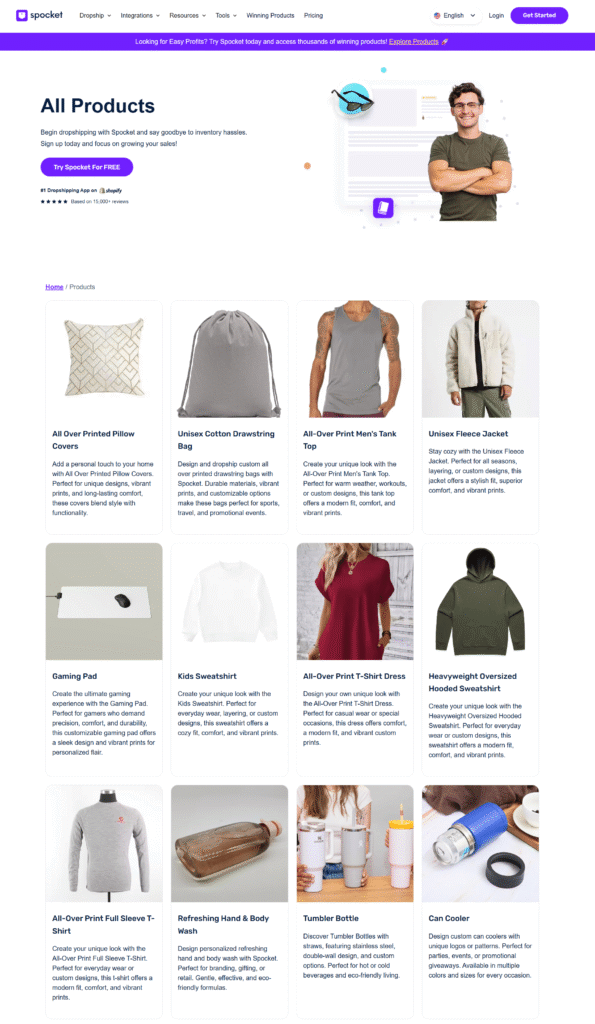
The Product Catalog: Quality Over Quantity (But There’s a Catch)
Spocket’s catalog contains over 5 million products from suppliers across the US, EU, Canada, Australia, and select other regions. Compare that to AliExpress’s hundreds of millions of products, and you immediately understand the trade-off: Spocket chose curation over endless selection.

Walking through the catalog, you’ll find the product categories skew heavily toward:
- Fashion and apparel (women’s clothing dominates)
- Jewelry and accessories
- Home decor
- Beauty and cosmetics
- Baby products
- Pet supplies
The quality of product images varies significantly. Some suppliers provide professional, white-background photography perfect for a branded store.
Others have clearly lifted images from manufacturers or offer mediocre smartphone photos. This inconsistency means you’ll spend time hunting for suppliers with decent visual assets, it’s not all plug-and-play.
One major limitation became apparent quickly: if you’re building a store in tech accessories, fitness equipment, or specialized niches like camping gear, Spocket’s selection feels limiting. The platform works best for general consumer goods and fashion-forward products where US/EU suppliers actually compete.
The US vs. EU vs. Global Supplier Split
Here’s something Spocket’s marketing glosses over: not every product ships from the US or EU. The platform includes suppliers from China, India, Brazil, and other countries under their “international” category. When you filter by “US suppliers” or “EU suppliers,” the catalog shrinks dramatically.
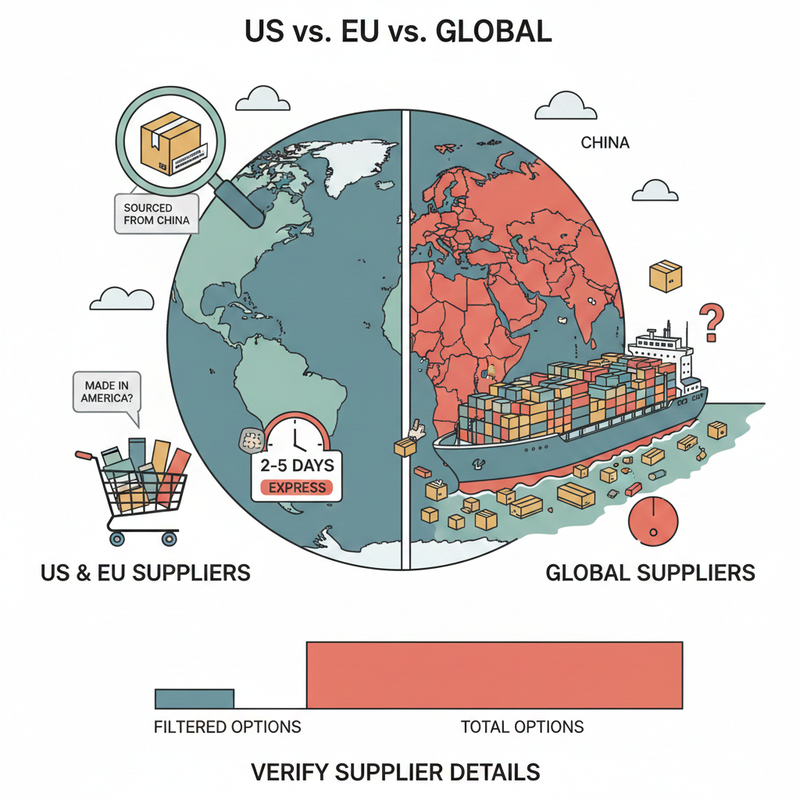
Testing the actual supplier locations revealed some surprises. Products marked “Ships from US” sometimes meant the supplier has a US warehouse but sources from China—which is fine for shipping speed but matters if you’re marketing “made in America” products. Always verify supplier details before committing to products.
The shipping time filters help: you can sort by “2-5 day shipping” or “Express shipping available.” These filters work well, though they further reduce your product options.
Pricing Structure: Breaking Down What You Actually Pay
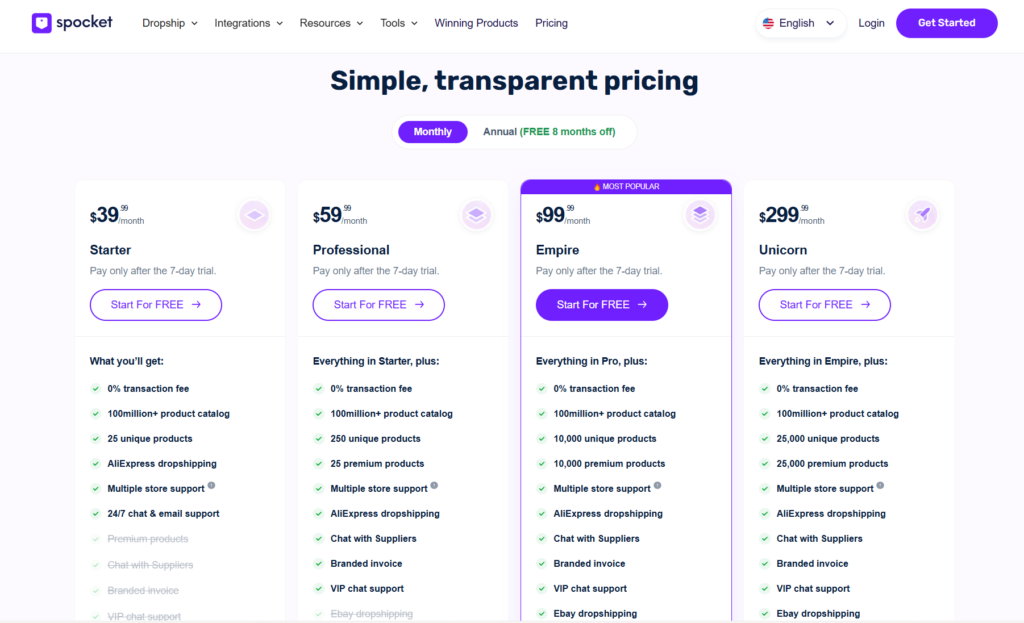
Spocket operates on a freemium model with four tiers. Let’s cut through the marketing and look at what you actually get:
Free Plan
- 25 products you can push to your store
- 25 “premium products” (Spocket’s term for exclusive items with better margins)
- Basic order processing
- Standard customer support
The free plan exists so you can test the interface and browse products, but it’s not viable for running a real business. Twenty-five products isn’t enough to build a compelling store unless you’re incredibly niche-focused.
Starter Plan ($39.99/month)
- 300 products
- 300 premium products
- Branded invoicing (removes Spocket branding from packing slips)
- Chat and email support
- Discount on products (varies by supplier)
This tier makes sense for beginners testing Spocket dropshipping while running their first store. The branded invoicing alone justifies the cost—you don’t want customers receiving packages with “Fulfilled by Spocket” on the invoice.
Pro Plan ($59.99/month)
- 1,000 products
- 1,000 premium products
- Everything from the Starter
- 30% discount on products from US/EU suppliers
- Bulk orders functionality
- Access to exclusive suppliers
The 30% discount is where things get interesting. On paper, this sounds like a game-changer for margins. In practice, it applies inconsistently. Some suppliers honor the full 30% off, others offer 10-15%, and some products show no discount at all. The discount also applies to the listed supplier price on Spocket, which is often already marked up from what the supplier charges their direct clients.
Empire Plan ($99.99/month)
- 10,000 products (more than most stores will ever need)
- 10,000 premium products
- Everything from Pro
- 40% discount on US/EU supplier products
- Priority customer support
- Dedicated account manager
This tier targets established stores doing significant volume. The dedicated account manager can help resolve supplier issues faster, which becomes valuable when you’re processing dozens of orders daily.
Hidden Costs Nobody Mentions
The subscription fee is just your entry ticket. Your actual costs include:
Product costs: You pay the supplier’s listed price for each item when a customer orders. These prices are usually 30-60% higher than wholesale prices on Alibaba for similar items, which squeezes your margins.
Shipping fees: Despite what some reviews claim, shipping isn’t free. It’s built into the product cost or charged separately depending on the supplier. Some suppliers offer “free shipping” but clearly pad the product price to compensate.
Transaction fees: If you’re using Spocket’s payment processing, there are small fees per order. Most users connect their own Stripe or PayPal to avoid this.
Premium product unlocking: Some of Spocket’s best products require you to upgrade to higher tiers or pay per-product unlock fees. This nickel-and-diming frustrated me more than the base subscription costs.
When you calculate total costs including product prices, shipping, and subscription fees, your profit margins often land between 20-35% before advertising costs. That’s tighter than many dropshippers expect.
Integration and Setup: How Smoothly Does It Actually Work?
Spocket’s Shopify integration takes about five minutes to set up. You install the app from the Shopify App Store, authorize the connection, and you can browse products immediately. The same process works for WooCommerce, BigCommerce, Wix, and Squarespace.
The Product Import Process
Finding products you want to sell is straightforward. You can search by keyword, filter by category, sort by shipping location, and save favorites to a list.
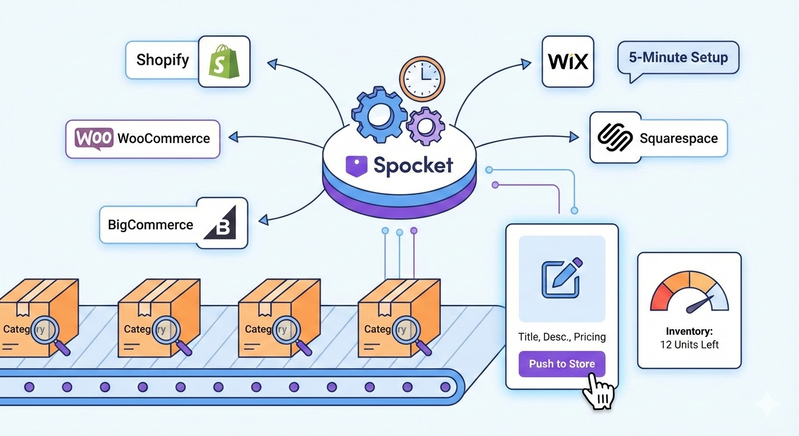
When you’re ready to import:
- Click “Push to Store” on any product
- Edit the product title, description, and pricing
- Select which product images to import
- Push it live to your store
The editing interface lets you customize everything before it goes live, which is essential because supplier-provided descriptions are often generic or poorly written. You’ll rewrite most of them.
One nice feature: Spocket shows you the supplier’s inventory count in real-time. If a supplier only has 12 units left, you see that immediately and can avoid promoting products that might go out of stock.
Order Fulfillment: The Make-or-Break Moment
When a customer places an order in your store, it appears in your Spocket dashboard. You review the order, ensure shipping details are correct, and click “Process Order.”
Spocket charges your connected payment method for the product cost plus shipping, then forwards the order to the supplier.
Here’s where theory meets reality: order processing speed depends entirely on the individual supplier. Some suppliers confirm and ship within 24 hours. Others take 3-4 days to even acknowledge the order. A few seem to check their Spocket dashboard once a week.
Spocket claims automated order processing, but in practice, you’re manually reviewing and approving most orders. The automation works for suppliers you’ve established relationships with, but for new suppliers, you’re babysitting the process.
Tracking information updates in Spocket and syncs back to your store automatically. When it works, it works great. When suppliers forget to upload tracking or upload incorrect tracking numbers (happened multiple times), you’re stuck playing detective to figure out where the order actually is.
Shipping Times: The Reality Behind the Promise
The main reason anyone considers Spocket over AliExpress is shipping speed. Let’s break down what “fast shipping” actually means:
US Suppliers with 2-5 Day Shipping: These deliver as promised about 75-80% of the time. Orders placed Monday usually arrive by Friday or the following Monday. This speed matches Amazon Prime expectations and significantly reduces support tickets and refund requests.
EU Suppliers: If you’re targeting European customers, EU suppliers typically deliver within 5-7 business days. For UK customers post-Brexit, expect occasional customs delays that push delivery to 10-12 days.
Express Shipping Options: Some suppliers offer expedited shipping for an additional fee ($5-15 depending on item size). This can get products to customers in 1-3 days, but charging customers enough to cover express shipping while remaining competitive on price is tricky.
International Suppliers on Spocket: Here’s where Spocket’s positioning gets muddy. Products from suppliers based in China, India, or Brazil ship in 15-30 days—essentially the same as AliExpress. Spocket includes these suppliers to bulk up their catalog, but they defeat the platform’s core value proposition.
Testing across different product categories and suppliers revealed significant variability. Fashion items from US suppliers shipped quickly and consistently. Home decor had more delays. Electronics (limited selection) were hit-or-miss.
The key learning: you must test-order products from any supplier before promoting them heavily. Order 2-3 samples to yourself, time the delivery, check product quality, and examine packaging. Suppliers who ship samples quickly usually handle customer orders well. Suppliers who take weeks to send samples? Skip them.
Product Quality: Better Than AliExpress, But Don’t Assume Perfection
One of Spocket’s differentiators is supposed to be higher product quality because US and EU suppliers generally maintain better quality control than low-cost Chinese factories.
After ordering samples from dozens of suppliers, the quality spread is wider than expected:
Top-tier suppliers (maybe 20% of the platform) deliver products that match or exceed the listing photos. These are often legitimate small brands or established wholesalers who maintain quality control. When you find these suppliers, hold onto them—they’re worth building your entire store around.
Mid-tier suppliers (about 50% of what’s available) deliver acceptable quality. Products look like the photos, function as described, but you can tell these aren’t premium items. They work fine for price-conscious customers but won’t wow anyone.
Bottom-tier suppliers (the remaining 30%) ship products that are disappointing compared to listing photos. Jewelry that looks cheap in person, clothing that fits oddly, or home decor items with visible defects. These suppliers damage your brand reputation and generate refund requests.
The challenge is you can’t always predict supplier quality from their Spocket profile. Reading reviews from other Spocket users helps (when available), but the best quality control method remains ordering samples yourself.
One pattern emerged clearly: suppliers offering products at suspiciously low prices while claiming “premium quality” rarely deliver on the quality promise. If a supplier’s pricing seems too good to be true compared to similar products, it probably is.
Supplier Communication: The Unexpected Frustration
Most Spocket suppliers don’t communicate directly with you through the platform. Unlike AliExpress where you can message suppliers before ordering, Spocket acts as the intermediary for most interactions.
When issues arise, wrong items shipped, delayed orders, quality problems—you contact Spocket support, who then contacts the supplier. This adds 24-48 hours to resolution time for any order issue.
Some suppliers do respond to direct emails, and their contact information is available in their Spocket profile. Building direct relationships with your best-performing suppliers can bypass Spocket’s support layer for faster problem resolution.
The lack of direct communication before ordering makes it harder to ask supplier-specific questions: Can you customize packaging? Do you offer rush fulfillment for an extra fee? What’s your return policy for defective items? These conversations happen slowly through Spocket’s support system or not at all.
Comparing Spocket to the Competition
Spocket vs. AliExpress Dropshipping
AliExpress wins on: Product variety (it’s not even close), lower product costs, established relationships with millions of suppliers, and the ability to negotiate prices for bulk orders.
Spocket wins on: Shipping speed for US/EU suppliers, better product quality averages, and professional branding opportunities (branded invoicing, faster delivery lets you charge premium prices).
The decision between them often comes down to your target market. Selling fashion accessories to American customers who expect fast shipping? Spocket makes sense. Building a gadget store targeting international customers price-shopping everything? AliExpress offers better economics.
Spocket vs. CJ Dropshipping
CJ Dropshipping operates as a hybrid model—they’re both a platform and a fulfillment partner. CJ sources products for you, handles warehousing, and ships orders.
CJ wins on: Customization options, branding services, and the ability to negotiate better pricing at volume. CJ also offers more hands-on support for scaling stores.
Spocket wins on: Ease of use, faster setup for beginners, and simpler product sourcing (browsing Spocket’s catalog beats explaining what you want to a CJ agent).
CJ makes more sense once you’re past the beginner stage and ready to invest in private label products or custom packaging.
Spocket vs. Modalyst
Modalyst focuses heavily on fashion and connects you with independent brands and designers. It’s more curated than Spocket.
Modalyst wins on: Unique, on-trend fashion products you won’t find elsewhere, better brand partnerships, and a more fashion-forward catalog.
Spocket wins on: Broader category selection, more supplier options, and generally faster shipping times (Modalyst includes many international suppliers).
For fashion-focused dropshipping stores, Modalyst and Spocket both deserve consideration. Many successful fashion dropshippers use both platforms simultaneously.
Who Actually Benefits from Spocket?
After extensive testing, Spocket works best for these specific dropshipper profiles:
New Dropshippers in Fashion/Lifestyle Niches
If you’re launching your first dropshipping store focused on women’s fashion, jewelry, or home decor, and you’re targeting US customers, Spocket offers the easiest path to acceptable shipping times without negotiating directly with suppliers. The learning curve is gentle, and you can validate product ideas quickly.
Established Stores Upgrading from AliExpress
Stores already profitable on AliExpress but suffering from shipping time complaints benefit from moving select products to Spocket. You don’t have to migrate everything—keep AliExpress for products where customers tolerate longer waits, and use Spocket for items where fast shipping justifies higher prices.
Dropshippers Building Branded Stores
If you’re moving beyond the “generic dropshipping store” model and building an actual brand, Spocket’s branded invoicing, faster shipping, and better product quality support that positioning. You can charge $45 for a product that costs you $22, and customers will pay it because they receive it in four days with professional packaging.
Who Should Avoid Spocket?
Ultra-budget-conscious dropshippers: If your entire business model depends on 60%+ profit margins and rock-bottom product costs, Spocket’s pricing won’t work. Stick with Alibaba or AliExpress.
Stores in tech, tools, or specialty niches: Spocket’s catalog limitations make it frustrating for stores outside mainstream consumer products.
International sellers targeting non-US markets: If you’re in Australia targeting Australian customers, Spocket’s US supplier advantage disappears. Look for region-specific platforms instead.
The Real Problems with Spocket Nobody Talks About
Problem #1: Inconsistent Supplier Performance
Spocket’s biggest weakness is supplier reliability varies wildly, and you won’t know which suppliers are problematic until you’ve already processed orders through them. There’s no robust rating system or quality score visible before you commit to a supplier’s products.
Problem #2: Limited Negotiation Power
You’re paying whatever price Spocket’s suppliers list. There’s no haggling, no bulk discounts (beyond the subscription-based percentages), and no relationship building that unlocks better terms. You’re stuck with the listed prices forever.
Problem #3: Inventory Sync Issues
While Spocket claims real-time inventory syncing, the reality is several suppliers update their inventory sporadically. You’ll occasionally sell products that are actually out of stock, then scramble to refund customers or source the product elsewhere.
Problem #4: The “Premium Product” Bait
Spocket restricts access to many of their best suppliers and products behind higher subscription tiers or individual unlocking fees. Just when you find the perfect product for your store, you discover you need to upgrade your plan or pay an extra $5/month to access that supplier. This fragmented pricing feels little manipulative.
Problem #5: Customer Service Response Times
Spocket’s support team is responsive for basic questions but slow for critical order issues. If a supplier ships the wrong item and your customer is upset, waiting 36 hours for Spocket to investigate and respond to the supplier isn’t acceptable. Direct relationships with suppliers (when possible) solve this, but that defeats the purpose of using Spocket as your intermediary.
Advanced Strategies for Maximizing Spocket’s Value
If you’re committed to using Spocket, here’s how to extract the most value:
Test extensively upfront: Order samples from 10-15 suppliers before launching products. Track shipping times, evaluate packaging, assess quality. Build your store around the suppliers who exceed expectations, not around products that look good in listings.
Create supplier scorecards: Track each supplier’s performance: average fulfillment time, product quality consistency, customer satisfaction, return rates. Drop underperforming suppliers ruthlessly, even if their products seem profitable.
Negotiate direct relationships: Once you’re ordering consistently from specific suppliers, reach out to them directly (contact info is in their Spocket profile). Negotiate better pricing for volume orders or faster fulfillment. Some suppliers will work with you outside Spocket for better margins.
Use Spocket selectively: Don’t build your entire store on Spocket. Use it for products where fast shipping creates competitive advantage, and source other products through whatever channels offer the best economics and reliability.
Invest in one supplier relationship: Find one exceptional Spocket supplier whose product line aligns with your niche. Order everything you can from them, build trust, and eventually transition to a direct wholesale relationship. Use them as your core supplier while Spocket products fill out your catalog.
Account for Spocket costs in pricing: Don’t price products based on AliExpress margins then switch to Spocket. Your product prices should reflect Spocket’s higher costs while emphasizing the value of fast shipping. “Ships from US in 3-5 days” lets you charge 20-30% more than competitors shipping from China.
Spocket’s Evolution and Future Outlook
Since launching, Spocket has expanded its supplier network, improved integration capabilities, and added features like bulk ordering and better inventory management. The platform is genuinely better in 2025 than it was two years ago.
The trend toward localized dropshipping—sourcing from suppliers closer to your customers—benefits Spocket’s positioning. As customers increasingly expect Amazon-like delivery speeds, the “ships from China in 3-4 weeks” model becomes less viable for many niches.
Spocket’s challenge is maintaining supplier quality while expanding their catalog. The temptation to add marginal suppliers just to inflate product counts could undermine their core differentiator. So far, they’ve balanced this reasonably well, but it’s worth monitoring.
The platform’s future likely includes more automation, better AI-driven product recommendations, and potentially their own fulfillment centers to guarantee shipping times (similar to what CJ Dropshipping offers).
Final Verdict: Is Spocket Worth It?
Spocket isn’t a miracle solution that will make your dropshipping business successful. It’s a tool that solves specific problems, primarily shipping speed and product quality, while creating new challenges around cost and supplier consistency.
Spocket is worth it if:
- You’re targeting US customers who value fast shipping
- You’re willing to charge premium prices that justify higher product costs
- You operate in fashion, accessories, home decor, or general consumer goods
- You’re building a branded store rather than a generic dropshipping site
- You have time to test and vet suppliers before promoting products
Skip Spocket if:
- You need ultra-thin margins to compete on price
- Your niche isn’t well-represented in their catalog
- You’re experienced enough to source directly from US wholesalers
- You can’t justify the monthly subscription given your order volume
- You’re targeting non-US markets where the shipping advantage disappears
The honest assessment after months of testing: Spocket works well for the right dropshipping business model, but it’s not universally superior to alternatives. It’s one tool in your sourcing toolkit, not the only tool you’ll need.
For beginners, start with the Starter plan for 2-3 months. Test extensively. If you find 5-10 reliable suppliers and your shipping time improvement translates to better conversion rates and fewer support tickets, upgrade to Pro. If you’re fighting with supplier quality and tight margins, cut your losses and explore other sourcing options.
The platform’s biggest value is time savings—you get access to vetted US suppliers without cold-calling wholesalers or navigating minimum order quantities. For many dropshippers, especially those just starting, that’s worth $40-60 per month. For others, it’s an expensive middleman standing between them and better margins.
Your move: test Spocket’s free plan today, order samples from five suppliers, and decide based on your actual experience rather than marketing promises. That’s the only way to know if Spocket dropshipping makes sense for your specific business.
Frequently Asked Questions
Is Spocket worth using?
Spocket is worth using if you’re targeting US customers and need faster shipping times than AliExpress provides. The platform delivers genuine value for dropshippers in fashion, accessories, and home decor niches who can justify charging premium prices to cover higher product costs. However, it’s not worth it for budget-focused stores competing primarily on price, or businesses in niches with limited product selection on the platform.
Is there better Spocket alternatives?
Yes, several alternatives may work better depending on your needs. CJ Dropshipping offers better customization and branding options for scaling stores. Modalyst provides more unique fashion products from independent brands. AliExpress remains superior for product variety and lower costs. Zendrop excels at automation and customer support. The best alternative depends on whether you prioritize product costs, shipping speed, catalog variety, or customization capabilities.
How much does Spocket cost?
Spocket costs $39.99/month for the Starter plan, $59.99/month for Pro, and $99.99/month for Empire. A limited free plan allows 25 products. Beyond subscription fees, you pay individual product costs (typically 30-60% higher than Alibaba prices) plus shipping fees when orders are placed. The Pro plan includes a 30% discount on US/EU supplier products, while Empire offers 40% off, though actual discounts vary by supplier.
Does Spocket work with Amazon?
No, Spocket does not integrate with Amazon. The platform only works with Shopify, WooCommerce, BigCommerce, Wix, Squarespace, and similar ecommerce platforms. Amazon’s strict dropshipping policies and requirements for identifying suppliers make it incompatible with Spocket’s business model.
If you’re selling on Amazon, you’ll need to use Amazon-approved wholesale suppliers or manage fulfillment through Amazon FBA instead.
Which is better, Zendrop or Spocket?
Zendrop is better for automation features, dedicated support, and custom branding options, while Spocket offers more US/EU suppliers and faster shipping for domestic orders. Zendrop provides better order fulfillment automation and customer service responsiveness. Spocket has a larger catalog of premium products from verified US suppliers.
Choose Zendrop if you prioritize automation and scaling support; choose Spocket if local supplier sourcing and shipping speed matter most for your target market.