If you’ve been keeping an eye on the AI revolution sweeping through workplaces worldwide, you’ve probably wondered whether getting certified in OpenAI tools could give your career a boost. With artificial intelligence reshaping how we work, the timing couldn’t be better to explore what OpenAI certifications actually offer, and whether they’re worth your time and investment.
Here’s the scoop: OpenAI just launched its first official certification programs on December 9, 2025, marking a major milestone in AI education.
But what exactly are these certifications, who are they for, and most importantly, will they actually help your career? Let’s dive deep into everything you need to know.
What Exactly Are OpenAI Certifications?
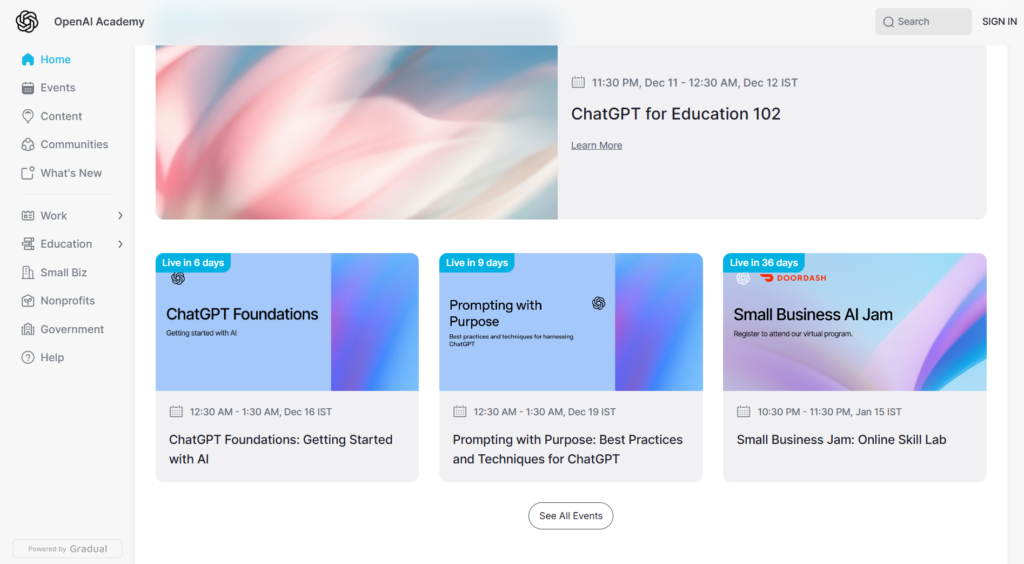
OpenAI certifications are formal credentials designed to validate your skills in using AI tools effectively. Think of them as proof that you know how to harness the power of tools like ChatGPT, the OpenAI API, and other AI technologies to solve real-world problems.
What makes these certifications different from other AI courses floating around online is that they come directly from OpenAI, the company behind ChatGPT and some of the most powerful AI models in the world. These aren’t just theoretical courses; they’re built to teach practical, hands-on skills that you can immediately apply in your job.
OpenAI has partnered with educational heavyweights like Coursera, ETS, and Credly by Pearson to ensure these certifications meet rigorous standards for learning design and real-world impact. That’s important because it means employers are more likely to recognize and value these credentials.
How Do OpenAI’s New Certification Courses Address the AI Skills Gap?
OpenAI’s new certification courses address the AI skills gap by delivering practical, standardized, and job-relevant AI education that helps individuals and organizations quickly develop real-world AI capabilities. These programs focus on hands-on learning, verifiable credentials, workforce alignment, and scalable access, key weaknesses in traditional AI education.
1. Closing the Gap Between Theory and Real-World AI Use
One of the biggest contributors to the AI skills gap is that many existing courses are theoretical, academic, or outdated. OpenAI’s certification courses are designed around practical AI usage, teaching learners how to:
- Use AI tools like ChatGPT effectively in real business workflows
- Design prompts, automate tasks, and analyze outputs
- Apply AI safely, ethically, and responsibly in professional settings
Learners train inside real AI environments, not simulated ones, allowing them to develop skills that are immediately transferable to the workplace.
Why this matters: Employers do not just need people who understand AI, they need people who can use AI productively from day one.
2. Creating a Standard Definition of “AI-Ready” Skills
Another major challenge in the AI talent market is the lack of a common standard for AI proficiency. Job titles like “AI-literate,” “AI-enabled,” or “AI-ready” often mean different things to different employers.
OpenAI’s certification courses address this by:
- Defining clear skill benchmarks (for example, AI foundations, applied prompting, and workflow automation)
- Issuing recognized credentials and digital badges
- Aligning certifications with real job roles and business needs
This standardization helps employers confidently assess candidates while enabling learners to clearly demonstrate their capabilities.
3. Accelerating Workforce Upskilling at Scale
The AI skills gap is not limited to new graduates, it also affects millions of existing workers who need reskilling or upskilling.
OpenAI’s certifications are designed to be:
- Short-form and modular, enabling faster learning
- Accessible to non-technical professionals (marketing, HR, operations, education, healthcare, and more)
- Scalable across companies, schools, and governments
This approach allows organizations to rapidly upskill large teams without requiring deep technical backgrounds or lengthy retraining cycles.
4. Aligning Education With Employment Outcomes
Traditional education often ends with course completion. OpenAI’s certification model goes further by connecting learning directly to employability.
Key ways this helps address the AI skills gap include:
- Credentials designed in collaboration with employers and credentialing partners
- Certifications that signal job-ready competence, not just course participation
- Plans to link certifications to talent platforms and hiring pipelines
This reduces the disconnect between learning AI skills and securing employment that requires them.
5. Expanding AI Literacy Through Educator Training
The AI skills gap begins early. Many teachers and institutions lack the training needed to teach AI responsibly and effectively.
OpenAI addresses this challenge by offering:
- Dedicated certification pathways for educators
- Guidance on classroom-safe AI usage
- Training that helps teachers prepare students for an AI-driven economy
By empowering educators, OpenAI helps build a long-term, sustainable AI talent pipeline.
6. Emphasizing Responsible and Ethical AI Use
A less visible but critical aspect of the AI skills gap is misuse, misunderstanding, and limited knowledge of governance and ethics.
OpenAI’s certification courses incorporate:
- AI ethics and safety principles
- Responsible data usage practices
- Human-in-the-loop decision-making frameworks
This ensures that AI adoption is not only rapid, but also safe, compliant, and trustworthy, which is increasingly important for employers and regulators.
In summary: OpenAI is transforming AI education from abstract learning into measurable, job-ready capability, helping individuals, businesses, and economies adapt to an AI-driven future.
The Two Main OpenAI Certification Programs
OpenAI launched two distinct certification tracks, each designed for different audiences and career goals.
1. AI Foundations
This is OpenAI’s flagship certification program aimed at workers across all industries and job functions. Whether you’re in marketing, finance, healthcare, retail, or any other field, AI Foundations is designed for you.
What sets this program apart is where it lives: directly inside ChatGPT. You’re not just watching videos or reading articles—you’re learning by doing. ChatGPT acts as your tutor, practice space, and feedback provider all in one. You complete tasks, get real-time guidance, and build practical skills through hands-on experience.
The course focuses on teaching you how to use AI tools effectively in your specific role. You’ll learn prompt engineering (how to communicate with AI to get the results you need), understand AI capabilities and limitations, apply AI to real-world business problems, and integrate AI into your daily workflow.
When you complete AI Foundations, you earn a certification that verifies you have job-ready AI skills. But the learning doesn’t stop there. OpenAI has designed a pathway where you can take additional courses and complete hands-on projects to work toward a full OpenAI Certification—a more comprehensive credential that demonstrates advanced capabilities.
Right now, AI Foundations is rolling out through pilot programs with major employers and public sector partners, including:
- Walmart (the world’s largest private employer)
- John Deere
- Lowe’s
- Boston Consulting Group
- Hearst
- Russell Reynolds Associates
- Upwork
- Elevance Health
- Accenture
- State governments (Delaware and New Jersey)
College students in the ChatGPT Lab get early access, and pilots are running at Arizona State University and throughout the California State University system. This means students can build AI skills and showcase them to employers before they even graduate.
2. ChatGPT Foundations for Teachers
If you’re an educator, this one’s for you. With about 60% of teachers already using AI tools, OpenAI recognized the need for a dedicated program to help educators use AI effectively and responsibly in educational settings.
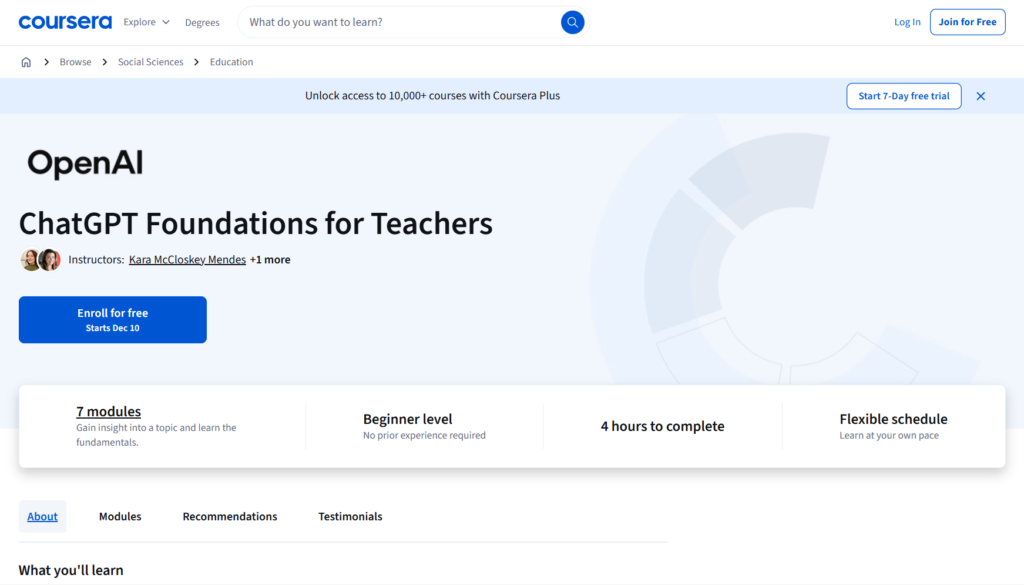
ChatGPT Foundations for Teachers is currently available on Coursera and completely free to enroll in. The course helps teachers understand how to save time on lesson planning, personalize classroom materials, provide better student support, and teach students to use AI tools responsibly.
By early 2026, this course will move directly into ChatGPT and ChatGPT for Teachers, offering the same hands-on learning experience as AI Foundations. OpenAI plans to release more teacher-focused certifications as the program expands.
This builds on OpenAI’s existing partnership with the American Federation of Teachers to train 400,000 K-12 educators with practical AI skills.
How Much Do OpenAI Certifications Cost?
Here’s some great news: accessibility is a core principle of OpenAI’s certification program.
The OpenAI Academy (the platform that hosts learning resources) is free for everyone. AI Foundations appears to be offered at no cost through employer and institutional partnerships. Walmart, for instance, announced it will offer the certification to all 2+ million U.S. associates at no cost starting in 2026.
ChatGPT Foundations for Teachers is completely free on Coursera, with no hidden fees or premium tiers required.
This focus on accessibility aligns with OpenAI’s ambitious goal: certify 10 million Americans by 2030. By keeping costs low or eliminating them entirely, OpenAI aims to democratize AI education and ensure that opportunity isn’t limited to those who can afford expensive training programs.
What Makes These Certifications Different?
Let’s be honest—the online education space is crowded with courses claiming to teach you AI. So what makes OpenAI certifications stand out?
Learning by Doing
Unlike traditional click-through certifications where you watch videos and take multiple-choice quizzes, OpenAI certifications emphasize hands-on practice. You’re working directly in ChatGPT, completing real tasks, and getting immediate feedback. This approach leads to genuine skill-building rather than just memorization.
Industry Validation
OpenAI has partnered with some of the world’s biggest employers to pilot these programs. Companies like Walmart, Accenture, and Boston Consulting Group aren’t just lending their names—they’re actively helping shape what skills the certifications teach. This means the curriculum is grounded in what employers actually need, not what sounds good in theory.
Portable Credentials
Through partnerships with ETS and Credly by Pearson, your OpenAI certification becomes a portable, verifiable credential. You can add it to your LinkedIn profile, share it with potential employers, and carry it with you throughout your career. It’s not locked into one company or platform.
Direct Path to Jobs
This is huge: OpenAI is building a Jobs Platform that will launch alongside the certification program. The platform will connect certified workers with employers specifically looking for AI skills. They’re partnering with Indeed and Upwork to make this happen, creating a clear pipeline from learning to certification to employment opportunities.
The Financial Case: Do AI Skills Really Pay More?
Here’s where things get really interesting. Multiple research studies from 2025 paint a compelling picture of AI skills as a serious financial investment.
According to PwC’s 2025 Global AI Jobs Barometer (which analyzed nearly 1 billion job postings from six continents), workers with AI skills earn an average of 56% more than those without them. That’s not a typo—56%. The previous year, that premium was 25%, meaning the value of AI skills is accelerating rapidly.
Other research corroborates this trend. Lightcast, a labor insights platform, found that job postings mentioning at least one AI skill advertised salaries 28% higher on average—roughly $18,000 more per year. If you have two or more AI skills, that premium jumps to 43%.
These aren’t just benefits for technical roles, either. Since ChatGPT launched in late 2022, job postings mentioning generative AI skills for non-tech roles have surged 800%. Marketing and public relations roles now rank second (after IT and computer science) in demanding AI skills, followed by science and research positions, and social analysis and planning roles.
The skills required in AI-exposed jobs are also changing 66% faster than other occupations, up from 25% the previous year. This means the job market is evolving rapidly, and staying ahead requires continuous learning.
Who Should Get OpenAI Certified?
The beauty of OpenAI certifications is their broad applicability. These credentials aren’t just for programmers or data scientists, they’re designed for anyone who wants to work more effectively with AI.
You should seriously consider getting certified if you’re a professional in any field looking to stay competitive, someone entering or re-entering the job market, a college student preparing for an AI-integrated workplace, an educator wanting to use AI responsibly in the classroom, or a career changer looking to pivot into AI-adjacent roles.
Interestingly, PwC’s research shows that demand for formal degrees is declining in AI-exposed jobs. Between 2019 and 2024, the percentage of AI-augmented jobs requiring a degree fell from 66% to 59%.
For jobs that AI automates, it dropped from 53% to 44%. This suggests that demonstrated skills and certifications are increasingly valuable regardless of your educational background.
What Skills Will You Actually Learn?
While the specific curriculum details are still rolling out as the programs expand, OpenAI has made it clear that these certifications focus on practical, applicable skills rather than theory. The core competencies include:
- Prompt Engineering: Learning how to communicate effectively with AI to get the results you need, this is the fundamental skill that underlies all AI tool usage.
- Understanding AI Capabilities and Limitations: Knowing what AI can and can’t do helps you use it effectively and avoid common pitfalls.
- Applying AI to Your Specific Role: Whether you’re in customer service, content creation, data analysis, or project management, you’ll learn how AI can enhance your particular workflow.
- Ethical AI Use: Understanding responsible AI practices, including how to identify bias, protect privacy, and use AI transparently.
- Problem-Solving with AI: Learning to break down complex problems and use AI as a tool to find solutions more efficiently.
The emphasis throughout is on job-ready skills that translate immediately into workplace value.
The Broader Context: Why Now?
OpenAI’s certification launch isn’t happening in a vacuum, it’s a response to massive shifts in the global workforce.
Right now, more than 800 million people use ChatGPT each week for everything from building skills to finding work to solving everyday problems. AI is being rapidly integrated into workplaces across every industry, and the research is clear: workers with AI skills are more productive, more valuable to employers, and earn significantly more.
But there’s also widespread uncertainty. Many workers feel unsure about which AI skills matter most or where to start learning. OpenAI’s certifications aim to create a clear, standardized path through this confusion.
The certification program is also part of OpenAI’s commitment to the White House’s efforts to expand AI literacy across the American workforce. With job markets being disrupted by AI, there’s a growing recognition that proactive upskilling programs can help workers navigate transitions rather than being left behind.
Third-Party OpenAI Courses vs. Official Certifications
It’s worth noting that many platforms already offer courses on using OpenAI’s tools and API. Sites like Udemy, DataCamp, Coursera, and others have hundreds of courses teaching everything from basic ChatGPT usage to advanced API development.
These third-party courses can be valuable, especially for technical developers who want to build applications using the OpenAI API. However, they’re fundamentally different from official OpenAI certifications in several ways.
Third-party courses aren’t officially recognized by OpenAI, may not reflect the latest features and best practices, don’t provide standardized, portable credentials that employers specifically seek, and aren’t integrated with OpenAI’s Jobs Platform ecosystem.
That said, if you’re a developer looking to master the OpenAI API for building applications, courses from DataCamp, Udemy, or similar platforms can complement official certifications by providing deeper technical dives into specific topics.
Potential Drawbacks to Consider
While OpenAI certifications offer significant benefits, it’s important to approach them with realistic expectations. The programs just launched, so their long-term recognition in the job market is still being established. While major employers are on board as pilot partners, widespread industry recognition takes time.
The current rollout is limited to pilot programs with specific employers and universities. If you’re not connected to one of these partners, you might need to wait for broader access.
AI technology evolves incredibly fast. Skills that are valuable today might need updating in just a few years, meaning certification is likely just the beginning of continuous learning rather than a one-time achievement.
We also don’t yet have data on actual career outcomes for certified individuals. While the research on AI skills in general is promising, we’ll need time to see whether OpenAI certifications specifically lead to job placements, promotions, or salary increases.
How to Get Started
If you’re ready to pursue an OpenAI certification, here’s your roadmap:
For AI Foundations: Check if your employer is part of the pilot program (the list includes major companies like Walmart, Accenture, and others). If you’re a college student, see if your university has joined the ChatGPT Lab or is participating in the pilot. If you’re not in a pilot program, you can join the OpenAI Academy for free and access learning resources while you wait for broader availability. OpenAI has indicated they’ll expand access after gathering feedback from initial pilots.
For ChatGPT Foundations for Teachers: Head directly to Coursera and search for “ChatGPT Foundations for Teachers.” The course is free and open for enrollment right now. Remember that by early 2026, the course will also be available directly in ChatGPT for an even more integrated learning experience.
General Tips: Start using ChatGPT regularly in your daily work to build familiarity. Follow OpenAI’s official channels for announcements about expanded access. Join online communities focused on AI skills to learn from others and stay updated. Consider complementing your certification with hands-on projects that showcase your abilities.
The Verdict: Are OpenAI Certifications Worth It?
So here’s the bottom line: should you pursue an OpenAI certification?
If you have access to these programs, especially at no cost through an employer or educational institution, the answer is a strong yes. The financial data supporting AI skills is compelling, with wage premiums ranging from 28% to 56% depending on the study. The certifications are free or very low-cost, removing financial barriers.
Major employers are actively seeking workers with verified AI skills, and jobs requiring AI capabilities are growing 7.5% even as overall job postings decline. OpenAI’s integration with the Jobs Platform creates direct pathways to employment.
Even if you’re not in a pilot program yet, getting ahead of the curve makes sense. As the programs expand throughout 2025 and 2026, early adopters will have a competitive advantage. The skills these certifications teach—prompt engineering, effective AI usage, understanding AI capabilities—are becoming baseline expectations across industries.
However, remember that certification alone won’t transform your career. The real value comes from applying what you learn, demonstrating tangible results in your work, and continuously updating your skills as AI technology evolves. Think of OpenAI certification as a foundation, not a destination.
The Future of AI Certification
Looking ahead, OpenAI has made it clear this is just the beginning. They plan to expand their certification offerings to cover different levels of AI fluency, from basics to advanced specializations like custom AI applications and prompt engineering expertise.
More industry-specific certifications will likely emerge as different sectors develop unique AI needs. The integration between certifications and the OpenAI Jobs Platform will deepen, creating smoother pathways from learning to employment.
As AI continues reshaping the workplace, formal certification programs will likely become as common as other professional credentials. Just as computer literacy became a baseline requirement over the past few decades, AI literacy is rapidly moving in the same direction.
Final Thoughts
The launch of OpenAI certifications represents a significant moment in how we think about AI education and workforce development. By making these programs accessible, practical, and directly connected to employment opportunities, OpenAI is helping create clearer pathways for people to benefit from AI rather than be displaced by it.
Whether these specific certifications become the gold standard remains to be seen—we’re still in the early days. But the broader trend is undeniable: AI skills are becoming increasingly valuable, employers are willing to pay premiums for them, and having verified credentials gives you a competitive edge.
If you’re wondering whether to invest your time in getting certified, consider this: the skills you’ll learn, how to effectively use AI tools, communicate with AI systems, solve problems more efficiently, have value regardless of what happens with any specific certification program. You’re not just getting a badge to add to your LinkedIn profile; you’re building capabilities that will serve you throughout your career as AI becomes more integrated into how we work.
The question isn’t really whether AI skills are worth learning—they clearly are. The question is how you’ll learn them. OpenAI certifications offer a structured, validated, and increasingly recognized path to building those skills.
Ready to get started? Head to academy.openai.com to explore the learning resources available now, or check with your employer or university about participating in the pilot programs. The future of work is being written right now, and having verified AI skills puts you in a position to help write it rather than just read about it later.
Frequently Asked Questions
How long does it take to complete an OpenAI certification?
While OpenAI hasn’t released specific timeframes for all certification programs, the courses are designed to be practical and job-focused rather than lengthy academic programs.
ChatGPT Foundations for Teachers on Coursera can be completed at your own pace. AI Foundations is built for hands-on learning directly in ChatGPT, suggesting it’s designed to fit into busy work schedules.
Most learners should expect to invest several hours to a few weeks depending on their existing AI familiarity and the depth of certification they’re pursuing.
Do OpenAI certifications expire, or are they valid forever?
OpenAI hasn’t specified expiration policies yet, but given how rapidly AI technology evolves, it’s realistic to expect that certifications may need periodic renewal or updating. Think of this less like a permanent credential and more like an ongoing learning journey. The good news is that the OpenAI Academy offers continuous learning resources, so staying current with new developments will be possible even after initial certification.
Can I get certified if my employer isn’t part of the pilot program?
Yes, but your options depend on which certification you’re pursuing. ChatGPT Foundations for Teachers is available to everyone right now on Coursera for free.
For AI Foundations, current access is limited to pilot partners, but OpenAI has indicated they’ll expand availability after gathering feedback from initial programs.
In the meantime, you can join the OpenAI Academy for free to access learning resources and prepare for when broader enrollment opens.
Do I need any prior AI or technical experience to start these certifications?
No prior AI experience is required for either AI Foundations or ChatGPT Foundations for Teachers. These certifications are explicitly designed for non-technical professionals across all industries.
If you can use a computer and navigate websites, you have the technical skills needed to start. The programs teach you everything from the ground up, including how to communicate effectively with AI tools.
How do I add my OpenAI certification to LinkedIn and my resume?
Through OpenAI’s partnerships with ETS and Credly by Pearson, your certification becomes a portable, verifiable credential. Once earned, you’ll receive a digital badge that can be directly added to your LinkedIn profile in the Licenses & Certifications section. The badge will link to verification details that employers can check.
For your resume, you can list it under “Certifications” or “Professional Development” sections with the issuing organization (OpenAI) and completion date.
What’s the difference between AI Foundations and a “full OpenAI Certification”?
AI Foundations is the entry-level certification that validates job-ready AI skills for any professional. It’s the first step in OpenAI’s certification pathway.
After completing AI Foundations, you can take additional specialized courses and complete hands-on projects to work toward a full OpenAI Certification, a more comprehensive credential that demonstrates advanced AI capabilities.
Think of AI Foundations as your foundation (naturally), and the full certification as the advanced credential you build toward.
Are these certifications recognized outside the United States?
While OpenAI’s initial focus is on certifying 10 million Americans by 2030, the certifications are backed by globally recognized organizations like Coursera, ETS, and Pearson. The skills taught, prompt engineering, effective AI usage, ethical AI practices, are universally valuable.
Several pilot partners like Accenture and Boston Consulting Group are global companies, suggesting international recognition is part of the vision. However, specific availability and employer recognition may vary by country initially.
Will there be certifications for developers and technical professionals who want to build with the OpenAI API?
While the current certifications focus on general AI usage skills rather than API development, OpenAI has indicated this is just the beginning of their certification program.
They plan to expand offerings to cover different levels of AI fluency, including advanced specializations. It’s reasonable to expect that developer-focused certifications for building custom applications with the OpenAI API will emerge as the program matures.
For now, technical developers can complement AI Foundations with third-party courses on platforms like DataCamp or Udemy that specifically cover OpenAI API development.