The AI coding revolution is here, and choosing the right platform can make or break your development workflow.
If you’re stuck between Emergent.sh and Replit, you’re not alone. Both platforms promise to transform how you build applications, but they take fundamentally different approaches to getting you from idea to deployed product.
I’ve spent weeks testing both platforms, building real applications, burning through credits, and experiencing firsthand what works and what doesn’t. This comprehensive comparison cuts through the marketing hype to give you the truth about Emergent.sh vs Replit in 2025.
What are Emergent.sh and Replit?
Before we dive into the comparison, let’s establish what these platforms actually do.
Emergent.sh: The Autonomous Vibe Coding Pioneer
Emergent.sh launched in 2025 as what they call the world’s first “agentic vibe coding platform.”
Founded by twin brothers Mukund and Madhav Jha (with impressive backgrounds from Google, Amazon, and Dunzo), Emergent focuses on one audacious goal: letting anyone build production-ready applications from plain English descriptions.
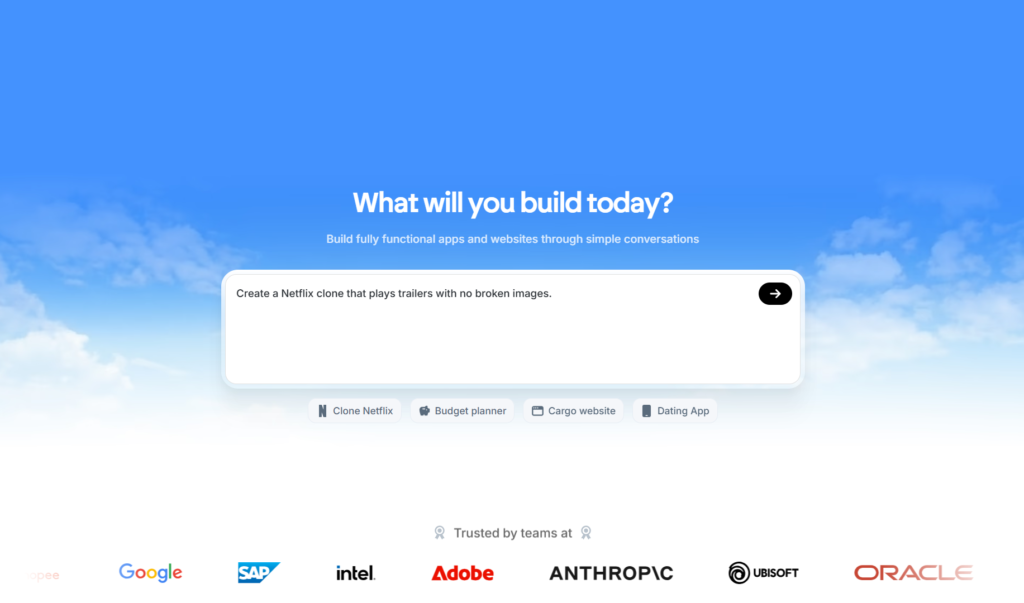
You don’t need to know a single line of code. You describe what you want, and Emergent’s AI agents handle the architecture, frontend, backend, database, authentication, payment integrations, and deployment.
The platform achieved remarkable traction, reaching $15 million in annual recurring revenue within just 90 days of launch and securing $30 million in total funding from Lightspeed, Y Combinator, and prominent AI angels, including Jeff Dean from Google.
Replit: The Browser IDE That Grew Up
Replit has been around since 2016 and has grown from a simple browser-based coding environment into a comprehensive AI-powered development platform. With over 20 million users worldwide, Replit established itself as the go-to platform for learning to code, building prototypes, and deploying applications without local setup.
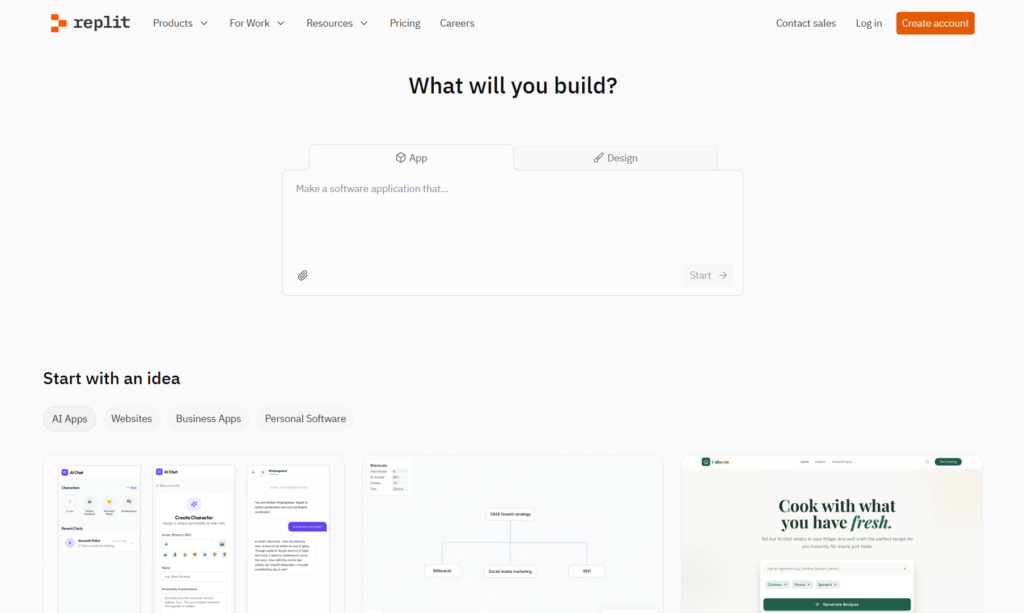
The introduction of Replit Agent in 2024 transformed the platform from a coding environment into an AI-first development tool.
Agent v3, released in September 2025, brought autonomous building capabilities that rival dedicated AI coding platforms. Replit also recently integrated with ChatGPT, allowing users to build apps directly from ChatGPT conversations.
How They Actually Work: A Critical Difference
Understanding how these platforms function reveals why choosing between them matters.
Emergent’s Fully Autonomous Approach
Emergent operates through a multi-agent system. When you start a project, you have a conversation with the platform about what you want to build. The AI asks clarifying questions: What authentication method do you prefer? What payment gateway? What frameworks?
Once you answer, specialized agents take over. The Builder agent writes code. The Designer agent creates the UI. The Quality agent tests everything. The Deploy agent handles production deployment. The Ops agent monitors your live application and automatically fixes issues when things break.
This sounds amazing in theory. In practice, the experience varies wildly. When Emergent works, it feels like magic. You watch as a complete application materializes from your description. When it doesn’t work, you burn through credits fixing AI-generated bugs.
Replit’s Collaborative Development Model
Replit takes a different approach. It’s fundamentally a cloud-based IDE that happens to have powerful AI assistance. You can code manually, use AI to help with specific tasks, or let Replit Agent build entire applications.
The platform supports over 50 programming languages and offers a comprehensive development environment directly in your browser. Write code, run it, test it, debug it, and deploy it all within the interface. The real-time collaboration features work like Google Docs for code, letting multiple developers work simultaneously.
Replit Agent works within this environment, generating code, fixing bugs, and implementing features. But you’re never locked out of the code. You can review everything the AI does, make manual edits, and maintain full control.
Feature Comparison: Where Each Platform Shines
Let’s break down the critical features that matter when you’re actually building software.
AI Capabilities and Autonomy
Emergent.sh: The AI is designed for complete autonomy. You set a budget (up to 500 credits per task), and the agents work independently to build your application. The platform uses Claude Sonnet 4.0, 4.5, and GPT-5 for different tasks. Emergent’s AI excels at understanding complex requirements and asking intelligent clarifying questions.
However, user reviews consistently mention the same problem: the AI makes mistakes that consume credits to fix. One user reported building a great app but only “after sinking a huge amount of money into it.” The AI might create a feature, then break something else, then charge you to repair the damage it caused.
Replit: Agent v3 represents a massive leap in autonomy. It can work for up to 200 minutes without intervention in Max Autonomy mode. The agent tests itself using automated browser testing, finds bugs, and fixes them. It ranked number one on OpenAI’s SWE-Bench, the leading benchmark for evaluating AI systems on real-world engineering problems.
The key difference? Replit gives you control over autonomy levels. You can configure the agent to work independently or stay hands-on, reviewing each step. The February 2025 update powered Agent with Claude 3.7 Sonnet, delivering faster and more accurate coding assistance.
Winner: Replit edges ahead. The ability to control autonomy levels and the transparent debugging experience provide reliability that Emergent’s all-or-nothing approach lacks.
Full-Stack Development Capabilities
Emergent.sh: This platform truly delivers on full-stack development. A single conversation generates frontend UI (React, Vue, Svelte), backend APIs (Node.js, Python, FastAPI), database schemas (PostgreSQL, MongoDB), authentication systems, payment processing (Stripe, Razorpay), and deployment configuration.
The platform handles DevOps automatically. Kubernetes clusters run your applications, with automatic scaling and monitoring. The Ops agent debugs and patches issues if something crashes in production. Average build time for simple applications is under 30 minutes.
Replit: Replit covers the full stack but requires more hands-on involvement. You get built-in authentication, database (PostgreSQL), hosting, and monitoring ready from day one. Need Stripe or OpenAI integration? They plug in cleanly and securely without managing API keys separately.
The January 2026 updates brought significant improvements. Design Mode creates interactive designs in under two minutes. Fast Build mode produces high-fidelity apps in nearly the same timeframe. The new Connectors platform provides 24 pre-built integrations, including Stripe, Figma, Zendesk, and Salesforce.
Winner: Emergent.sh for speed, Replit for reliability. Emergent builds complete applications faster, but Replit’s integrated approach means fewer unexpected issues.
Deployment and Hosting
Emergent.sh: Deployment happens with one click. Your application goes live on Emergent’s managed Kubernetes infrastructure. You get a production URL immediately. The platform handles SSL certificates, scaling, and uptime monitoring automatically.
The downside? Deployment costs 50 credits on the Standard plan, which equals $10. That’s half your monthly credit allocation gone in one click. Users consistently express frustration about this hidden cost. Most competing platforms offer free deployment.
Replit: Replit provides multiple deployment options. Autoscale deployments handle traffic spikes automatically. Static deployments work perfectly for static sites. Scheduled deployments run on timers. Reserved VMs give you always-on projects.
The Core plan includes 100 GiB of free static deployment transfer monthly. Additional deployment options and resources cost extra, but the base deployment is included. The transparency around deployment pricing prevents the sticker shock that Emergent users experience.
Winner: Replit. The flexible deployment options and included hosting in the base plan provide better value.
Code Quality and Debugging
Emergent.sh: The platform generates clean, modern code following best practices. The Quality agent runs tests before deployment. However, when bugs occur, debugging gets expensive. You describe the problem to the AI, which attempts to fix it while consuming more credits.
There’s a code editor (VS Code instance), but accessing it requires clicking through pop-ups with links and passwords. The interface isn’t designed for non-coders, creating a frustrating gap when you need to make simple edits that the AI struggles with.
Replit: The debugging experience is exceptional. When your app has errors, the “Debug with Agent” button appears. The AI systematically fixes issues, explaining each problem and showing the solution. You watch the error count drop while understanding what’s being fixed.
Beyond AI debugging, Replit provides professional developer tools: an integrated debugger for stepping through code, console and server logs showing real-time output, shell access for advanced fixes, and in-browser developer tools.
Winner: Replit. The transparent debugging process and professional tooling make error resolution manageable rather than expensive.
Pricing Analysis: The Real Cost of Building
This is where things get complicated for both platforms. The credit-based pricing models create unpredictability that frustrates users.
Emergent.sh Pricing Breakdown

Free Tier: Limited credits to test the platform. You can explore basic features but can’t deploy applications.
Standard Plan ($17-20/month): 100 monthly credits, unlimited small projects, GitHub integration, mobile app support. The catch? Deployment costs 50 credits ($10), immediately consuming half your allocation. Additional credits cost roughly $0.20 each.
Pro Plan ($167-200/month): 750 monthly credits, premium integrations, 1M token context window, priority support, custom agent creation. Designed for serious development work.
Team Plan ($250/month): 1,250 shared credits, unified billing, real-time collaboration, up to 5 team members included.
Real-World Costs: User reviews paint a troubling picture. One person mentioned their 110 credits didn’t last a full day. Another explained, “I kept losing credits because the AI made mistakes, and I had to spend more credits just to fix what the AI broke.”
The credit system lacks transparency. You don’t know how many credits a task will consume until it’s done. The AI might get stuck in loops, burning credits without making progress. One user built an app successfully, but only after investing far more money than anticipated.
Replit Pricing Structure
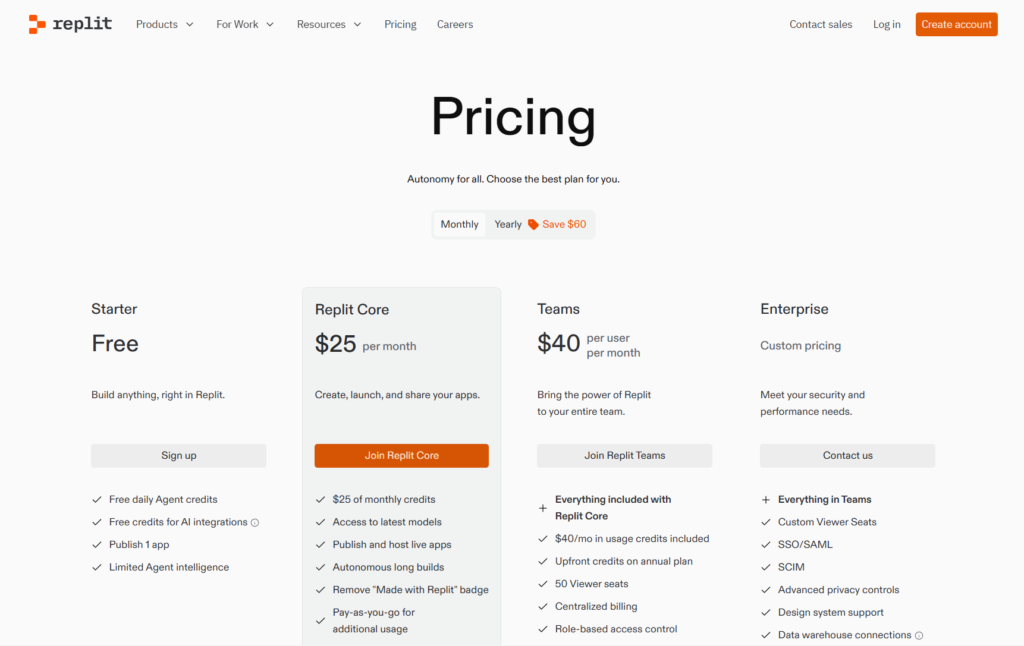
Starter Plan ($0/month): Free tier includes Replit Agent trial, 10 development apps, $3 in credits, 1 vCPU, 2 GiB memory. All projects are public. Perfect for learning and experimentation.
Core Plan ($20/month annually, $25/month): Full Replit Agent access, $25 in monthly usage credits (increased from $10 in February 2025), unlimited public and private apps, 4 vCPUs, 8 GiB RAM, 50 GiB storage per app, 100 GiB outbound data transfer. This is where Replit becomes genuinely useful.
Teams Plan ($35/user/month annually, $40/month): Everything in Core plus $40 in monthly credits per user, role-based access control, centralized billing, private deployments, team collaboration features.
Enterprise Plan (Custom pricing): SSO/SAML, SCIM provisioning, custom compute arrangements, dedicated support, enhanced security controls.
Real-World Costs: The $25 monthly credits sound generous but disappear quickly with heavy Agent usage. Users report additional spending of $100-300/month on top of base plans when actively developing. The effort-based pricing model charges based on computational work performed, making costs unpredictable.
However, Replit provides better cost transparency. The Usage tab shows exactly what you’ve used and what you’ll get if you upgrade. You can set spending limits to prevent unexpected charges. The billing interface clearly explains costs without requiring external research.
Cost Comparison Verdict
Both platforms suffer from credit unpredictability. Emergent.sh has lower entry pricing but hidden deployment costs. Replit costs more upfront but includes deployment and provides better transparency.
For hobbyists and learners: Replit’s free tier is more useful.
For solo developers building one project: Emergent.sh Standard plan could work if you budget carefully for deployment.
For active development, Replit Core provides better value with higher included credits and no deployment surprises.
For teams: Replit Teams offers better collaboration features and clearer per-user pricing.
Use Cases: Who Should Use Which Platform?
Your choice should align with your specific needs and technical background.
Choose Emergent.sh If You:
- Are a non-technical founder with a clear vision. If you can articulate requirements precisely and validate implementations, Emergent lets you build without coding knowledge. The conversational interface feels natural if you’re not a developer.
- Need rapid MVP development for investor presentations or customer validation. Emergent’s speed from concept to deployed application is unmatched when it works correctly.
- Build mobile applications. Emergent is the only platform in this comparison that builds and deploys mobile apps, providing a significant advantage for mobile-first products.
- Prefer hands-off development. If you want to describe your idea and let AI handle everything, Emergent’s fully autonomous approach aligns with this preference.
Choose Replit If You:
- Have any coding experience. Replit’s hybrid approach lets you use AI assistance while maintaining control. You can review code, make manual edits, and understand what’s happening.
- Value learning and skill development. The platform excels as an educational tool. Documentation, tutorials, and the agent’s explanations help you learn while building.
- Need reliable collaboration. Real-time collaborative coding with up to 50 viewer seats makes Replit perfect for teaching, pair programming, and team development.
- Want cost predictability and transparency. Better billing interfaces and spending controls help you manage budgets more effectively.
- Build in multiple languages. Support for 50+ programming languages provides flexibility that Emergent’s opinionated stack doesn’t match.
- Work on existing codebases. Replit’s General Agent works with any framework or project type, including existing applications. Emergent focuses on new builds.
User Experience and Interface Design
The interface you work in daily significantly impacts productivity and satisfaction.
Emergent.sh Interface
The experience starts with a conversational prompt. You describe what you want to build, and Emergent asks clarifying questions. This feels collaborative and approachable, especially for non-developers.
However, several interface issues frustrate users:
The pricing page doesn’t clearly communicate deployment costs. Users discover the 50-credit deployment fee only when clicking the deploy button, creating unpleasant surprises.
The code editor requires clicking through pop-ups to access a VS Code instance with links and passwords. This works for developers but confuses the non-technical audience Emergent targets.
The credit budget system shows a white number under the message box (like “9.3 / 10.000”) as your spending limit for the current conversation. This prevents accidentally draining your balance but adds complexity.
Activity logs show what agents are doing, but understanding whether progress is efficient or wasteful requires technical knowledge most users lack.
Replit Interface
Replit’s dashboard immediately feels polished and intuitive. The center features a welcoming prompt: “Hi, what do you want to make?” with helpful tags like “Web app,” “Data app,” and “Game” to guide thinking.
The left sidebar organizes everything logically: Create App, Import code or design, Apps, Deployments, Usage, Developer Frameworks, Learn, and Documentation. Small touches like theme selectors make the workspace feel personal.
The Usage tab provides complete transparency. You see exactly what you have, what you’ve used, and what you’d get by upgrading. The billing dashboard explains costs clearly without requiring detective work.
When Replit Agent works, you watch code appear in real-time. The integrated preview pane shows your application running immediately. Error messages appear with helpful debugging suggestions. The whole experience feels designed for developers at all skill levels.
Winner: Replit
The interface refinement comes from years of iteration with millions of users. Emergent shows promise but needs more polish to match Replit’s user experience, particularly around cost transparency and code access.
Performance, Speed, and Reliability
How quickly can you actually build and deploy working software?
Emergent.sh Performance
When Emergent works optimally, the speed is remarkable. Simple applications deploy in under 30 minutes. Complex applications with multiple features, integrations, and database schemas complete in under an hour.
The multi-agent architecture works on different aspects simultaneously. While the Builder agent writes backend code, the Designer agent creates the frontend. This parallel processing accelerates development.
However, reliability issues plague the platform. User reviews consistently mention:
The AI gets stuck in loops, repeatedly trying and failing at the same task while burning credits.
Features work initially but break when new features are added, requiring expensive fixes.
The agent’s hallucinating capabilities, running tests it claims passed when no connection existed to actually run those tests.
These reliability problems undermine the speed advantage. Yes, your first version deploys quickly, but how many iterations and credit refills until it actually works correctly?
Replit Performance
Replit emphasizes both speed and quality control. Design Mode creates interactive designs in under two minutes. Fast Build mode produces high-fidelity apps in similar timeframes, prioritizing speed over precision.
Agent v3 is 10 times more independent than v2, with a proprietary testing system that’s 3 times faster and 10 times cheaper than competing models. The agent tests itself using automated browser testing, catching issues before deployment.
Throughout 2025, Replit shipped hundreds of features improving speed and reliability. Flask deployments got 40 times faster with gunicorn. Agent became free to try with the first 10 checkpoints, removing barriers to testing.
The platform’s maturity shows in stability. With millions of users stress-testing the infrastructure daily, edge cases get identified and fixed quickly. Deployment reliability is high, with clear error messages when issues occur.
Winner: Replit
While Emergent can build faster initially, Replit’s combination of speed and reliability produces working applications more consistently. The testing infrastructure catches problems before deployment rather than after.
Collaboration and Team Features
Modern development is rarely solo work. How well do these platforms support teams?
Emergent.sh Team Capabilities
The Team plan ($250/month) includes:
- Shared pool of 1,250 credits monthly
- Unified billing and admin dashboard
- Real-time team collaboration
- Up to 5 team members included
- Scaling options for larger teams
However, collaboration happens primarily through GitHub integration. You push your work to GitHub and share links with teammates. This provides version control but lacks the real-time collaborative coding that modern teams expect.
Role-based access and permissioning exist in the Enterprise plan, but details remain vague. The platform focuses more on individual builders than coordinated team development.
Replit Team Features
Replit pioneered Google Docs-style coding. Multiple developers edit simultaneously with live cursor positions and instant change propagation. You see exactly what your teammate is changing in real-time.
The Teams plan includes:
- Role-based access control
- Centralized billing across team members
- Private deployments
- Up to 50 viewer seats for non-developers accessing internal tools
- $40 in monthly credits per user
The collaboration extends beyond code. Product managers can view live applications and provide feedback. Designers can see implementations without setting up development environments. The viewer seats make Replit exceptional for teaching and internal tool development, where non-technical stakeholders need access.
SCIM provisioning arrived for enterprise teams in 2025, enabling automated user management. SSO and SAML support meet enterprise security requirements.
Winner: Replit
The real-time collaboration capabilities make Replit the clear winner for teams. Emergent’s GitHub-based workflow works but feels outdated compared to Replit’s live collaborative environment.
Security, Compliance, and Enterprise Readiness
For business applications, security matters as much as functionality.
Emergent.sh Security
Emergent runs on Google Cloud infrastructure, providing enterprise-grade reliability and security. The platform includes:
- Automated security scanning
- Managed Kubernetes deployments
- SSL certificates automatically configured
- Always-on monitoring with automatic issue resolution
The Enterprise plan promises SSO, role-based access, and enhanced controls, but public documentation about security certifications, compliance frameworks, and audit capabilities remains limited.
For startups and small businesses, the built-in security is probably sufficient. For enterprises with strict compliance requirements, you’ll need to contact Emergent directly to understand capabilities.
Replit Security
Replit takes security seriously, with comprehensive features across pricing tiers:
Pre-deployment security scanning detects malicious files and blocks supply chain attacks. Enterprise admins can enforce scans across all team deployments.
SOC2 compliance and standard enterprise admin controls meet business requirements.
Automatic vulnerability detection with best practices documentation helps developers fix issues.
Development server protection automatically detects and blocks deployment of development servers, preventing common CVE exposures.
The Enterprise plan adds SSO/SAML, SCIM provisioning, custom infrastructure options, and dedicated support. Public documentation clearly explains security features and compliance capabilities
Learning Curve and Documentation
How quickly can you become productive with each platform?
Emergent.sh Learning Resources
Emergent has the shallowest learning curve if you’re non-technical. Articulate your requirements clearly, and you can build applications. Skill development focuses on describing needs and validating implementations, not learning syntax or frameworks.
However, documentation is limited. The Help Center covers basics like credits, billing, and getting started. An active Discord community provides peer-to-peer support. Email support via support@emergent.sh handles troubleshooting, with faster responses for Pro plan users.
For complete beginners, the lack of extensive learning resources creates barriers. You need to figure out how to effectively communicate with AI agents through trial and error.
Replit Learning Experience
Replit excels as an educational platform. The dashboard includes a “Learn” section with built-in YouTube tutorials right in the interface. The Documentation section features clean light/dark toggles and organized information.
Throughout building, the AI Agent’s explanations serve as real-time tutorials. When it fixes errors, it teaches you about conflicts, database methods, and API versioning. The Git integration with automatic commits lets you review complete change histories to understand what happened.
This combination of formal documentation and contextual learning makes Replit feel like it’s teaching you rather than just doing work for you. The platform grew popular in educational settings for good reason.
Winner: Replit
The comprehensive learning resources and educational focus make Replit more accessible for skill development while building.
Integration Ecosystem and Extensibility
Modern applications need to connect with external services.
Emergent.sh Integrations
Emergent provides built-in integrations for popular services:
- Stripe and Razorpay for payments
- Google Sheets and Airtable for data
- Notion for documentation
- Slack for communications
- Various SaaS tools
You share your API keys with Emergent, and it generates end-to-end flows including checkout pages and webhooks. The Pro plan unlocks premium integrations and early access to beta features.
The platform also supports transferring platform credits to LLM API requests through the Emergent Universal Key, avoiding the need to bring your own model keys for application features.
Replit Integrations
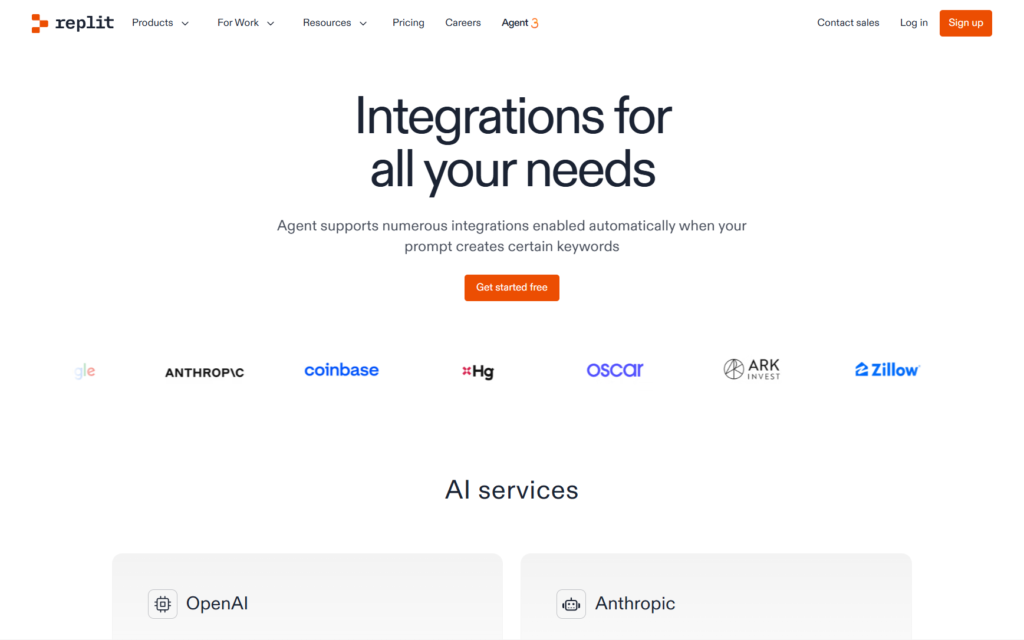
The December 2025 integrations overhaul significantly expanded capabilities. Agent can now seamlessly add:
- xAI (Grok), OpenAI, Anthropic for AI features
- Google Services for various functionality
- Perplexity for search capabilities
- Firebase for backend services
- Slack API for communications
- SendGrid for email
- Stripe for payments
The new Connectors platform provides 24 pre-built integrations including Figma, Zendesk, Salesforce, and ClickUp, all powered by MCP (Model Context Protocol). You can also import from Vercel, GitHub, and other major platforms with one-click migration.
Winner: Replit
The expanded integration ecosystem and connector platform provide more flexibility for building sophisticated applications.
The Verdict: Which Platform Wins in 2025?
After extensive testing and research, here’s the honest truth: there’s no universal winner. Your choice depends on your specific situation.
Choose Emergent.sh If:
You’re a non-technical founder who needs to validate an idea quickly and can afford the credit consumption. The fully autonomous approach works when you have clear requirements and can articulate them precisely. The mobile app development capability is unique and valuable if you’re building mobile-first products.
However, be prepared for unpredictable costs and potential frustration when the AI makes mistakes. Budget generously for fixes and iterations beyond your initial estimate.
Choose Replit If:
You have any coding background, want to learn while building, need team collaboration, value cost transparency, or work on existing codebases. Replit’s mature platform, extensive features, professional tooling, and reliable infrastructure make it the safer choice for most developers and teams.
The hybrid approach of AI assistance with human control provides the best of both worlds: speed from AI with reliability from human oversight.
The Future Outlook
Both platforms continue evolving rapidly. Emergent’s remarkable early traction ($15M ARR in 90 days) and strong funding position it well for continued development. As the AI improves and the credit system becomes more transparent, the platform could become more compelling.
Replit’s integration with ChatGPT, continuous feature improvements throughout 2025, and massive user base ensure it will remain a dominant force in AI-powered development. The platform’s commitment to education and accessibility aligns with long-term growth.
Final Recommendations
For absolute beginners with zero coding experience: Emergent.sh if you have the budget. The conversational interface requires less technical knowledge, though be prepared for a learning curve in effectively communicating with AI.
For students and learners: Replit without question. The free tier is more useful, the learning resources are superior, and the platform teaches you actual development skills.
For solo developers and freelancers: Replit Core ($20/month) provides better value with more included credits, transparent billing, and no surprise deployment fees.
For small teams (3-10 people): Replit Teams ($35/user/month annually) offers superior collaboration features and clearer per-user pricing.
For enterprises: Replit Enterprise provides better security documentation, compliance features, and mature team management capabilities.
For mobile app development: Emergent.sh currently offers the only path in this comparison, making it the default choice if mobile is your priority.
The Bottom Line
The Emergent.sh vs Replit comparison ultimately reveals two different philosophies. Emergent bets on fully autonomous AI agents that handle everything for you. Replit believes in AI-human collaboration where developers maintain control while getting intelligent assistance.
In 2025, the collaborative approach wins for most use cases. The technology isn’t quite ready for fully autonomous software development without supervision. Replit’s hybrid model acknowledges this reality while still providing impressive AI capabilities that accelerate development significantly.
That said, Emergent represents an exciting vision of the future. As the AI improves and the platform matures, the dream of natural language to production-ready software becomes more achievable. For now, Replit offers the more reliable path from idea to deployed application for most developers.
Choose based on your skills, budget, and tolerance for unpredictability. Both platforms push the boundaries of what’s possible with AI-assisted development. The real winner? Developers now have powerful tools that would have seemed like science fiction just a few years ago.
The AI coding revolution is here. Whether you choose Emergent.sh or Replit, you’re participating in a fundamental transformation of how software gets built. Choose wisely, budget carefully, and build something amazing.
Read more related articles:
Emergent promo code: Save 5% on all payments you’ll make