The AI app development landscape has exploded in 2026, and two platforms dominate the conversation among founders, developers, and product teams: Emergent.sh and Lovable.dev. Both promise to turn your ideas into production-ready applications through simple prompts, but they take fundamentally different approaches to get you there.
After spending weeks testing both platforms, analyzing hundreds of user reviews, and building real applications on each, I’m breaking down everything you need to know to make the right choice.
Whether you’re a non-technical founder trying to ship your first MVP, a developer looking to accelerate your workflow, or a product team evaluating AI coding tools, this comparison will give you the clarity you need.
What Makes These AI App Builders Different?
Before diving into the specifics, let’s understand what sets Emergent.sh and Lovable.dev apart from traditional development and even other AI coding platforms.
Emergent.sh: The All-in-One Automation Machine
Emergent.sh positions itself as a complete vibe coding platform that handles everything from your initial prompt to deployment.
Founded by twin brothers Mukund and Madhav Jha (with impressive backgrounds from Google, Amazon SageMaker, and Dunzo), Emergent uses multiple AI agents working together to build full-stack applications.
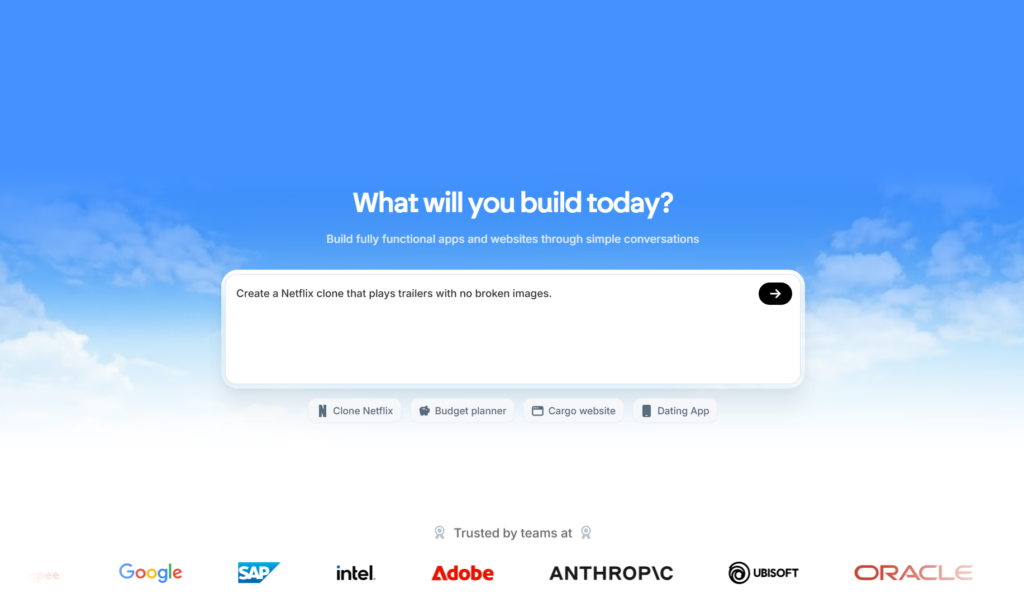
The platform has grown explosively, reaching 700,000+ users and $10M ARR within just two months of launch. That’s not hype, it’s a signal that their approach resonates with builders who want speed without touching code.
Key Philosophy: Emergent believes software should come from people who understand problems, not just those who can code. Their multi-agent system coordinates planning, coding, testing, and deployment so you can go from conversation to production in minutes.
Lovable.dev: The Developer-First Code Generator
Lovable.dev takes a different path. Instead of abstracting away all the code, Lovable generates clean, production-ready React and TypeScript code that you can own, edit, and deploy anywhere. The platform focuses on giving you both speed and control.
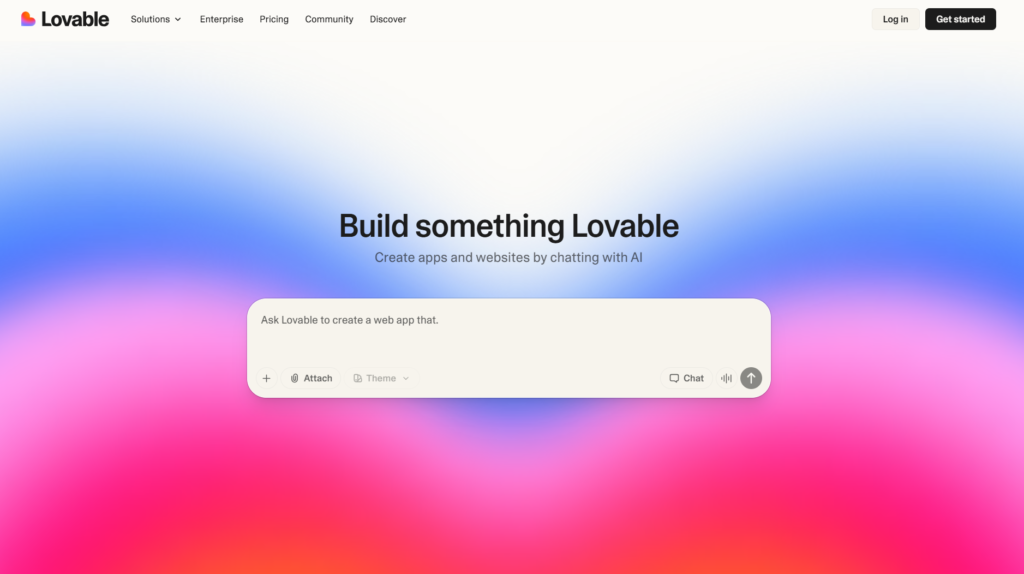
With $75M in annual recurring revenue and 30,000+ paying users in 2026, Lovable has proven that developers want AI assistance without losing ownership of their codebase. The platform uses Gemini 2.5 Flash as its default model but can leverage multiple AI models including GPT-5 and Claude Sonnet 4.5.
Key Philosophy: Lovable believes the future of development is conversation-driven but code-accessible. You get the magic of natural language building with the flexibility of real code you can take anywhere.
The Core Feature Showdown
Let’s compare how these platforms handle the essential aspects of app development.
Development Approach: How You Actually Build
Emergent.sh operates through a conversational interface where you describe your application in plain English. Multiple AI agents then collaborate to create your frontend, backend, database schema, APIs, and integrations. The platform asks clarifying questions before building, authentication method, AI integrations, calendar connections, and payment setup, ensuring it understands your requirements.
You’re not just getting a prototype. Emergent generates production-ready applications with real backends, proper database structures, and working integrations. The platform handles React for the frontend, includes backend logic in Python or Node.js, and manages PostgreSQL or MongoDB databases automatically.
Lovable.dev also starts with natural language prompts but gives you more granular control through its visual editor and code access. The platform generates React components with Tailwind CSS styling and Supabase backend integration. You can describe what you want, then switch to point-and-click editing or dive directly into the code.
Lovable offers two modes: Chat Mode for interactive development with multi-step reasoning, and Agent Mode for autonomous development where the AI proactively debugs and solves problems independently. The platform generates TypeScript code following modern best practices with proper type definitions and accessibility attributes.
The Verdict: Emergent wins for pure speed and hands-off automation. Lovable wins if you want to understand or modify the code afterward.
AI Intelligence: How Smart Are These Tools?
Emergent.sh uses a multi-agent architecture powered by GPT-4, Claude Sonnet 4, Claude Sonnet 4.5, and Gemini 2.5 Pro. Different agents handle different aspects—one manages planning, another handles coding, a third focuses on testing. This orchestration ensures cleaner code and fewer bugs compared to single-agent solutions.
The platform includes a 1M token context window on the Pro plan, allowing it to understand and work with massive codebases. It can analyze existing GitHub repositories, understand the architecture, and extend or modernize them automatically.
Lovable.dev defaults to Gemini 2.5 Flash for the best balance of speed, cost, and intelligence. However, you can prompt it to use more powerful models:
- Gemini 3 Pro, GPT-5, and Gemini 2.5 Pro for deep reasoning (most expensive)
- GPT-5 Mini and Gemini 2.5 Flash for balanced performance
- GPT-5 Nano and Gemini 2.5 Flash Lite for simple tasks (cheapest)
- Specialized models like Nano Banana Pro for image handling
The platform’s Agent Mode can explore codebases, search the web for solutions, and debug proactively without constant hand-holding.
The Verdict: Both platforms are highly intelligent, but Emergent’s multi-agent system produces more consistent full-stack applications. Lovable gives you more control over which AI models to use for specific tasks.
Code Quality and Ownership
This is where the platforms diverge significantly.
Emergent.sh keeps your code within its ecosystem. You can connect GitHub for version control and even edit code in a VS Code instance that opens in your browser, but the primary workflow keeps you inside Emergent’s environment. The platform generates complete, exportable codebases for both applications and agent logic, allowing teams to self-host or extend with developers later.
The code Emergent generates is production-quality—it follows naming conventions, maintains consistent architecture, and includes proper error handling. However, you don’t get immediate access to download and modify everything yourself without working through their system.
Lovable.dev generates code you fully own. Every application creates real React components and Supabase backend code that you can export to GitHub with full version control. You get clean TypeScript with proper types, modern React patterns using hooks, and Tailwind CSS for styling.
The platform provides two-way sync, make changes locally in your IDE, and they’ll reflect in Lovable’s visual editor, or vice versa. This flexibility means you’re never locked into the platform. If you decide to continue development outside Lovable, you can do that seamlessly.
The Verdict: Lovable decisively wins on code ownership and portability. If you need full control over your codebase or plan to hand off to developers, Lovable is the clear choice. Emergent works better if you want to stay within one platform throughout the product lifecycle.
Backend and Database Handling
Emergent.sh generates complete backend architectures including database schemas, API endpoints, authentication flows, and business logic. The platform supports both PostgreSQL and MongoDB, handling migrations and relationships automatically.
When you update a data model, Emergent intelligently propagates changes across your database schema, API endpoints, and UI forms. This coherent approach prevents the common problem of frontend and backend getting out of sync during rapid iteration.
For complex applications, Emergent can create sophisticated data relationships, implement caching strategies, and optimize database queries. The platform’s agents understand performance implications and make smart architectural decisions.
Lovable.dev integrates deeply with Supabase for backend services. The platform auto-generates PostgreSQL, MySQL, or MongoDB databases through Supabase integration, including authentication, API generation, and data persistence.
While Lovable creates functional backends, the experience is more template-driven. You get standard CRUD operations and authentication patterns, but implementing complex business logic or unconventional data architectures may require more manual coding than with Emergent.
The Verdict: Emergent provides more sophisticated backend automation out of the box. Lovable gives you a solid foundation but expects developers to customize complex logic themselves.
Pricing Breakdown: What You’ll Actually Pay
Both platforms use credit-based systems, but their structures and hidden costs differ significantly.
Emergent.sh Pricing

Free Plan:
- 10 monthly credits
- 10 daily credits
- Community support access
- Perfect for testing workflows
Reality Check: With only 10 credits, you can’t even deploy a single application to production (deployment costs 50 credits/month). This is purely for exploration.
Standard Plan – $20/month ($204/year with 17% discount):
- 100 monthly credits
- 10 daily credits
- Unlimited small projects
- Popular integrations (Google Sheets, Airtable)
- Mobile app building support
- Save to GitHub
- Fork projects for collaboration
Reality Check: Your 100 monthly credits will be consumed quickly. Deploying one app takes 50 credits monthly just to keep it live—that’s half your allocation gone before building anything new.
Pro Plan – $200/month ($2,004/year with 17% discount):
- 750 monthly credits
- Premium integrations (Stripe, Razorpay)
- 1M token context window
- Edit system prompts
- Custom agent creation
- Priority support
- Advanced GitHub collaboration
- More powerful server allocation
Hidden Costs:
- Each development iteration consumes credits unpredictably
- Hosting costs 50 credits per app per month
- Complex features burn through credits faster
- No published menu of credit costs, you discover them as you build
One user reported spending $80 in top-ups before realizing the Pro plan would have been more cost-effective. Another found their 110 credits didn’t last a full day when building a moderately complex application.
Lovable.dev Pricing
Free Plan – $0:
- 5 daily credits (30 monthly maximum)
- Public projects only
- Unlimited collaborators
- One-click deployment
- GitHub synchronization
- Access to lovable.app domains
Reality Check: The daily credit cap makes this useful only for testing. You’ll burn through 5 credits in 2-3 iterations on even a simple project.
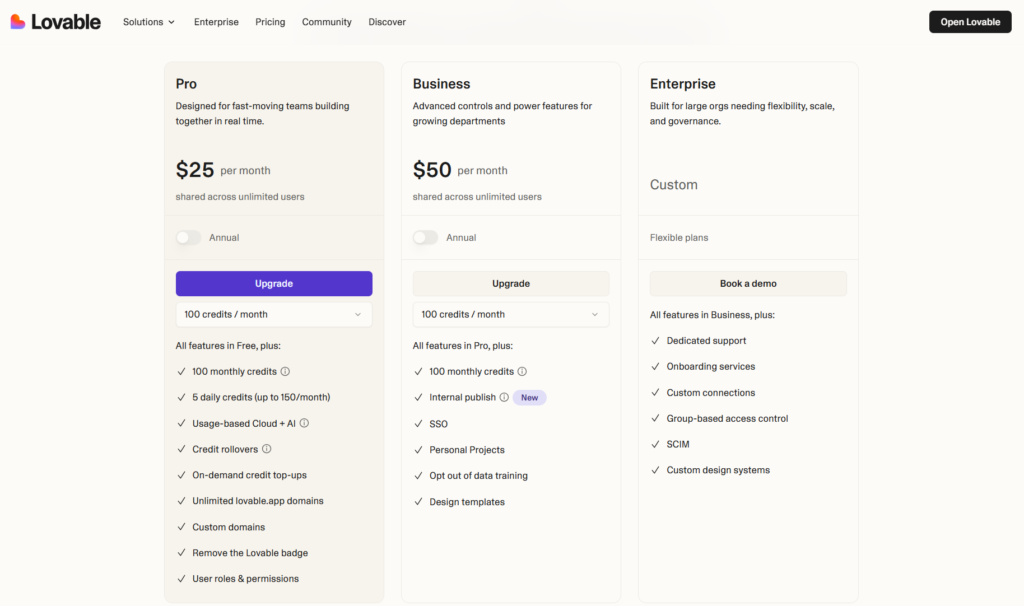
Pro Plan – Starting at $25/month ($21/month billed annually):
- 100 monthly credits (plus 5 daily)
- Unlimited private projects
- Custom domain support
- Remove Lovable branding
- Up to 3 editors per project
- Dev Mode with full code visibility
- AI-powered suggestions
- Multiplayer editing
- Security scans for Supabase apps
- Credits roll over monthly
Business Plan – Starting at $50/month ($42/month billed annually):
- 100+ monthly credits (customizable)
- All Pro features
- Single Sign-On (SSO)
- Personal projects separate from team work
- Design templates
- Opt-out of AI training on your data
- Team workspace for up to 20 users
- Centralized billing
Enterprise – Custom Pricing:
- Dedicated support
- Onboarding services
- Custom integrations
- Group-based access control
- Custom design systems
Flexible Credit System: You can customize credit allocations from 100 to 10,000 credits/month. Pricing scales accordingly:
- 100 credits: $25/month (Pro) or $50/month (Business)
- 10,000 credits: $3,584/month (Business tier)
The Credit Reality: Each message to the AI consumes one credit regardless of complexity. Unlike Emergent where costs vary unpredictably, Lovable’s system is more transparent. However, complex applications still consume credits quickly through iteration cycles.
Direct Cost Comparison
For a solo developer building 2-3 small applications per month:
- Emergent Standard ($20/month): Tight budget, frequent credit purchases likely needed
- Lovable Pro ($25/month): More comfortable allocation with rollover protection
For a small team building 1-2 complex applications monthly:
- Emergent Pro ($200/month): Better value if using integrated deployment
- Lovable Business ($50/month base): Better if you export and host elsewhere
The Verdict: Lovable offers more predictable pricing with transparent credit consumption. Emergent’s unpredictable credit usage and expensive deployment costs (50 credits/month per app) create budget uncertainty.
Real-World Performance: Speed vs. Reliability
Build Speed
Emergent.sh excels at rapid generation. Users report creating functional tools live in less than 10 minutes. Simple apps deploy in under 5 minutes. More complex projects like dashboards or marketplaces typically complete in under 30 minutes.
The platform’s multi-agent coordination means development happens in parallel—while one agent designs the UI, another structures the database, and a third handles integrations. This parallel processing delivers impressive speed.
However, users report occasional reliability issues during generation or deployment that can interrupt the flow. The system sometimes gets stuck in loops, consuming credits while making minimal progress.
Lovable.dev also delivers impressive speed, although it is slightly slower than Emergent for initial builds. The trade-off is more stability, fewer generation failures, and more predictable iterations.
Where Lovable shines is in refinement speed. Because you get direct code access, making precise adjustments is faster than reprompting an AI. For design-heavy applications that require pixel-perfect layouts, this hands-on approach often proves effective.
The Verdict: Emergent wins pure initial build speed. Lovable wins on iteration stability and refinement velocity.
Production Readiness
Emergent.sh generates applications that include:
- Complete authentication flows
- Database migrations
- API rate limiting
- Error handling
- Security best practices
- Automated scaling infrastructure
The platform’s dedicated pre-deploy testing validates UI flows, API calls, database interactions, and external integrations in realistic conditions. This testing agent catches issues before they reach production.
However, users note that Emergent’s automatic solutions sometimes create over-engineered code or make assumptions that don’t fit specific use cases. Debugging these issues within Emergent’s environment can be challenging without deep technical knowledge.
Lovable.dev produces clean, maintainable code that developers can immediately understand and extend. The React components follow modern patterns, TypeScript types are properly defined, and Supabase integration uses standard approaches.
The challenge is that Lovable gives you the foundation but expects you to handle production concerns like monitoring, logging, performance optimization, and advanced security yourself. It’s production-capable code, but you’ll need to add the operational layer.
The Verdict: Emergent handles more production concerns automatically. Lovable gives you cleaner code but expects more operational setup work.
Integration Capabilities
Native Integrations
Emergent.sh offers extensive built-in integrations:
- Payment Processing: Stripe and Razorpay with full checkout flows, webhook handling, and subscription logic
- Authentication: Google OAuth, custom OAuth credentials, username/password
- Productivity Tools: Google Sheets, Airtable
- AI Services: Native LLM key for chatbots and AI features
- Calendar: Google Calendar with real OAuth or simulated calendars
- Email: Automated notification systems
- Analytics: Built-in tracking and monitoring
The platform’s Universal Key is particularly powerful—it allows your deployed applications to consume the same credit pool that powers development, simplifying AI feature deployment.
Lovable.dev focuses on core integrations:
- Backend: Deep Supabase integration for database, auth, and storage
- Version Control: GitHub sync with two-way updates
- Design: Figma integration through Builder.io for design handoff
- AI Services: Lovable AI integration for adding AI features (requires separate billing)
For other integrations, you’ll need to code them yourself using the generated Supabase backend or add custom API connections. The platform provides templates and patterns but less automated integration setup than Emergent.
The Verdict: Emergent wins significantly on built-in integrations. Lovable requires more manual integration work.
Deployment and Hosting
Emergent.sh Deployment
Emergent handles deployment automatically within its ecosystem. Click deploy, and your application goes live with:
- Managed hosting infrastructure
- Automatic scaling based on traffic
- SSL certificates
- Custom domain support
- Continuous monitoring
The catch: Deployment costs 50 credits per application per month. For the Standard plan ($20/month with 100 credits), this means you can only keep one app deployed, consuming half your monthly allocation just for hosting.
Users have expressed frustration with this pricing structure, as deployment is free on most competing platforms like Base44, Bolt.new, and Lovable.
Lovable.dev Deployment
Lovable offers one-click deployment to its hosting infrastructure at no additional credit cost beyond development. You also get:
- Custom domain support on paid plans
- GitHub integration for self-hosting
- Export to Vercel, Netlify, or any hosting platform
- Preview environments for testing
Because you own the code, you’re not locked into Lovable’s hosting. Many users export to GitHub and deploy on their preferred infrastructure, using Lovable purely as a development accelerator.
The Verdict: Lovable wins decisively. Free deployment, flexible hosting options, and no vendor lock-in provide much better value and freedom.
Collaboration Features
Emergent.sh offers:
- Real-time collaboration in secure workspace
- Shared resource management
- Project forking for team workflows
- GitHub integration for version control
- More powerful team features on Pro plan
The platform works well for small teams building together but lacks sophisticated role-based permissions or granular access controls on lower tiers.
Lovable.dev provides:
- Unlimited collaborators even on free plan
- Up to 3 editors per project on Pro
- 20 users on Business plan with centralized billing
- Multiplayer editing with real-time updates
- Role-based permissions on Business plan
- GitHub sync for developer collaboration
Lovable’s collaboration model scales better for larger teams, especially with the Business plan’s workspace management features.
The Verdict: Lovable offers more sophisticated collaboration tools and better scales for teams.
Use Case Recommendations
Choose Emergent.sh if:
- You’re a non-technical founder who wants to ship MVPs without learning any code
- Speed is your top priority and you need to validate ideas rapidly
- You need complex integrations like payment processing, calendar management, or advanced authentication
- You’re building internal tools for your company where code ownership matters less
- You want AI features that share your development credit pool
- You prefer staying in one platform from development through deployment
Best Use Cases:
- SaaS MVPs with standard features
- Internal dashboards and admin panels
- Automation workflows and business tools
- Customer portals with authentication
- Simple e-commerce platforms
Choose Lovable.dev if:
- You’re a developer who wants to accelerate your workflow without losing code control
- Code ownership is important and you need exportable, maintainable code
- You’re building design-heavy applications that require pixel-perfect layouts
- You plan to hand off to developers for further customization
- You want deployment flexibility without vendor lock-in
- You need transparent, predictable costs for budgeting
Best Use Cases:
- Polished UI prototypes for investor demos
- Design-centric landing pages and marketing sites
- React applications you’ll continue developing manually
- Projects requiring custom backend logic
- Applications needing specific hosting requirements
Common Complaints and Limitations
Emergent.sh Issues Users Report:
- Unpredictable credit consumption: No clear pricing per feature makes budgeting difficult
- Expensive deployment: 50 credits/month per app feels excessive
- Error loops: AI sometimes gets stuck, consuming credits without progress
- Limited code access: Harder to debug or customize without full code control
- Marketing focus: Users note heavy marketing spend over fixing core usability issues
Lovable.dev Issues Users Report:
- Credit burn rate: Complex projects consume credits faster than expected
- AI inconsistency: Sometimes generates buggy or conflicting code requiring fixes
- Publishing errors: Deployment occasionally fails or takes hours to reflect
- Limited backend customization: Advanced backend logic requires manual coding
- Frontend-focused: Backend capabilities lag behind UI generation quality
The Decision Framework
Here’s a simple framework to make your choice:
If you answer “yes” to most of these, choose Emergent.sh:
- I don’t know how to code and don’t plan to learn
- I need to launch multiple MVPs quickly to test ideas
- Built-in integrations are crucial for my projects
- I’m comfortable with unpredictable costs
- I don’t need to own or customize the codebase deeply
- Speed matters more than code quality
If you answer “yes” to most of these, choose Lovable.dev:
- I have some development knowledge or work with developers
- Code ownership and portability are important
- I need predictable, transparent costs
- Design quality is critical for my applications
- I want flexibility in hosting and deployment
- I might need custom backend logic
Alternatives Worth Considering
If neither platform perfectly fits your needs, consider these 2026 alternatives:
Vitara AI: Combines Emergent’s speed with Lovable’s code ownership. Generates full-stack applications with both frontend and backend code you can download and own.
Bolt.new: StackBlitz’s browser-based full-stack generator supporting React, Next.js, Vue, and Svelte. Great for rapid prototyping with multiple framework options.
v0 by Vercel: Creates production-ready React components with Tailwind CSS. Best for developers who want UI generation without a full backend setup.
Replit Agent: Browser-based IDE with AI assistance. Excellent for learning and prototyping with strong community support.
Base44: Wix-acquired platform with integrated backend, analytics, and payment processing. All-in-one solution similar to Emergent but within Wix ecosystem.
My Honest Assessment
After building real applications on both platforms, here’s my take:
Emergent.sh is genuinely impressive when it works. The ability to go from conversation to deployed application in minutes feels like magic. For non-technical founders validating ideas or teams building internal tools, it’s incredibly empowering.
However, the platform’s credit system creates anxiety. You never quite know how much your next feature will cost, and the deployment pricing feels like a hidden tax. The lack of code ownership also bothers me—you’re dependent on Emergent’s continued existence and pricing decisions.
Lovable.dev feels more honest. You pay for development, you get clean code, and you own it completely. The credit system is transparent, deployment is free, and you can leave whenever you want. For anyone with development experience or access to developers, this is the safer long-term bet.
That said, Lovable expects more technical understanding. If you truly can’t code and have no technical partners, you’ll hit walls with custom logic and complex backends that Emergent would handle automatically.
The Bottom Line
There’s no universal winner between Emergent.sh and Lovable.dev. Your choice depends entirely on your technical skills, budget constraints, and project requirements.
Emergent.sh wins for: Pure speed, non-technical users, complex integrations, and all-in-one automation.
Lovable.dev wins for: Code ownership, cost transparency, developer handoff, and deployment flexibility.
Most importantly, both platforms represent the future of software development. The ability to describe what you want and receive functional applications—whether as automated deployment or clean code—fundamentally changes who can build software and how quickly ideas become reality.
In 2026, we’re not choosing between AI tools and traditional development. We’re choosing which AI-assisted workflow fits our skills, preferences, and goals. Both Emergent and Lovable deliver on that promise in different ways.
Try both free plans. Build the same simple application on each platform. You’ll quickly discover which approach resonates with how you think and work. That personal fit matters more than any comparison article can capture.
The era of “I can’t build that because I don’t code” is over. With tools like Emergent.sh and Lovable.dev, the only question left is: What are you going to build?