You’ve narrowed your CRO tool shortlist down to two of the most talked-about platforms in the experimentation space: Convert and VWO. Both tools have been around for over a decade. Both carry strong reputations. And both will let you run A/B tests that move your conversion metrics in the right direction.
But here’s the thing: they are not the same tool, and choosing the wrong one will cost you more than money. It will cost you time, momentum, and the kind of institutional trust that a broken experimentation program is incredibly slow to rebuild.
This comparison is built for the optimizer who needs a straight answer. No promotional spin. No surface-level feature lists. Just a clear, honest breakdown of where each platform shines, where it falls short, and which type of organization it genuinely serves best in 2026. By the time you finish reading, you’ll know exactly which one belongs in your tech stack.
Quick Comparison Table: Convert vs. VWO at a Glance
| Feature / Factor | Convert | VWO |
|---|---|---|
| Best For | Lean teams, CRO agencies, privacy-first companies, budget-conscious optimizers | Mid-market to enterprise teams needing an all-in-one optimization platform |
| Starting Price | $399/month (Growth plan, monthly) | Usage-based; quote required (Free trial available) |
| Free Trial | 15 days, no credit card required | 30 days, no credit card required |
| A/B Testing | Yes (all plans) | Yes (all plans) |
| Multivariate Testing | Pro and Enterprise plans | Yes (available across plans) |
| Split URL Testing | Yes | Yes |
| Full-Stack / Server-Side Testing | Yes (Pro and Enterprise plans) | Yes (separate VWO Feature Experimentation product) |
| Heatmaps | Experimental heatmaps only | Full heatmaps with session-level integration |
| Session Recordings | No | Yes |
| Form Analytics | No | Yes |
| Funnel Analysis | No | Yes |
| AI Features | No dedicated AI module | VWO Copilot (AI-powered optimization) |
| Personalization | Yes (via Deploys) | Yes (dedicated VWO Personalize product) |
| Mobile App Testing | No | Yes (dedicated product) |
| Pricing Transparency | Fully public on website | Quote-based for most plans |
| Data Privacy | First-party cookies only; EU-based servers (Frankfurt) | Google Cloud Platform; strong compliance stack |
| Support Speed | ~7-12 minute first response (4x faster than industry avg) | 45-minute first response (industry avg is 2.6 hrs) |
| Compliance | GDPR, CCPA, HIPAA, SOC 2 Type 2, ISO 27001 | GDPR, CCPA, HIPAA, SOC 2, ISO 27001, ISO 27701 |
| Integrations | 90+ native integrations | 100+ integrations |
| Flicker-Free Technology | SmartInsert™ (proprietary, since 2016) | Asynchronous SmartCode |
| Statistics Engines | Frequentist and Bayesian | Enhanced SmartStats (Bayesian-first) |
What Is Convert?
Convert, officially called Convert Experiences, is a dedicated A/B testing and experimentation platform that has been operating since 2009.
Headquartered in Delaware, the company has remained self-funded throughout its 15-plus-year history, which means it has never been pressured by investors to cut corners, inflate pricing, or bloat the platform with features nobody actually needs.
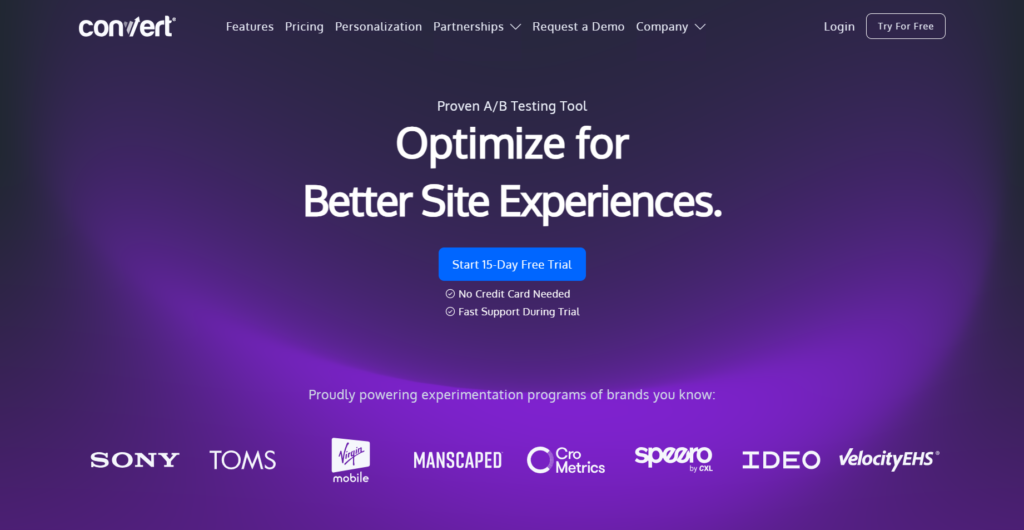
The core pitch is simple: reliable, affordable, privacy-first A/B testing for teams that are serious about experimentation. Convert stores all data on carbon-neutral servers based in Frankfurt, Germany.
It operates exclusively with first-party cookies, which is a significant point of differentiation in a post-cookie world where GDPR enforcement is only getting stricter. As of 2026, Convert reports having optimized over 40,000 websites across its 15-year run, and its G2 ratings consistently position it as a High Performer and Easiest Setup winner in the mid-market and small business categories.
Where Convert truly distinguishes itself is in the combination of pricing transparency, flicker-free testing reliability, and support responsiveness.
You can browse pricing, start a trial, pick a plan, and go live with your first test without ever talking to a salesperson. That self-service model is rare at this feature level, and it matters enormously for lean teams and agencies that need to move fast.
What Is VWO?
VWO, built by Wingify and founded in 2010, has grown into something considerably larger than a pure A/B testing tool.
By 2026, it positions itself as a comprehensive Digital Experience Optimization platform, encompassing testing, behavioral analytics, personalization, voice-of-customer research, feature experimentation, and program management, all under one roof.
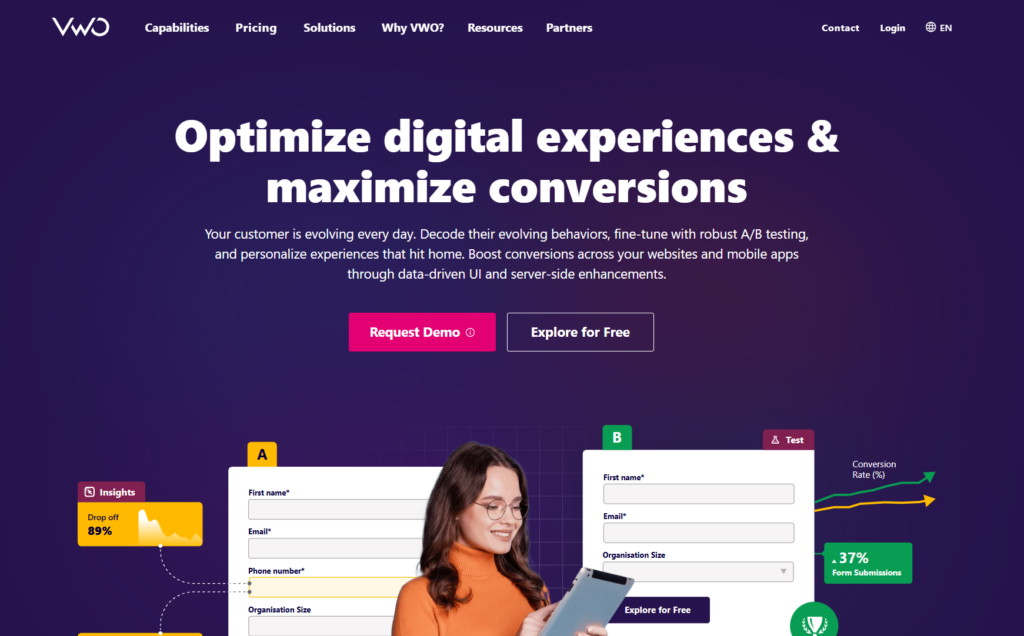
The numbers backing VWO are substantial: over 170 billion experiences optimized, more than 2 million experiments run, and more than 675,000 websites powered. Customers range from fast-growing SaaS startups to global enterprises including brands like Agoda, Allstate, Decathlon, and NVIDIA. The platform runs on Google Cloud Platform (GCP), which provides the kind of scalability and uptime guarantees that large organizations demand.
VWO’s biggest strategic bet in recent years has been VWO Copilot, its AI-powered optimization assistant that analyzes user behavior patterns, surfaces actionable insights, generates test variations from natural language descriptions, and uncovers hidden user segments.
For teams looking to accelerate their experimentation velocity without proportionally growing their headcount, Copilot is a genuinely compelling addition. VWO also recently introduced a dedicated Voice of the Customer product called VWO Pulse, rounding out what is already one of the most complete CRO suites in the market.
Testing Capabilities: How Deep Does Each Platform Go?
A/B Testing and Core Experimentation
Both platforms deliver solid A/B testing. You get visual editors, code editors, traffic allocation controls, and audience targeting on both sides of the fence. Neither tool will leave a seasoned optimizer reaching for workarounds on standard test types.
That said, the depth of each platform’s targeting engine is worth examining. Convert ships with a 40-plus filter targeting engine that covers device, geography, time of day, traffic source, weather, language, custom JavaScript, custom tags, and behavioral conditions, all in a single flat-rate plan.
VWO’s targeting is equally robust but segments some of those features, including behavioral targeting, advanced post-segmentation, and collision prevention, as add-ons that cost extra on lower-tier plans. For agencies running complex multivariate campaigns across many client accounts, that distinction in total cost of ownership adds up quickly.
Multivariate testing (MVT) is available on both platforms. Convert it to its Pro and Enterprise plans, while VWO includes it more broadly. Split URL testing is available on all tiers for both tools.
One area where Convert genuinely leads is flicker prevention. Convert’s proprietary SmartInsert technology has been delivering flicker-free A/B tests since 2016, with over a billion experiments rendered without the visual flash that ruins user experience and compromises test data integrity.
VWO counters with its Asynchronous SmartCode, which the company describes as having the least impact on Total Blocking Time of any tool in the industry. In practice, both solutions handle flicker well, but Convert’s 10-year track record with SmartInsert is a strong proof point.
Convert also includes built-in SRM (Sample Ratio Mismatch) checks, sequential testing on Pro and above, and both Frequentist and Bayesian statistical engines, giving your data science team the flexibility to work with whichever framework your organization prefers.
VWO uses its Enhanced SmartStats engine, which is Bayesian-first and includes sequential testing correction natively. Both approaches produce statistically defensible results; the choice comes down to your team’s preferred methodology.
Multipage and Full-Stack Testing
Convert’s multi-page testing allows you to run experiments that span multiple pages in a user journey, which is critical for testing checkout funnels or multi-step lead gen flows. This capability lives in the Pro plan and above.
Full-stack and server-side experimentation is where the architectures diverge most sharply. Convert includes full-stack experimentation and feature flags as part of its Pro and Enterprise plans, so you get server-side testing without purchasing a separate product.
VWO handles this through its standalone VWO Feature Experimentation product, which is a separate platform with SDKs available in eight-plus programming languages, including Node.js, Python, Ruby, Go, Java, PHP, .NET, and JavaScript.
For engineering teams running complex back-end experiments or progressive feature rollouts, VWO Feature Experimentation is genuinely powerful. But it does mean managing a second product relationship, a second billing line, and potentially a second onboarding effort.
Behavior Analytics: A Category Where VWO Has No Peer
This is the most significant capability gap between the two tools, and it deserves honest treatment.
Convert does not offer native heatmaps, session recordings, funnel analysis, or form analytics. It provides experimental heatmaps that let you see click and engagement patterns within a specific test, but if you want the full qualitative research stack, you will need to integrate Convert with a third-party behavior analytics tool like Hotjar, Microsoft Clarity, or FullStory.
VWO, by contrast, makes behavior analytics a core pillar of its platform through its VWO Insights product. You get full-session recordings, heatmaps that integrate directly with your test reports so you can compare user behavior between control and variation, funnel analysis, form analytics, and an observations feature that lets you annotate behavioral patterns into your test planning workflow.
The tight integration between VWO’s behavioral insights and its testing engine is where the platform creates a feedback loop that is genuinely hard to replicate by stitching together multiple tools.
For teams that want to build hypotheses from qualitative data and then validate those hypotheses through testing, all within a single platform, VWO’s approach is substantially more efficient. That said, teams that already have a dedicated analytics and recording stack and use Hotjar or a similar tool routinely may not see enough marginal value from VWO’s Insights module to justify the premium over Convert.
Personalization Features
Both platforms support personalization, though their implementations differ in scale and philosophy.
Convert calls its personalization capability. A Deploy lets you activate a targeted experience for a defined audience segment using the same 40-plus filter targeting engine that powers regular A/B tests. Every Convert plan includes Deployments, with Growth offering 10, Pro offering 100, and Enterprise offering 300.
Deploys work well for segment-specific content swaps, post-test winner rollouts, and targeted promotions. They are straightforward and powerful for most use cases a lean team or agency will encounter.
VWO takes personalization considerably further with its dedicated VWO Personalize product. VWO Personalize connects to the platform’s Customer Data Platform (VWO Data360), which ingests user attributes, behavioral events, third-party data, and offline data to build dynamic audience segments. It supports omnichannel personalization across websites, mobile apps, and server-side surfaces.
For large B2C or enterprise teams that want to move beyond simple segment-based targeting into truly adaptive, data-driven personalization, VWO’s offering operates at a different scale.
The honest summary: Convert’s Deploys are sufficient for most testing programs. VWO Personalize is for organizations that have already built a mature experimentation practice and are ready to invest in sophisticated personalization infrastructure.
AI Features
Artificial intelligence has reshaped every software category since 2023, and CRO tools are no exception.
Convert does not yet have a dedicated AI module as of 2026. The platform’s roadmap continues to focus on testing reliability, privacy compliance, and performance, which is a deliberate product choice rather than an oversight. Convert does offer an AI Wizard for basic text recommendations within the editor, but it does not have a comprehensive AI-driven optimization assistant.
VWO Copilot is a genuine differentiator. Launched as part of VWO’s 2024-2025 platform evolution, Copilot uses AI to analyze user behavior patterns, identify optimization opportunities, help teams build variations directly from natural-language descriptions, and surface hidden audience segments that manual analysis often misses.
The practical value is not just in saving time, but also in test velocity. Teams that previously might run four tests per month can realistically accelerate to six or eight, because the hypothesis-to-variation pipeline moves faster with AI assistance.
If your organization is actively trying to scale its experimentation program without scaling headcount proportionally, VWO Copilot is a meaningful capability advantage. If your team runs a focused, deliberate testing cadence and prefers to do its own analytical work, the absence of an AI layer in Convert will not feel like a gap.
Pricing Plans Comparison: One of the Biggest Decision Factors
Let’s be direct here, because pricing transparency is actually one of the starkest differences between these two tools.
Convert Pricing
Convert’s pricing is fully public, fully self-service, and structured around monthly tested users (MTUs):
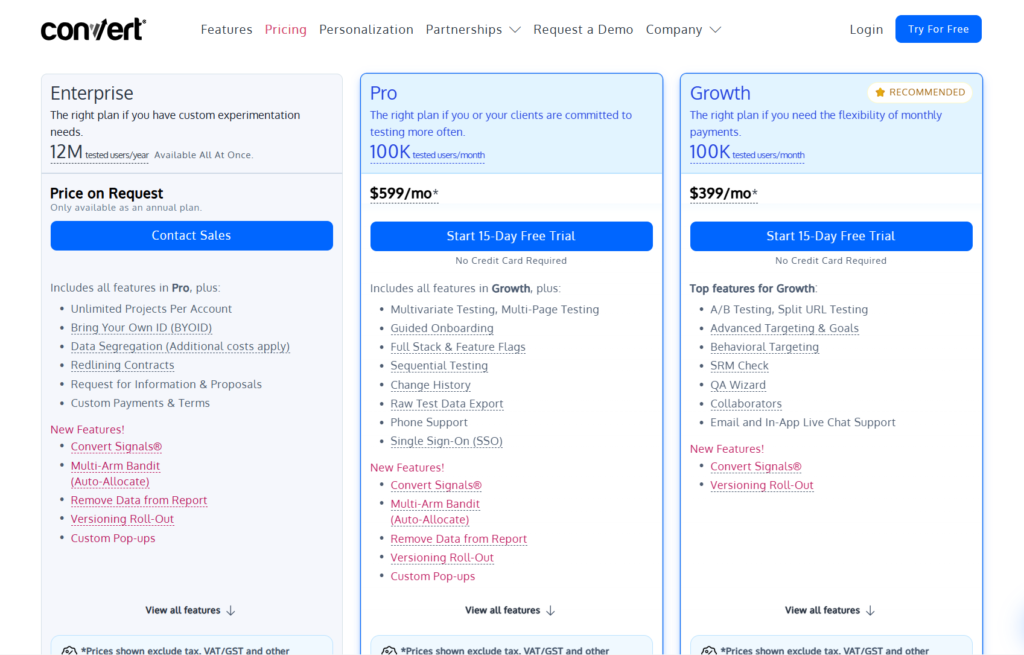
Growth Plan: $399/month (billed monthly) or $299/month (billed annually at $3,588/year) for up to 100,000 MTUs. This plan covers A/B testing, split URL testing, advanced targeting, SRM checks, the QA Wizard, behavioral targeting, and 90-plus integrations. Email and chat support are included. Multivariate testing, full-stack, and sequential testing are not included.
Pro Plan: $599/month (billed monthly) or $420/month (billed annually at $5,040/year) for up to 250,000 MTUs. This unlocks multivariate testing, multi-page testing, full-stack experimentation and feature flags, sequential testing, change history, raw data export, phone support, Single Sign-On (SSO), the Multi-Arm Bandit auto-allocate feature, and guided onboarding with a dedicated account manager.
Enterprise Plan: Custom pricing for organizations with more than 1 million MTUs per month. Includes everything in Pro, plus Bring Your Own ID (BYOID), data segregation, unlimited projects, redlining contracts, and custom payment terms.
Every Convert plan includes a free VWO migration service, which is a tactically smart offer for anyone making the switch.
Convert’s overuse policy is also worth understanding: if you exceed your plan’s MTU limit, your account stays open. You simply purchase additional traffic at $399 per 100,000 MTUs for Growth or $699 per 250,000 MTUs for Pro. Convert does not penalize you for growing.
VWO Pricing
VWO does not publish standard plan pricing on its website. Pricing is usage-based and tied to Monthly Tracked Users (MTUs), with exact rates available only through a demo or sales conversation.
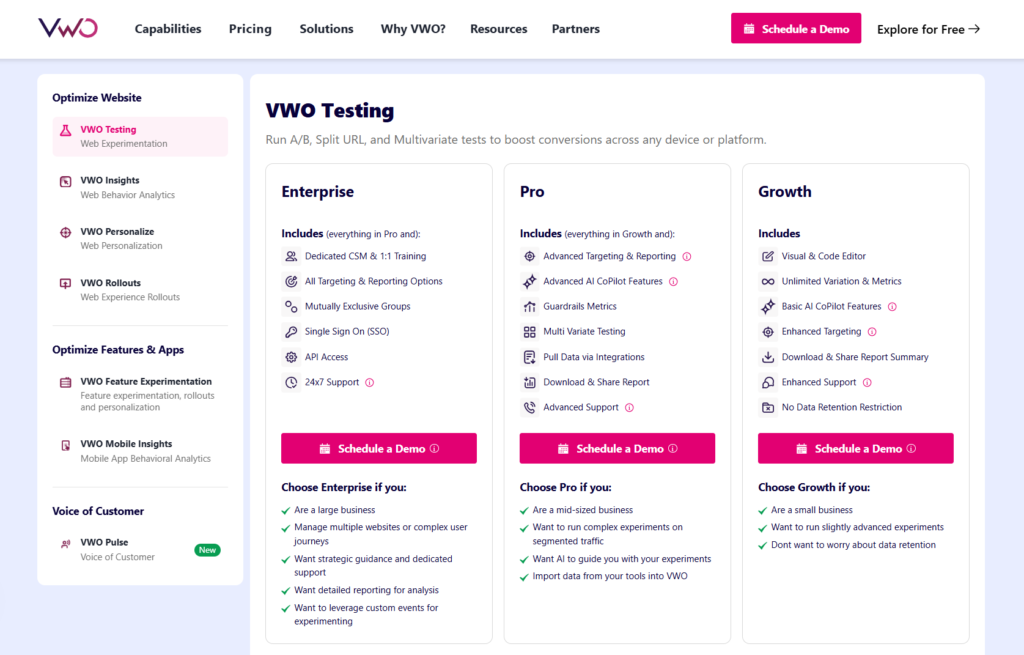
VWO offers a 30-day free trial, which is the longest free trial in this comparison and a meaningful advantage for teams that need more time to evaluate a platform before committing.
What is known publicly is that VWO scales through multiple product tiers, and organizations that want access to the full suite, including VWO Insights, VWO Personalize, VWO Data360, VWO Plan, and VWO Feature Experimentation, are generally working with enterprise-level contracts.
Teams in the mid-market who want heatmaps and session recordings in addition to A/B testing should expect a higher total investment than what Convert charges for pure testing.
The pricing model difference is actually philosophically significant. Convert lets you pick a plan, know exactly what you will pay, and start testing today. VWO requires a conversation with sales first. Neither approach is wrong, but if your organization moves fast and hates procurement-driven delays, Convert’s self-service model is a genuine operational advantage.
Ease of Use and User Interface
Both platforms have invested heavily in their user interfaces, and both are considered approachable by industry standards.
Convert’s interface has been consistently praised on G2 for its intuitiveness and thoughtful design. Users regularly highlight that the platform is easy to navigate without extensive training, and that even less technical team members can build and QA tests without developer involvement. The visual editor is clean, the targeting rules are readable in plain language, and the reporting dashboards surface the data that actually matters without burying it in noise.
VWO’s interface has similarly strong reviews for clarity. The platform’s no-code visual editor is powerful enough for non-technical marketers to run tests independently, which is a deliberate design goal for a product that aims to serve growth marketers, UX researchers, product managers, and engineers from a single interface.
The added complexity that comes with a broader product suite, including behavior analytics, personalization, and program management, means that VWO’s navigation has more layers. For first-time users, the breadth of the platform can initially feel overwhelming, but the onboarding experience and contextual help documentation mitigate this well.
Both tools offer Chrome extension debuggers, preview URLs, and QA workflows. Convert additionally offers a proprietary QA Wizard that reviews variant health, checks goal configuration, and validates snippet installation in real time, which CRO agencies in particular find very useful for client handoffs.
Privacy, Security, and Compliance
Privacy is not a checkbox feature in 2026. It is a business risk factor, and it should influence your platform choice accordingly.
Convert’s privacy architecture is designed from the ground up for a first-party data world. The platform operates exclusively with first-party cookies, meaning it does not require third-party tracking cookies that are progressively blocked by browsers and challenged by regulators.
All data is stored on carbon-neutral servers in Frankfurt, Germany, which means your visitor data never crosses into jurisdictions with weaker privacy protections. Convert is GDPR, TTDSG, BDSG, CCPA, HIPAA, SOC 2 Type 2, and ISO 27001 certified, and it has a zero-data-breach record. For organizations in regulated industries, including healthcare, fintech, and legal services, that track record carries real weight.
VWO hosts all data on Google Cloud Platform (GCP), which provides enterprise-grade security infrastructure, 100 percent uptime SLAs, and robust encryption both in transit and at rest. VWO carries an impressive compliance stack: SOC 2, ISO 27001, ISO 27701 (privacy information management), ISO 27017, ISO 27018, ISO 45001, ISO 14001, GDPR, CCPA, HIPAA, and PCI-DSS.
The ISO 27701 certification in particular is notable because it extends beyond information security into formal privacy information management, which is a higher bar than many tools in the category clear.
Both platforms take privacy seriously. Convert’s advantage is its European data residency and first-party-only cookie architecture, which is structurally simpler for privacy-conscious teams to audit and explain to legal departments. VWO’s advantage is the sheer breadth of its compliance certifications and the enterprise-grade infrastructure backing.
Support and Onboarding: What Happens After You Sign Up
The post-sales experience is where many CRO tools disappoint, and it is an area where both Convert and VWO have made deliberate investments.
Convert’s support is often cited as its most underrated competitive advantage. The platform advertises a first response time of approximately 7 to 12 minutes, which is roughly four times faster than the industry average measured by Zendesk benchmarks.
More importantly, the people responding to your tickets have deep platform expertise. G2 reviewers consistently note that Convert’s support team does not send generic canned responses; they diagnose actual problems and find solutions, even for complex edge cases involving unusual test configurations.
Guided onboarding is included in Convert’s Pro and Enterprise plans. The onboarding process covers proper snippet installation, setting up the first project, running an A/A test as a validation step, goals configuration, and enabling integrations. This is a structured process, not a one-hour Zoom call and a knowledge base link.
VWO offers 24/7 support across all plans, which is a meaningful advantage for international teams or organizations that run campaigns outside standard business hours. VWO’s first response time of 45 minutes compares very favorably to the industry average of 2.6 hours. Dedicated onboarding and training resources are available, and enterprise clients receive end-to-end consultation with dedicated account management.
The honest difference: for lean teams or agencies that need rapid, expert responses during test-critical moments, Convert’s support speed is a real operational advantage. For enterprise organizations that value always-on availability and structured success programs, VWO’s 24/7 model and dedicated success team provide a different kind of safety net.
Integrations
Neither platform will leave you stranded in your existing tech stack.
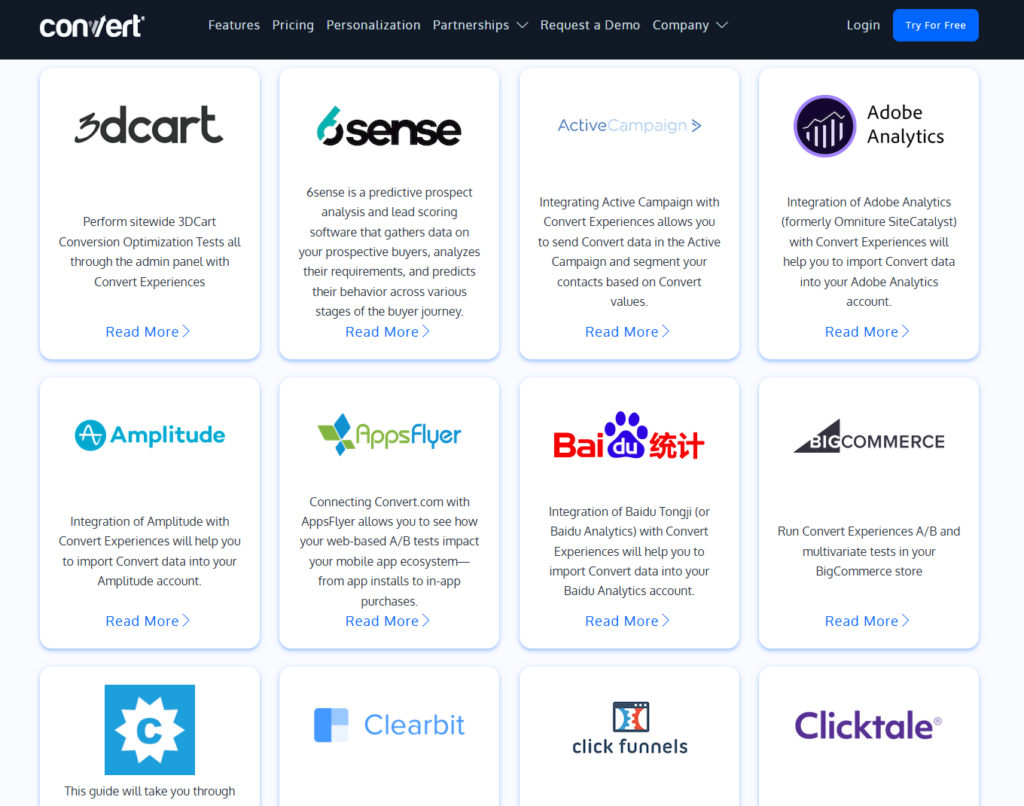
Convert connects with 90-plus native integrations, covering the major analytics platforms, tag managers, data warehouses, CRMs, e-commerce platforms (including dedicated Shopify A/B testing support), push notification tools, heatmap tools, and more. All integrations are described as one-tag connections that work without requiring Zapier as an intermediary.
VWO supports 100-plus integrations and places particular emphasis on its Customer Data Platform connectors. The VWO Data360 layer can ingest data from external platforms via its Data API, third-party integrations, and offline data sources, enabling VWO’s testing and personalization engines to act on a unified customer data view. This is particularly relevant for organizations running CRM-driven segmentation or CDP-powered personalization workflows.
Both platforms integrate with Google Analytics 4, Segment, Salesforce, HubSpot, Mixpanel, Amplitude, and the major email and marketing automation platforms.
Convert vs. VWO: Who Should Choose Which?
At this point in the comparison, the decision framework becomes fairly clear. Here is how to think about it honestly.
Choose Convert if:
You are a CRO agency, a lean in-house team, or a fast-growing mid-market company that needs a reliable, powerful A/B testing platform without the overhead of an all-in-one suite.
If pricing transparency matters to you, if GDPR compliance and first-party data architecture are non-negotiable, and if you value responsive human support over a large feature catalog, Convert delivers excellent value at a price that makes sense.
The Pro plan at $420/month (billed annually) gives you full-stack testing, MVT, sequential testing, feature flags, and guided onboarding, all in a single plan, with no modules to buy separately.
Convert is also a smart choice for teams currently on VWO who feel they are paying for depth they don’t use. Convert offers a free migration service, which removes one of the main friction points that keeps teams locked into platforms they have outgrown or that no longer fit their needs.
Choose VWO if:
You lead a mid-market or enterprise optimization program where testing is one component of a broader digital experience strategy. If you need heatmaps and session recordings integrated directly into your test reporting, if mobile app testing is on your roadmap, if you want AI-powered experimentation assistance through VWO Copilot, or if your personalization needs go beyond simple audience segments, VWO is the more complete platform. The investment is higher, but for organizations that will actively use the full product surface, the return justifies the cost.
VWO is also the right choice for organizations that prioritize a longer free trial period, since its 30-day trial gives teams materially more time to evaluate the platform with real traffic before committing to a contract.
Head-to-Head Summary: 8 Key Dimensions
- Testing Power: Both platforms are strong. Convert edges ahead on targeting granularity at the base plan level; VWO edges ahead on mobile app testing.
- Behavior Analytics: VWO wins clearly. Convert has no native session recordings, form analytics, or funnel analysis.
- AI Capabilities: VWO wins. VWO Copilot has no equivalent in Convert’s current product.
- Pricing Value: Convert wins for transparency and affordability at comparable feature levels. VWO wins for teams that use the full suite.
- Privacy Architecture: Convert wins for first-party cookie design and EU data residency. VWO wins for breadth of compliance certifications.
- Support Speed: Convert wins on response time. VWO wins on 24/7 availability.
- Ease of Getting Started: Convert wins on self-service setup. VWO offers more structured onboarding with dedicated success teams.
- Scalability for Enterprise: VWO wins on product breadth. Convert wins on pricing predictability.
Final Verdict
The Convert vs. VWO decision is not really about which tool is objectively better. It is about which tool is right for the specific maturity level, budget, and operational model of your organization.
Convert is the best A/B testing tool for teams that want reliability, speed, privacy compliance, and transparent pricing without the complexity of an enterprise suite. It has earned its reputation through 15 years of focused execution on core testing infrastructure, and it remains one of the most cost-effective ways to run a high-quality experimentation program in 2026. The moment you try to squeeze behavior analytics, AI-driven insights, or mobile app optimization into your workflow, however, you will be reaching outside the platform.
VWO is the best choice for organizations that are ready to run a full-cycle optimization program from a single platform. If you want to observe, hypothesize, test, personalize, and measure everything in one place, and if you have the budget and team bandwidth to use that full capability, VWO justifies its premium. The Copilot AI layer, the behavior analytics integration, and the depth of VWO’s compliance certifications are genuine enterprise advantages that Convert simply does not yet match.
Try Convert’s 15-day free trial at convert.com if your priority is a lean, powerful, privacy-first A/B testing platform. Try VWO’s 30-day free trial at vwo.com if you want to experience the full-platform approach before committing.
Frequently Asked Questions
Is Convert cheaper than VWO?
Yes, in most comparable configurations. Convert’s Growth plan starts at $399/month with publicly listed pricing. VWO does not publicly list its pricing and operates on a quote-based model for most plans, which typically results in higher total costs for organizations that need the full product suite.
Does Convert have heatmaps?
Convert includes experimental heatmaps that show engagement data within a specific test, but it does not offer full heatmaps, session recordings, form analytics, or funnel analysis. For those capabilities, you would need to integrate a dedicated tool like Hotjar alongside Convert.
Can Convert do server-side testing?
Yes. Convert’s full-stack experimentation and feature flag capabilities are included in its Pro and Enterprise plans. VWO handles server-side testing through its separate VWO Feature Experimentation product.
Which tool is better for CRO agencies?
Convert has a strong track record with CRO agencies and offers multi-project management, granular role-based permissions, and a large network of certified agency partners. Many top-tier agencies run their entire client testing program on Convert.
How does VWO Copilot work?
VWO Copilot is an AI-powered optimization assistant integrated directly into the VWO platform. It analyzes user behavior data to surface insights and optimization opportunities, converts natural-language descriptions into test variations, and identifies hidden user segments. It is designed to increase test velocity by reducing the manual work between hypothesis and live experiment.
Does VWO offer a free trial without a credit card?
Yes. VWO offers a 30-day free trial with no credit card required, giving you full access to the platform’s features for evaluation purposes.
Which tool handles GDPR compliance better?
Both tools are GDPR compliant. Convert’s structural advantage is its use of first-party cookies only and EU-based server infrastructure in Frankfurt, which reduces data transfer risk. VWO holds a broader set of compliance certifications, including ISO 27701 for privacy information management.
Can I migrate from VWO to Convert?
Yes. Convert offers a free VWO migration service with its Pro and Enterprise plans, covering the transition of experiments, settings, and configurations from VWO to Convert.