You’ve narrowed your shortlist down to two names that keep appearing in every serious conversation about conversion rate optimization: Convert and Optimizely.
On the surface, both platforms promise to help you run A/B tests, increase conversions, and make smarter product decisions. But beneath those shared promises, these two tools are built for very different audiences, with very different budgets and goals.
Choosing the wrong platform wastes more than money. It wastes the months it takes to onboard, integrate your stack, and realize you picked a tool that doesn’t actually fit how your team works.
This guide cuts through the marketing language on both sides and gives you a direct, honest comparison of Convert vs Optimizely in 2026, so you can make a decision you’ll feel confident about six months from now.
Quick Comparison Table: Convert vs Optimizely at a Glance
| Feature / Category | Convert | Optimizely |
|---|---|---|
| Primary Focus | A/B testing and full-stack experimentation | Full Digital Experience Platform (DXP) |
| Best For | SMBs, growing ecommerce brands, CRO agencies | Enterprise brands, large product teams |
| Pricing Model | Transparent, public pricing starting at $399/mo | Custom pricing, quote-based only |
| Free Trial | 15-day free trial, no credit card required | No self-serve free trial |
| A/B Testing | Yes, core product feature | Yes, via Web Experimentation module |
| Feature Flags / Full Stack | Included in Pro and Enterprise plans | Yes, via Feature Experimentation module |
| Personalization | Yes, via Deploys | Yes, dedicated Personalization product |
| Stats Engine | Frequentist and Bayesian (both included) | Proprietary Stats Accelerator (Bayesian) |
| Flicker-Free Technology | Yes, SmartInsert™ since 2016 | Yes |
| Visual Editor | Yes | Yes |
| AI Features | Convert Signals®, Multi-Arm Bandit | Opal AI agents across the entire platform |
| Integrations | 90+ native integrations | 100+ integrations |
| Privacy and Compliance | GDPR, CCPA, HIPAA, SOC 2 Type 2, ISO 27001 | GDPR, SOC 2, enterprise-grade compliance |
| Data Storage | EU-based servers in Frankfurt, Germany | US-based by default |
| First-Party Cookies | Yes, exclusively | Yes |
| Support Speed | Avg. first response under 12 minutes | Standard enterprise support tiers |
| CMS / Content Tools | No | Yes, full Content Management System |
| Commerce Features | Shopify A/B testing focus | Full Configured Commerce product |
| G2 Rating | Rated “Excellent” based on 76 reviews | Highly rated, primarily enterprise reviews |
| Carbon-Neutral | Yes, EU carbon-neutral servers | Not publicly stated |
What Is Convert? (And Who Actually Uses It?)
Convert has been around since 2009, quietly building one of the most respected A/B testing platforms in the market without the venture capital noise that surrounds many of its competitors.
The company is self-funded and bootstrapped, which matters more than you might think. It means Convert has never been forced to raise prices suddenly, introduce paywalled features, or push customers onto higher tiers to hit investor targets.
The platform is built specifically around experimentation. That is not a limitation; it is a deliberate choice. Convert does A/B testing, split URL testing, multivariate testing, multi-page testing, and full-stack experimentation. It does these things exceptionally well, and it does not try to be a CMS, a DAM, or an entire marketing suite on top of it.
In 2026, Convert’s user base includes CRO agencies, ecommerce brands, SaaS companies, and mid-market teams that need serious testing functionality without enterprise-level pricing. The platform has optimized over 40,000 sites across its 15-year history, and its G2 reviews consistently highlight three things: ease of setup, pricing fairness, and genuinely fast support.
Convert’s newer features in 2026 include Convert Signals®, which provides behavioral intelligence to surface insights from your experiments, Multi-Arm Bandit (Auto-Allocate) testing for automated traffic distribution to winning variants, and Custom Pop-ups for experiment-based on-site messaging. These additions show that while Convert stays focused on experimentation, it continues to evolve meaningfully within that lane.
What Is Optimizely? (And Who Is It Actually Built For?)
Optimizely started as a pure A/B testing tool back in 2010 and has since grown through a series of acquisitions into a fully integrated Digital Experience Platform (DXP).
In 2026, calling Optimizely an “A/B testing tool” would be like calling Salesforce a “contact manager.” Technically accurate for a small slice of what it does, but deeply misleading about the scope of the product.
Today, Optimizely’s product suite includes Web Experimentation, Feature Experimentation, Content Marketing Platform, Content Management System, Personalization, Analytics, Commerce (both Configured and Customized), and a Digital Asset Management tool. These products are unified under the Opal AI layer, which acts as an AI agent layer across the entire platform, helping teams ideate, test hypotheses, generate on-brand content, automate workflows, and analyze results faster.
Optimizely’s client list includes Nike, Zoom, Salesforce, Shell, Dolby, and Calendly. These are not companies experimenting with CRO on a budget. They are large organizations with dedicated experimentation teams, dedicated engineers, and IT governance requirements that demand the kind of integrated platform Optimizely provides.
The critical thing to understand about Optimizely in 2026 is that it is no longer selling you a testing tool. It is selling you a digital operating system for your marketing and product teams. That is extremely valuable if you need exactly that. It is expensive overkill if you do not.
Convert vs Optimizely: A/B Testing and Experimentation Features
When it comes to the pure mechanics of running an A/B test, both platforms are highly capable. But they approach experimentation with different philosophies, and those differences show up clearly when you get into the details.
Types of Tests
Convert supports A/B testing, split URL testing, multivariate testing (on Pro and Enterprise), multi-page testing, and full-stack experimentation, including server-side testing and feature flags. All of these are available within a single tool with a consistent interface.
Optimizely separates its web testing and feature experimentation into distinct products. Web Experimentation handles client-side A/B tests and personalization. Feature Experimentation handles server-side testing, feature flags, and SDK-based testing across 10 programming languages. If you need both, you are paying for and managing two separate Optimizely products, each with its own contract and implementation.
For most teams, Convert’s unified approach is actually a significant advantage. You do not need to context-switch between platforms or reconcile data from two separate reporting interfaces.
Visual Editor and Code Editor
Both platforms include a no-code visual editor for making front-end changes without developer involvement, as well as a code editor for custom JavaScript and CSS implementations.
Convert’s visual editor is known for being intuitive, and user reviews on G2 specifically call out how accessible it is even for non-technical team members. The code editor is comprehensive and includes live logs, so developers can debug test behavior in real time without leaving the app.
Optimizely’s visual editor is polished and designed for marketers to use independently. It adds an AI-powered layer through Opal, which can suggest variation ideas and generate test copy. That is a genuinely useful feature for larger teams that need to scale their experimentation velocity.
Statistics Engine
This is one of the more important technical differentiators in any A/B testing platform comparison. Both Convert and Optimizely offer Bayesian statistics. Convert goes further by also offering a Frequentist stats engine, giving your data scientists and CRO analysts the flexibility to choose the methodology that fits their experimental design.
Convert also includes Sequential Testing on Pro and Enterprise plans, which allows you to monitor results continuously without inflating your false positive rate. This is a feature that enterprise-grade tools often charge extra for, and Convert includes it as standard.
Optimizely uses its proprietary Stats Accelerator, which uses Bayesian inference and adaptive sampling to reach statistical significance faster. It works well and is trusted by sophisticated experimentation teams. The tradeoff is that you have less control over the underlying statistical framework compared to Convert’s dual-engine approach.
Targeting Capabilities
Convert’s targeting engine supports over 40 audience filters, including behavioral targeting, geotargeting, device targeting, weather-based targeting, traffic source targeting, time-of-day targeting, language targeting, cookie-based targeting, and custom JavaScript and tag targeting. Collision prevention is included, which is critical when you are running multiple simultaneous experiments and need to prevent audience overlap from corrupting your results.
Optimizely offers advanced audience targeting across its products, including AI-powered predictive audiences through its Data Platform integration. For teams with large, complex customer bases and the data infrastructure to support predictive segmentation, this is genuinely powerful.
For the majority of businesses running multiple concurrent experiments, Convert’s targeting depth covers every realistic use case without requiring additional integrations or add-on purchases.
SRM Checks and Test Quality
Sample Ratio Mismatch (SRM) checks are a critical but often overlooked part of a rigorous experimentation program.
An SRM occurs when the actual traffic split between variants differs meaningfully from the intended split, which can invalidate your entire test result. Convert includes SRM checks as a standard feature across all plans. This level of quality control, built into the platform by default, reflects Convert’s commitment to the integrity of your experimental data.
Optimizely handles SRM detection within its experimentation reporting, though the depth of automated QA tooling is more variable depending on which product tier you are using.
Convert vs Optimizely: Pricing and Value
Let’s address the elephant in the room directly, because pricing is likely one of the top reasons you are doing this research.
Convert’s Pricing
Convert publishes its pricing openly, which is itself a statement about the kind of company it is.
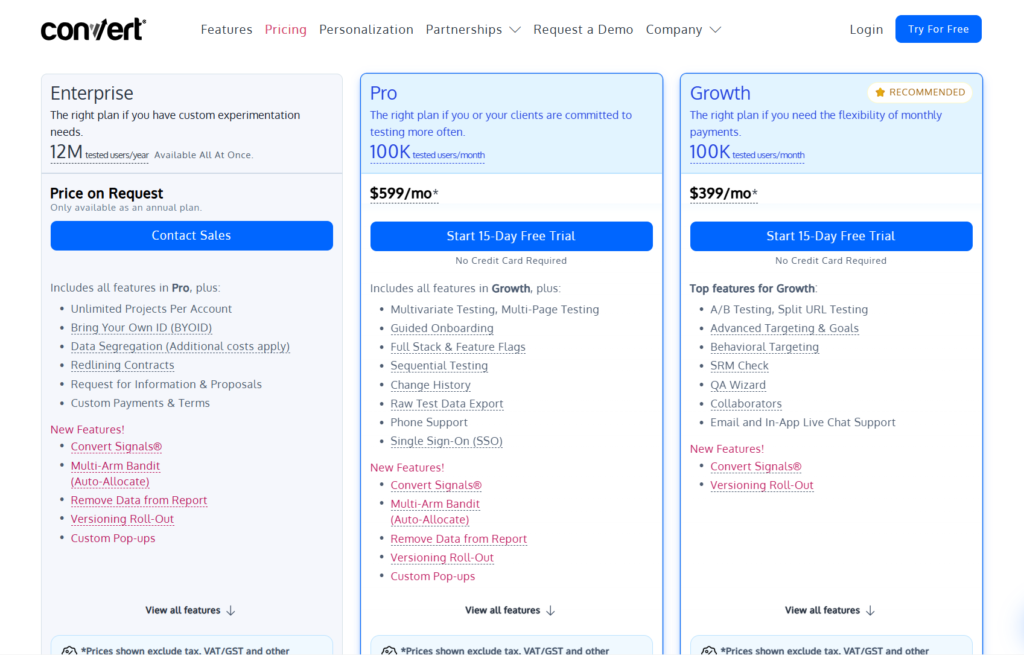
Growth Plan: $399/month (or $299/month billed annually at $3,588/year). Supports 100,000 Monthly Tested Users. Includes A/B testing, split URL testing, advanced targeting, behavioral targeting, SRM checks, QA Wizard, email and live chat support, and 90+ integrations. Best for smaller teams just building out their experimentation program.
Pro Plan: $599/month (or $420/month billed annually at $5,040/year). Supports 250,000 Monthly Tested Users. Adds multivariate testing, multi-page testing, full-stack experimentation with feature flags, sequential testing, raw data export, phone support, Single Sign-On (SSO), change history, guided onboarding, and the new Multi-Arm Bandit and Custom Pop-ups features.
Enterprise Plan: Custom pricing for teams needing over 1 million Monthly Tested Users. Includes everything in Pro plus Bring Your Own ID (BYOID), data segregation, unlimited projects, dedicated account management with weekly check-ins, custom payment terms, and contract redlining. Convert supports enterprise needs up to 1.2 billion Monthly Tested Users.
A few things worth noting about Convert’s pricing model. First, Convert never forces plan upgrades. If you are on a legacy plan, they honor that pricing. Second, all plans include full-stack experimentation on Pro and above, not as a separate paid add-on. Third, overuse is handled gracefully. If you exceed your Monthly Tested Users cap, your account stays active and you are notified at 90% and 100% thresholds, rather than being shut off mid-experiment.
Optimizely’s Pricing (Custom and Quote-Based)
Optimizely does not publish pricing. Every product in their suite requires a custom quote. Based on widely reported market data and industry conversations, Optimizely’s Web Experimentation typically starts in the range of $36,000 to $50,000 per year for a basic implementation, with costs scaling significantly for larger teams or additional product modules.
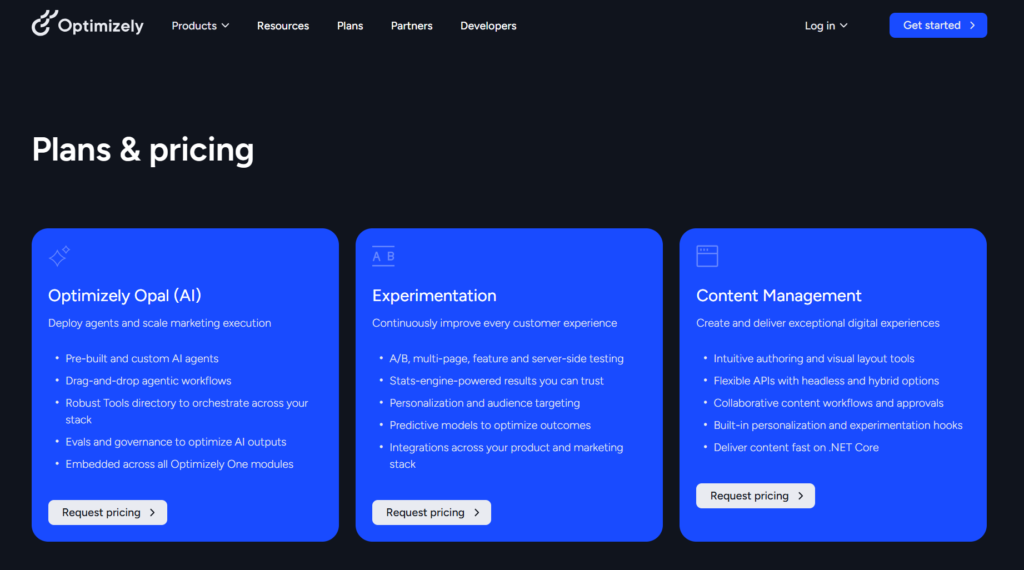
If you need Feature Experimentation, Analytics, Personalization, and CMS in addition to web testing, you are likely looking at six figures annually before professional services and implementation costs. For large enterprises with budgets to match, that pricing reflects a comprehensive platform that delivers real value. For growing companies and agencies, it is simply the wrong tool for the budget they have available.
There is no self-serve free trial for Optimizely. You need to go through a sales process, get a demo, and negotiate a contract. That friction is appropriate for a platform of this complexity, but it is a real barrier if you want to evaluate the tool before committing.
Convert vs Optimizely: Privacy, Compliance, and Data Security
Privacy has become one of the most important factors in selecting any customer-facing technology in 2026, and both platforms take it seriously. The differences, however, are worth understanding.
Convert is built around a privacy-first architecture by design, not as an afterthought. The platform uses first-party cookies exclusively, meaning it does not rely on third-party tracking infrastructure that is becoming increasingly unreliable as browser policies tighten. Its servers are based in Frankfurt, Germany, which keeps data within EU jurisdiction and simplifies GDPR compliance significantly for any business that handles European customer data.
Convert holds ISO 27001 certification, SOC 2 Type 2 compliance, and is compliant with GDPR, CCPA, HIPAA, and TTDSG. These are not marketing checkboxes. They represent independently audited security and privacy standards that matter for businesses in healthcare, financial services, and any sector handling sensitive personal data.
Additionally, Convert operates carbon-neutral EU servers, and the company donates 8% of every plan fee toward tree planting through the TIST program, 1% toward Stripe Climate, and 1% toward conservation initiatives. For companies with ESG commitments, this is genuinely meaningful.
Optimizely also maintains enterprise-grade compliance, including GDPR and SOC 2 certifications, and has robust data governance features suitable for large-scale enterprise use. Its data is primarily US-based by default, which creates additional compliance steps for businesses that need European data residency.
Convert vs Optimizely: Integrations and Ecosystem
Neither platform locks you into a silo when it comes to your existing tech stack.
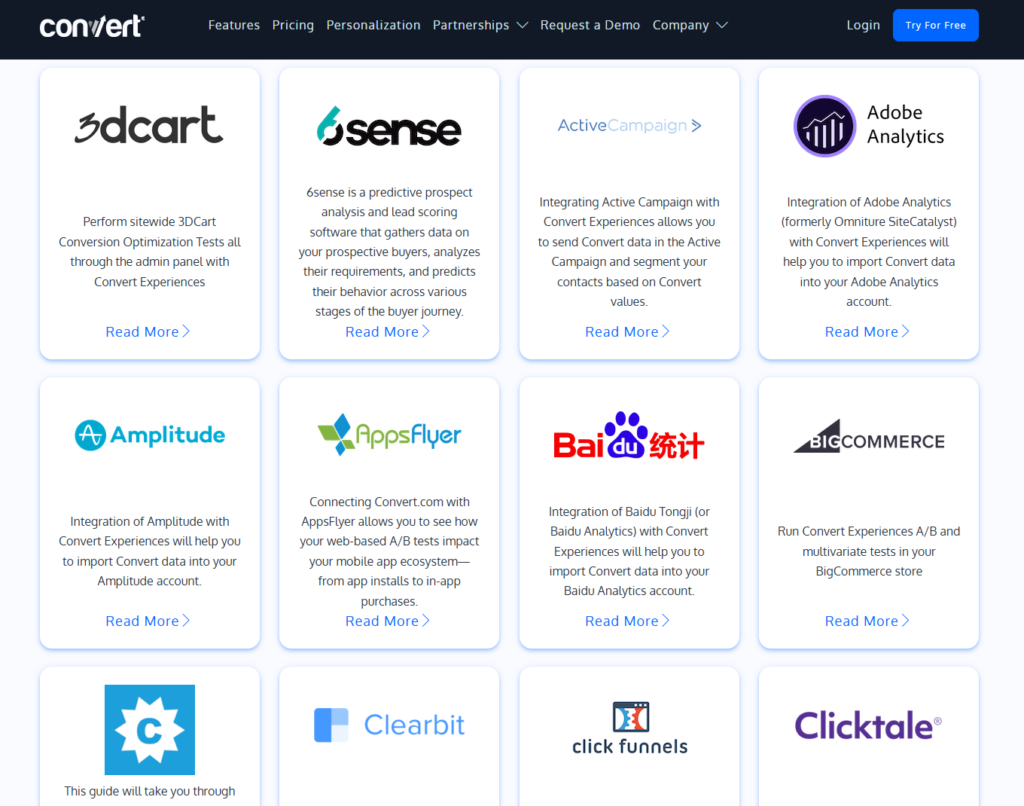
Convert supports 90+ native integrations, including Google Analytics 4, Mixpanel, Segment, Hotjar, Heap, HubSpot, Salesforce, Shopify, BigCommerce, Klaviyo, and many more. These integrations are one-tag and do not require Zapier or middleware to activate. The platform’s open API also allows custom integrations with virtually any tool in your stack.
For Shopify merchants specifically, Convert has deep A/B testing support designed for the Shopify environment, including product page testing, checkout optimization, and theme variation testing. This makes it a particularly strong choice for ecommerce brands running on Shopify who want testing fidelity without technical workarounds.
Optimizely’s integration ecosystem is broader, exceeding 100 integrations, and benefits from the platform’s status as a major enterprise vendor.
It connects natively with Salesforce Marketing Cloud, Adobe Experience Cloud, Marketo, Contentful, and a wide range of enterprise data platforms. Optimizely also integrates with its own products within the suite, which creates a unified data layer when you are using multiple Optimizely products together.
Convert vs Optimizely: Ease of Use and Setup
One of the most common frustrations teams report with enterprise experimentation platforms is the time it takes to go from contract signing to running the first live test. Months of implementation, technical scoping, and training are not unusual with large DXP platforms.
Convert is designed to move fast. The platform scores G2 badges for “Easiest Setup” in both mid-market and small business categories. Its 10-step onboarding process walks new users through snippet installation, project setup, an A/A test configuration, goal setup, and integration activation. Support during the 15-day trial is active and responsive, with an average first response time of under 12 minutes.
For agencies that manage multiple client accounts, Convert’s structure supports this well. Projects are organized cleanly, role-based permissions allow fine-grained access control, and the bulk editing and import/export template features reduce repetitive setup work across clients.
Optimizely requires a more involved implementation, particularly for teams that are adopting multiple products across the suite. The Web Experimentation product has become more accessible over the years, but setting up Feature Experimentation with SDK integration across a production engineering environment requires real technical resources.
Optimizely provides professional services and access to the Optimizely Academy for training, but these are additional investments on top of license fees.
Convert vs Optimizely: Support Quality
This is an area where Convert consistently surprises new customers, and it is worth spending real time on.
Convert’s support team is known for two qualities that are rare in SaaS: speed and depth. The average first response time, according to Zendesk performance data, is 11 minutes and 34 seconds, which the company describes as up to 4x faster than competing tools in the A/B testing space. More importantly, the support team consists of people who actually know the product deeply, not first-tier agents working from a script.
Support is available via in-app live chat, email, and phone on Pro and Enterprise plans. The team handles everything from basic setup questions to complex JavaScript debugging in multi-page experiences. Multiple G2 reviews specifically call out instances where support resolved obscure, highly customized test issues that most tools would have escalated to a developer queue and forgotten.
Optimizely’s support is structured in the way you would expect for an enterprise vendor: tiered SLAs based on contract level, a dedicated support portal, access to the developer community, and professional services available for implementation assistance.
For large enterprises with complex environments, this support model is appropriate and well-resourced. For smaller teams that need a quick answer to get a test live by Friday, Convert’s model is dramatically more practical.
Convert vs Optimizely: AI and Automation Features in 2026
AI has become a genuine differentiator in the experimentation space in 2026, and both platforms have invested meaningfully in it, though in very different directions.
Convert’s AI additions in 2026 center on the experimentation workflow. Convert Signals® surfaces behavioral patterns and suggests data-backed observations tied to your experiment results. The Multi-Arm Bandit (Auto-Allocate) feature automatically shifts traffic toward better-performing variants during a test, reducing revenue loss from underperforming variants without requiring manual intervention. These are targeted, practical additions that improve the ROI of your testing program without adding platform complexity.
Optimizely’s AI investment is far broader in scope. The Opal AI platform spans the entire Optimizely suite, functioning as an agent layer that can help marketers generate content, suggest test hypotheses, build audience segments, analyze performance data, and automate approval workflows. For large teams running coordinated campaigns across content, testing, and commerce, Opal creates genuine productivity gains. Optimizely reports a 35% increase in test impact and a 37% boost in website engagement across its user base.
The honest assessment here is that Optimizely’s AI capabilities are more expansive, but they are designed for teams with the infrastructure to support them. Convert’s AI additions are more focused but immediately actionable without a dedicated AI operations team.
Who Should Choose Convert?
Convert is the right choice if you recognize yourself in any of the following scenarios.
You are a CRO agency that manages testing programs for multiple clients. Convert’s pricing model, project structure, and agency-specific features make it the platform of choice for some of the highest-regarded optimization agencies in the world. The G2 reviews are full of agency professionals praising the combination of deep features, manageable pricing, and fast support.
You are a growing ecommerce brand on Shopify or a similar platform, with serious conversion goals and a need for a reliable, privacy-compliant testing tool that your team can actually use without a full-time developer dedicated to the platform.
You are a SaaS company or mid-market business that wants full-stack experimentation, including feature flags and server-side testing, without paying for an entire enterprise DXP suite that you will use 20% of.
You care about data privacy and compliance and want your testing data stored in the EU, processed only with first-party cookies, and audited against ISO 27001 and SOC 2 Type 2 standards.
You want transparent pricing and a vendor that will not force you to upgrade, surprise you with usage fees, or require a procurement negotiation every time your contract comes up for renewal.
Who Should Choose Optimizely?
Optimizely is the right choice if your situation matches a different set of criteria.
You are part of a large enterprise with a dedicated experimentation team, engineering resources for SDK integration, and a budget that supports a six-figure annual contract across one or more products in the suite.
You need a unified digital experience platform where your content management, A/B testing, personalization, analytics, and commerce tools are all integrated under one vendor relationship and one data model. For enterprise organizations where platform fragmentation is a real cost and governance issue, Optimizely’s consolidated suite delivers genuine operational value.
You are running feature experimentation at scale across complex engineering environments, with multiple teams using SDKs across different programming languages, and you need the level of governance, audit logging, and integrations that Feature Experimentation provides.
You have AI-powered content and experimentation requirements where Opal’s multi-agent capabilities across content creation, personalization, and test ideation can meaningfully accelerate your team’s output.
You are already invested in other parts of the Optimizely ecosystem and want a tightly integrated testing layer rather than a standalone point solution.
Convert vs Optimizely: Final Verdict
Here is the direct answer: for the vast majority of businesses reading this comparison, Convert is the better choice in 2026.
Not because Optimizely is a bad product, because it is not. It is one of the most capable digital experience platforms on the market. But Optimizely is built for a specific kind of customer: large enterprise organizations with large teams, large budgets, and complex cross-functional requirements that justify the investment in a full DXP.
Convert is built for everyone else who wants to run world-class experiments. Its pricing is fair, public, and predictable. Its features are deep enough to support sophisticated testing programs, including full-stack experimentation, multivariate testing, statistical rigor, and behavioral targeting. Its support is faster and more hands-on than almost anything else in the industry. And its privacy architecture is genuinely ahead of most tools still relying on third-party cookie workarounds.
If your primary goal in 2026 is to run more tests, get better results, and improve your conversion rates without drowning in platform complexity or budget shock, Convert delivers more value per dollar than any comparable tool on the market.
If you are a Nike, a Zoom, or a Shell-scale organization that needs an integrated platform across content, testing, personalization, and commerce, Optimizely is worth the investment conversation.
The best place to start with Convert is their 15-day free trial at convert.com, which requires no credit card and gives you access to the full feature set from day one. For Optimizely, the path starts with a demo request at optimizely.com.
Frequently Asked Questions: Convert vs Optimizely
Is Convert a good alternative to Optimizely?
Yes, particularly for SMBs, CRO agencies, ecommerce brands, and mid-market companies. Convert matches or exceeds Optimizely’s core experimentation capabilities at a fraction of the cost, with faster support and a cleaner privacy architecture.
Does Optimizely offer a free trial?
No. Optimizely requires going through a sales and demo process before any access is granted. Convert offers a 15-day free trial with no credit card required.
How does Convert’s pricing compare to Optimizely’s?
Convert’s plans start at $399/month with public, transparent pricing. Optimizely does not publish pricing and typically starts in the range of $36,000 to $50,000+ per year, depending on which products you need.
Which platform is better for CRO agencies?
Convert is the stronger choice for CRO agencies. Its project structure, role-based permissions, agency-specific account management features, and pricing model are purpose-built for agencies running experiments across multiple clients.
Which tool has better A/B testing statistics?
Both platforms are statistically rigorous. Convert’s dual Frequentist and Bayesian engine approach gives analysts more methodological flexibility, and the inclusion of Sequential Testing on Pro plans is particularly valuable for teams that need to monitor results continuously without inflating false-positive rates.
Can Convert handle enterprise-scale traffic?
Yes. Convert supports experimentation programs up to 1.2 billion Monthly Tested Users and operates on Akamai’s CDN for reliable delivery at scale. Enterprise plans include data segregation, BYOID, and custom SLAs.
Which platform is more privacy-friendly?
Convert’s architecture is privacy-first by design: first-party cookies only, EU-based servers in Frankfurt, ISO 27001 certified, SOC 2 Type 2 compliant, and fully GDPR, CCPA, and HIPAA compliant. For businesses with strong data privacy requirements, Convert’s architecture is a meaningful advantage.