
Context.dev and Brandfetch both turn a company domain into logos, colors, and company data, but they come at the job from different directions. Brandfetch is a dedicated brand data platform with an index of more than 50 million brands, free logo and search endpoints, and brand profiles that companies can claim and manage themselves.
Context.dev is a web data API whose Brand API (formerly Brand.dev) builds each record from the company’s public web presence, adds a full design-system extractor, and shares one key with scraping, search, and monitoring.
Choose Brandfetch if you want a logo CDN with generous free limits and curated, first-party brand profiles. Choose Context.dev if you want deeper design data, a lower list price per brand lookup, or a single API for brand data and web scraping.
Context.dev vs. Brandfetch at a Glance
| Context.dev | Brandfetch | |
|---|---|---|
| Best for | Brand data plus design-system data, with web scraping under the same key | Logo delivery and curated brand profiles at scale |
| Coverage | Any company with a public web presence; records built from that presence | 50M+ brands, refreshed from the open web, with first-party profiles that brands can claim |
| Ways to look up a company | Domain, work email, company name, stock ticker, transaction descriptor, or URL | Domain, plus Brand Search for name autocomplete and a Transaction API for merchant data |
| Design data | Logos and colors, plus a separate style guide call for typography, spacing, shadows, and component styles | Logos, colors, fonts, and firmographics in the Brand API |
| Free tier | 1,000 credits a month (100 brand lookups) and 10K one-time Logo Link credits | 100 brand fetches (one-time), free Logo API (1M renders a month), free Brand Search (500K a month) |
| Entry paid plan | $19 a month for 7,500 credits (750 brand lookups) | $129 a month, or $99 a month billed yearly, for 2,500 brand fetches |
| Overage per 1,000 brand lookups | $10 to $22, depending on plan | $100 |
| Beyond brand data | Scraping, crawling, search, answers, monitors | Transaction API, datasets, Brand Context API for AI agents |
| AI tooling | MCP server, CLI, SDKs in five languages | MCP, Brand Context API, Zapier, n8n, Make |
| Compliance | SOC 2 Type II | SOC 2 badge and a public trust center |
The sections below explain where each row comes from and what it means for your product.
What Is Context.dev?
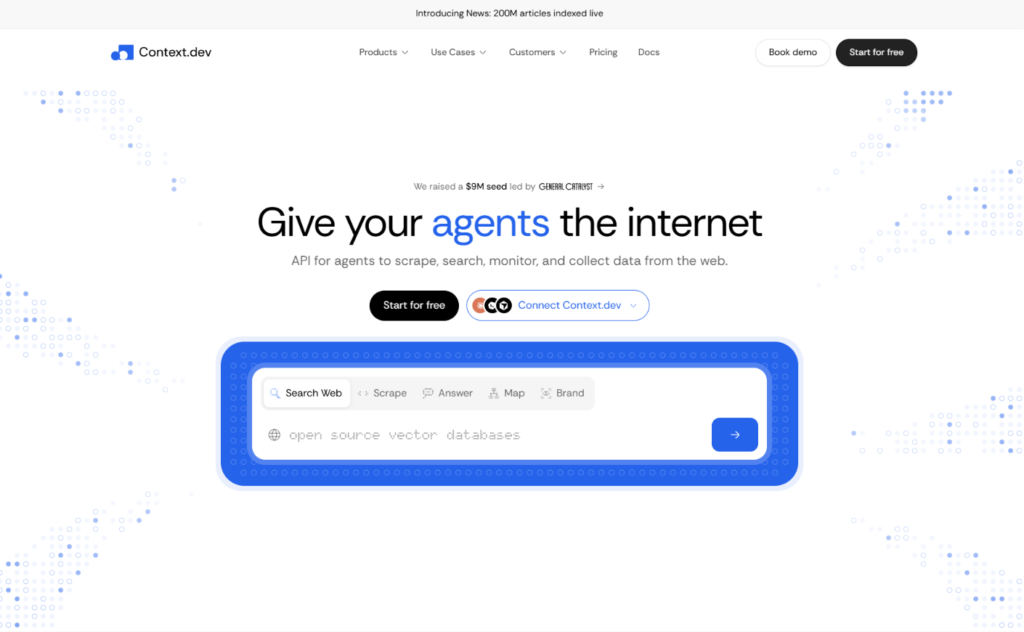
Context.dev is a web data API for developers who build AI products, and it is backed by Y Combinator. The part that matters here is its Brand API. Until March 21, 2026 that product was called Brand.dev. The company renamed itself, and existing integrations kept working without code changes.
The Retrieve Brand endpoint accepts a domain, work email, company name, stock ticker, transaction descriptor, or direct URL. It returns a company profile with logos, colors, a description, an address, social profiles, and industry labels. A second endpoint, Extract Style Guide, returns the site’s design system: typography, spacing, shadows, component styles, and font links. These are two separate requests for the same domain, and you combine the results into one record.
Logos are discovered from the company’s public presence. For a Logo API request, the engine renders the website in a headless browser, scans the HTML and meta tags, and pulls assets from official social accounts on X, LinkedIn, Instagram, and YouTube.
Each logo comes back with a media URL, light-or-dark display guidance, colors, resolution, and an icon-or-logo label. If you only need to drop a logo into an image tag, Logo Link is a separate product with its own quota.
The Brand API sits inside a wider platform that also scrapes pages to Markdown, crawls sites, runs web search, returns sourced answers, and monitors pages for changes. Customers featured on the brand side include Mintlify, daily.dev, Sunrun, and Propane.
What Is Brandfetch?
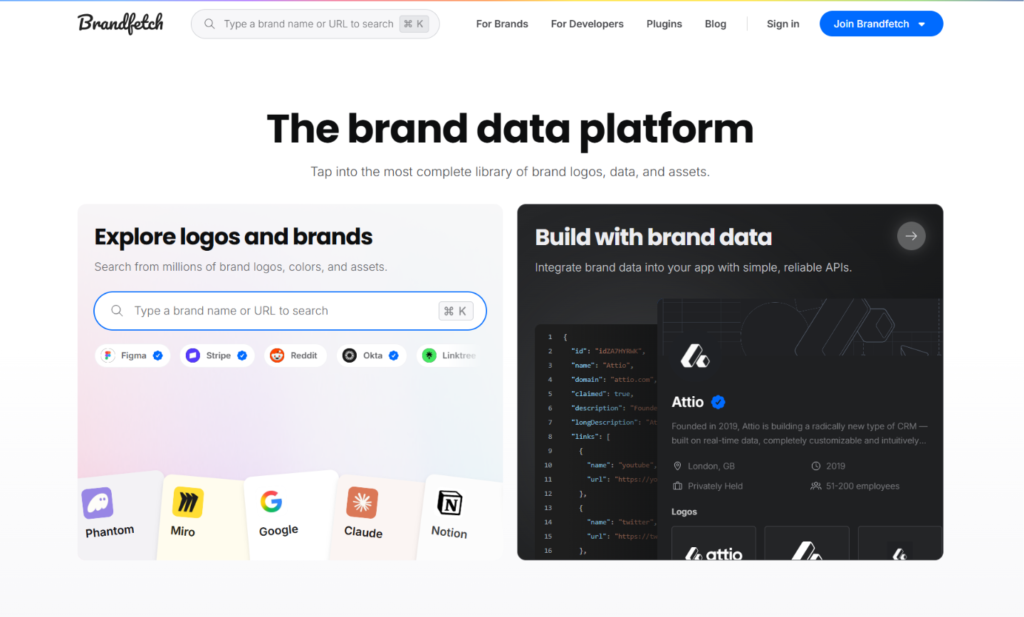
Brandfetch is a Swiss company, based in Savigny, that calls itself the leading brand data aggregator. It hosts more than 50 million brands. The business has two sides. The public site lets anyone search logos, colors, and assets, and lets brand owners claim and manage their own profile for free, with updates syncing to more than 100 partner sites. The developer side is where the company makes its money, and its FAQ says so plainly: the business model focuses on the API product.
The developer lineup has six parts:
- Brand API returns the full brand record, including logos, colors, fonts, and firmographics.
- Brand Context API supplies brand context to AI agents.
- Logo API serves logos through a CDN, with a free allowance.
- Brand Search API autocompletes brand names.
- Transaction API matches merchants in financial feeds to logos and metadata.
- Brandfetch MCP connects the data to AI assistants.
Brandfetch also sells ready-made logo datasets by industry, offers integrations with Zapier, n8n, and Make, and has a connector that puts its 50M+ brands inside Claude.
Its pricing page highlights customer results such as a 5% conversion lift at Typeform and a 675% lift at CyberRisk, plus a merchant-identification project with Envestnet | Yodlee. Those figures are vendor-reported, so read them as case studies rather than benchmarks.
Feature Comparison: Logos, Brand Data, and Design Systems
On the basics, the two overlap heavily. Both turn a domain into a logo, colors, and a company profile. The differences show up in how logos are delivered, how deep the design data goes, and what else the vendor can do for you.
Logos and logo delivery
Brandfetch built its reputation on logos. The Logo API serves images through a CDN. Logos arrive as SVG when one is available, and otherwise as the best PNG it can find, with a transparent background. The CDN links on Brandfetch’s own site include parameters for theme, size, and fallback style, such as a lettermark when no logo exists, which saves you from writing that logic yourself. The Logo API runs on its own quota, separate from brand fetches.
Context.dev offers two routes. Logo Link is an image URL for use in an img tag, sold as a separate product with its own credits and terms. The Logo API route goes through the Brand endpoint and returns the logos it discovered, each with a media URL, a mode field (light, dark, or usable on either), extracted colors, resolution, aspect ratio, and an icon-or-logo label. One caveat from its own FAQ: the API returns the assets it finds, not a guaranteed matrix of SVG, PNG, and other formats, so you need a fallback policy for missing variants.
Company profile data
Brandfetch’s Brand API returns a record with the brand’s name, domain, a short and a long description, social links, logos, colors, and fonts. Its sample record also shows firmographic details: headquarters location, founding year, ownership type, and employee range.
Context.dev’s Retrieve Brand returns logos, colors, a description, an address, social profiles, and industry labels. It stands out for how many ways you can ask. Besides a domain, it accepts a work email, a company name, a stock ticker, a transaction descriptor, or a URL. That helps when your product starts from a signup email or a messy payment string rather than a clean domain.
Both vendors say that not every field exists for every company, so handle missing values in your code. Context.dev also offers a People enrichment endpoint, at 20 credits per match.
Design systems
This is the clearest gap. Context.dev’s Extract Style Guide call returns typography, spacing, shadows, component styles, and font links from a company’s site. That is enough to theme a screen, a generated deck, or a docs site in someone else’s look. Mintlify uses Context.dev to turn a GitHub repo URL into a branded documentation site, and Comp AI builds on-brand sales decks with it. Brandfetch covers colors and fonts, but the pages reviewed list nothing like spacing, shadows, or component styles.
Search, autocomplete, and finance
Brandfetch has a dedicated Brand Search API for autocompleting brand names, with 500K free requests a month, which suits a brand picker in a signup flow. Its Transaction API matches merchants in a financial feed to logos and metadata, a use case Envestnet | Yodlee describes in its customer story. Context.dev covers the first need with a Search Brands endpoint at one credit per call, free on Pro, Growth, and Scale. It handles the second through the transaction-descriptor lookup type in Retrieve Brand.
AI agents and automation
Both have moved toward agents. Brandfetch offers a Brand Context API and an MCP server, plus a connector for Claude and no-code integrations with Zapier, n8n, and Make. Context.dev offers an MCP server, a CLI, and SDKs for TypeScript, Python, Ruby, Go, and PHP, and it frames brand lookup as entity enrichment: turn a company name that appears in a prompt into structured context in one call.
What else you get
Brandfetch can scope custom datasets covering hundreds of millions of logos for large buyers. Context.dev gives you everything else on the web through the same key: scraping to Markdown, crawling, search, sourced answers, and page monitoring. If brand data is one of several web data needs, that breadth matters. If it is your only need, it may not.
Pricing Comparison: Context.dev vs. Brandfetch
Brandfetch is the better deal if you only need logos, and Context.dev is far cheaper per full brand lookup. Brandfetch’s Logo API is free up to 1 million renders a month. Its paid brand data, though, lists at roughly $40 to $52 per 1,000 fetches on the entry plan, while Context.dev’s equivalent starts near $25 and falls below $5 at the top self-serve tier.
Context.dev pricing
Context.dev meters everything in credits. A Retrieve Brand call costs 10 credits, so a plan’s brand lookups are its credits divided by ten. Extract Style Guide also costs 10 credits per call. Searching brands costs one credit and is free on Pro, Growth, and Scale. Failed requests and blocked requests are not billed. The pricing page lists these plans:
| Plan | Price per month | Credits | Brand lookups included | Overage per 1,000 credits |
|---|---|---|---|---|
| Free | $0 | 1,000 | 100 | None |
| Developer | $19 | 7,500 | 750 | $2.20 |
| Pro | $99 | 125,000 | 12,500 | $1.80 |
| Growth | $299 | 500,000 | 50,000 | $1.40 |
| Scale | $499 | 1,000,000 | 100,000 | $1.00 |
| Enterprise | Custom | 2,000,000+ | 200,000+ | Custom |
Logo Link, the image-URL product, has separate quotas that rise by plan, from a one-time 10,000 on Free to 10 million on Scale. Annual billing saves two months, and eligible startups and nonprofits can get 30% off an annual plan for 12 months.
Brandfetch pricing
Brandfetch meters usage in brand fetches, one per call, shared across the Brand API, Brand Context API, and Transaction API. Logo renders and brand searches have separate limits. The pricing page shows:
| Plan | Price | Brand fetches | Logo renders | Brand searches |
|---|---|---|---|---|
| Free | $0 | 100, one-time | 1M a month | 500K a month |
| Growth | $129 a month, or $99 a month billed yearly | 2,500 a month, with tiers up to 10,000 | 5M a month, with tiers from 5M to 20M | 1M a month, with tiers from 1M to 5M |
| Custom | Contact sales | Over 10,000 | Over 20M | Over 5M |
Fetches reset monthly and do not roll over. Overage is $0.10 per fetch, up to a cap you set, with usage alerts at 80% and 100%. The Logo API and Brand Search API are soft-capped, so going over triggers a notification rather than a hard stop. Qualified startups and nonprofits get 40% off paid plans for the first 12 months. Custom plans add self-hosted assets, custom licensing terms, enterprise SLAs, and a dedicated account manager.
The cost of 1,000 full brand lookups
To compare the two directly, the table prices one full brand record per lookup. It uses each vendor’s list price and leaves out logo-only traffic.
| Context.dev | Brandfetch | |
|---|---|---|
| Entry plan, per 1,000 lookups | About $25 (Developer: $19 for 750 lookups) | $51.60 monthly, or $39.60 billed yearly (Growth: 2,500 fetches) |
| Best self-serve rate | $4.99 (Scale: $499 for 100,000 lookups) | Tiers to 10,000 fetches; custom pricing above that |
| Overage, per 1,000 lookups | $10 to $22, depending on plan | $100 |
Two monthly examples show what that means in practice:
- 2,500 brand lookups a month. Context.dev costs about $58.60: the $19 Developer plan plus 18 overage blocks of 1,000 credits at $2.20. Brandfetch Growth costs $129 monthly or $99 billed yearly.
- 12,500 brand lookups a month. Context.dev’s $99 Pro plan covers this exactly, with 125,000 credits. On Brandfetch this volume sits above the 10,000-fetch ceiling of the Growth tiers, so it falls under custom pricing.
There are caveats. Context.dev bills a full brand and style guide record as 20 credits, double the figures above. Brandfetch’s records may include curated, brand-claimed data that Context.dev’s discovered records do not, which can justify a premium. And for logo-only workloads, the comparison flips: Brandfetch’s free 1M renders a month is far more generous than Context.dev’s Logo Link allowance on its Free plan.
Concurrency and rate limits
Context.dev caps concurrent requests by plan: 1 on Free, 10 on Developer, 100 on Pro, 250 on Growth, and 500 on Scale. A bursty onboarding flow could hit the Free or Developer ceiling before it hits the credit limit. Brandfetch’s pricing page does not list a concurrency figure, so ask its team if your traffic spikes.
Data Quality, Coverage, and Freshness
Brandfetch’s edge is curation, and Context.dev’s edge is control. Neither company publishes an independent accuracy benchmark, so the useful question is how each one keeps data current and what you can do when a record is wrong.
How Brandfetch keeps data fresh
Brandfetch layers several sources. An API request triggers a background recrawl if the brand has not been refreshed in three months, so popular brands stay current through use. Claimed brands are managed by their owners, who can edit a profile after verifying a work email on the brand’s domain.
Curated brands are looked after by a QA team that tracks rebrands, and crowdsourced updates arrive from users of its plugins and integrations. Brandfetch also says it is the only platform with first-party brand data, since owners can claim profiles. It is open about the other side: it does not obtain each brand’s permission, and the rest of its data is aggregated from public sources.
How Context.dev keeps data fresh
Context.dev builds a record from the company’s public web presence and may reuse previously collected data. The maxAgeMs setting defaults to about 90 days and accepts anything from 0 to one year, where 0 asks for a fresh retrieval.
That gives you a dial: pay the lookup cost again for a new pull, or accept cached data. The company is clear about the limit. It does not guarantee that a response reflects a rebrand right after it happens, and it points to an update form for specific corrections. It also advises treating returned media URLs as external resources your application should handle defensively.
The two refresh windows are close in practice, at roughly three months each. The difference is who can intervene. On Brandfetch, a brand owner can fix a profile and the fix propagates. On Context.dev, you control the cache age, and corrections go through a request form.
How to test both on your own users
A small test will tell you more than any claim. This is a method that works for most product teams:
- Build a list of 100 to 200 domains drawn from your real traffic, mixing large brands, funded startups, small local businesses, non-US companies, and a few that rebranded recently.
- Run the list through both APIs and record whether each returns a logo, a color palette, and a description.
- Check each logo by eye. Look for the wrong mark, such as a partner badge or a favicon, and for variants that work on both light and dark backgrounds.
- Compare colors and fonts against each company’s own site, and read a sample of descriptions for accuracy.
- Divide your total spend by the number of records you could actually ship, and compare that cost per usable record.
Both vendors have free tiers, so this test costs nothing.
Developer Experience, Licensing, and Support
Both are quick to start with, so the more important differences are in licensing and caching terms. Read those before you build.
Getting started
Context.dev is self-serve. You sign up, copy an API key, install an SDK, and call the API. Official SDKs cover TypeScript, Python, Ruby, Go, and PHP, and there is a playground, a CLI, and an MCP server. Architect’s CPTO and Mintlify’s engineering manager both describe integrating in about ten minutes.
Brandfetch has a developer portal with sign-up, documentation, and a playground. Its plan comparison lists REST API, Logo CDN, MCP, webhooks, GraphQL, and data shares as delivery methods, so check which ones your plan includes.
Licensing and caching rules
This is where brand data differs from most APIs. Brandfetch says you may use its data commercially for internal use cases, such as showing a logo in your app. Sublicensing the data to your customers, or including it in your own API responses, needs a specific agreement. It also gives caching guidance: Brand API responses can be cached for 30 days to reduce credit use, and Logo API images can be cached locally under its usage guidelines. It publishes a logo fair-use guide as well.
Context.dev tells you to cache the Brand response according to your needs and to handle returned media URLs defensively. Read its terms and DPA if you plan to redistribute data. In both cases, remember that logos are trademarks. A vendor’s license does not change what the trademark owner allows, so follow each brand’s own usage rules, especially in ads or anything that implies a partnership.
Support and service levels
- Context.dev: email support on every plan, Slack from Pro, priority support from Growth, and a dedicated Slack channel plus a 99.9% uptime SLA on Enterprise.
- Brandfetch: best-effort support on Free, priority support on Growth, and a dedicated account manager, enterprise SLAs, and priority brand QA on Custom plans.
Both publish a status page. If you need a named contact and contractual uptime, both reserve that for their top tiers.
Security and Compliance
Both vendors show a SOC 2 credential and a public trust center, which covers the baseline most procurement teams ask for. Context.dev states that it is SOC 2 Type II compliant and links a trust center. Its Enterprise tier adds SSO and SAML, SCIM provisioning, and an MSA and DPA. Brandfetch displays a SOC 2 badge that links to its own trust center, and its parent company, Brandfetch SA, is based in Switzerland.
Brand data is mostly business information, but two details deserve a look. First, Context.dev lets you look up a company by work email. That means an email address, which is personal data, travels to the API. If you only need the company, sending just the domain part is a simpler choice. Second, Context.dev’s People enrichment endpoint returns person-level data, so its use carries the obligations that come with any personal data. Brandfetch’s brand records center on companies.
On data provenance, Brandfetch says its records come from public sources plus profiles that owners claim, without seeking each brand’s permission. Context.dev builds records from public web signals. Neither arrangement removes your own duty to check how you use the data, and a lawyer should review any plan that redistributes it.
Which One Should You Choose?
Choose by what you display and how often you look things up. A few patterns cover most teams.
Choose Context.dev if you:
- Need design data beyond logos and colors, such as typography, spacing, shadows, and component styles, to theme a screen, deck, or docs site.
- Start from a work email, company name, stock ticker, or payment descriptor instead of a clean domain.
- Run from a few hundred to roughly 100,000 full brand lookups a month and want the lowest list price per record.
- Want brand data, scraping, search, and monitoring under one API key.
- Build AI agents that need to turn a company mention into structured context.
Choose Brandfetch if you:
- Mainly need logos at high volume and want a free CDN allowance of 1 million renders a month.
- Value first-party profiles that brand owners can claim and keep current.
- Need brand-name autocomplete for a signup or picker, with 500K free searches a month.
- Work in fintech and need merchant logos for transaction feeds.
- Want custom datasets of hundreds of millions of logos, self-hosted assets, or custom licensing terms.
Can you use both?
Yes, and the split is natural. Use Brandfetch’s free Logo CDN to show logos across your product, and call Context.dev when you need a style guide, an email-based lookup, or other web data. Since both have free tiers, you can wire up each one before deciding where your paid volume should go.
Pros and Cons
This table sums up where each product shines and where it asks for a compromise.
| Strengths | Trade-offs | |
|---|---|---|
| Context.dev | Style guide extraction (typography, spacing, shadows, components); six lookup types, including work email and ticker; lower list price per full brand lookup; one key for brand data and web scraping; SOC 2 Type II | Logo formats are not guaranteed; brand and style guide are two separate paid calls; no first-party claimed profiles; no published brand count; concurrency capped by plan |
| Brandfetch | 50M+ brands; first-party profiles that owners can claim; free Logo API (1M renders a month) and Brand Search (500K a month); Transaction API for merchants; custom datasets | Higher price per brand fetch and $0.10 overage; only 100 free brand fetches, one-time; narrower scope than a web data platform; sublicensing requires a separate agreement |
Frequently Asked Questions
Is Context.dev a good Brandfetch alternative?
Yes, especially if you want design-system data or a lower price per full brand lookup. It is a weaker fit if your main need is a high-volume free logo CDN or brand-owner-claimed profiles, which are Brandfetch’s strengths.
Which is cheaper, Context.dev or Brandfetch?
For full brand records, Context.dev is cheaper at list price: about $25 per 1,000 lookups on its entry plan and $4.99 on Scale, against $39.60 to $51.60 on Brandfetch’s entry plan. For logos alone, Brandfetch is cheaper because its Logo API is free up to 1 million renders a month.
Which has the better free tier?
It depends on the job. Context.dev gives 1,000 credits a month, or 100 brand lookups, and the allowance renews. Brandfetch gives 100 brand fetches once, but its free Logo API and Brand Search allowances are large and monthly.
Which one returns more design data?
Context.dev. Its Extract Style Guide call returns typography, spacing, shadows, component styles, and font links. Brandfetch’s Brand API returns logos, colors, and fonts.
Is Context.dev the same as Brand.dev?
Yes. Brand.dev was renamed Context.dev on March 21, 2026. Existing Brand.dev integrations kept working without code changes.
Can I use either one as a Clearbit alternative?
Both position themselves that way. Context.dev notes that the Clearbit Logo API shut down on December 1, 2025, and it publishes a migration guide that maps logo-by-domain to Logo Link and company profiles to Retrieve Brand. Brandfetch publishes its own Clearbit comparison page. Test both on your own domains before you switch.
Can I look up a company by email or ticker?
Context.dev can: Retrieve Brand accepts a work email, company name, stock ticker, transaction descriptor, or URL in addition to a domain. The Brandfetch pages reviewed describe domain-based lookups, with a separate Brand Search API for names.
Do both have an MCP server?
Yes. Context.dev offers an MCP server and a CLI. Brandfetch offers an MCP server and a connector for Claude.
Can I resell or redistribute the data?
Not freely. Brandfetch says that sublicensing its data or including it in your own API responses requires a specific agreement. Check Context.dev’s terms for your plan, and talk to a lawyer before building a product on redistributed brand data.
Final Verdict: Context.dev vs. Brandfetch
Context.dev wins on depth and price for full brand records, and Brandfetch wins on logo delivery and curated, first-party data. If you theme interfaces, generate on-brand documents, or need web data alongside brand data, start with Context.dev. If you mostly display logos at volume, want owner-claimed profiles, or work with merchant data in fintech, Brandfetch is the more natural home.
The cheapest way to decide is a short test. Take 100 domains from your real traffic, run them through the Context.dev free tier and the Brandfetch free plan, and compare how many records you can ship and what each costs. Your own domains will tell you more than any comparison, including this one.
