
Choosing a website builder usually means choosing a philosophy. Do you want a polished, closed platform where everything is designed to work together? Or do you want an open ecosystem where you own the files and can add almost any feature you can imagine? Framer and 10Web sit on opposite sides of that choice.
Framer is a design-first, no-code website builder with its own editor, CMS, and hosting. 10Web is an AI website builder that generates real WordPress sites, then hosts them on managed cloud infrastructure with built-in speed optimization. Both promise a professional website in a short time. Both use AI to help you get started. But what you end up with, and what it takes to keep that site running, is very different.
The short answer: choose Framer if you want a beautifully designed, fast, low-maintenance marketing site that you can build visually and publish quickly. Choose 10Web if you want WordPress, with its plugins, WooCommerce, and portability, but with AI doing the setup and a managed host handling the technical work. Framer is the stronger choice for design-led sites. 10Web is the stronger choice for content-heavy sites, online stores, and anyone who values owning their site files.
This guide compares Framer and 10Web across ease of use, design, features, SEO, performance, e-commerce, ownership, maintenance, and pricing, so you can pick the right one with confidence.
Framer vs. 10Web: Quick Comparison
| Category | Framer | 10Web |
|---|---|---|
| What it is | A visual no-code website builder with a built-in CMS and hosting | An AI website builder that creates WordPress sites with managed hosting |
| Best for | Marketing sites, portfolios, landing pages, startups, design-led brands | Blogs, business sites, online stores, agencies, WordPress users |
| Platform underneath | Proprietary Framer platform | WordPress, with an Elementor-based editor |
| Design control | Very high, with animation and pixel-level precision | Good, though bound by WordPress themes and the editor |
| AI features | AI page and layout generation inside the editor | AI site generation, content, images, and site recreation |
| E-commerce | No native store; relies on integrations | WooCommerce-based store tools |
| Plugins and extensions | Smaller marketplace of plugins and components | The full WordPress plugin ecosystem |
| Hosting | Included | Managed Google Cloud hosting included |
| Site ownership | No code export | Standard WordPress, which can be exported |
| Maintenance | Handled by Framer | Mostly handled, but WordPress concepts still apply |
| Typical paid cost | Roughly $10 to $30 per month per site | Roughly $10 to $23 per month for individual plans, with agency plans higher |
| Learning curve | Moderate | Low to start; moderate if you want to customize deeply |
What Is Framer?

Framer is a visual website builder with a design-tool feel. If you have used Figma, the canvas, frames, stacks, and components will look familiar. You design pages, add animations and interactions, connect a CMS, and publish to a live site without leaving the editor. Hosting, security certificates, and delivery are handled for you.
Its strengths are design control, a built-in toolkit for marketing teams (CMS, localization, redirects, A/B testing), and flexibility for developers who want to add custom code or React components. Framer also includes AI tools that draft pages and layouts for you to refine. It revised its plans in mid-2026, adding AI credits and changing editor pricing, so check current details before you buy.
The defining trait is that it is one product. Design, content, and hosting all live in the same place, and you never touch a plugin.
What Is 10Web?
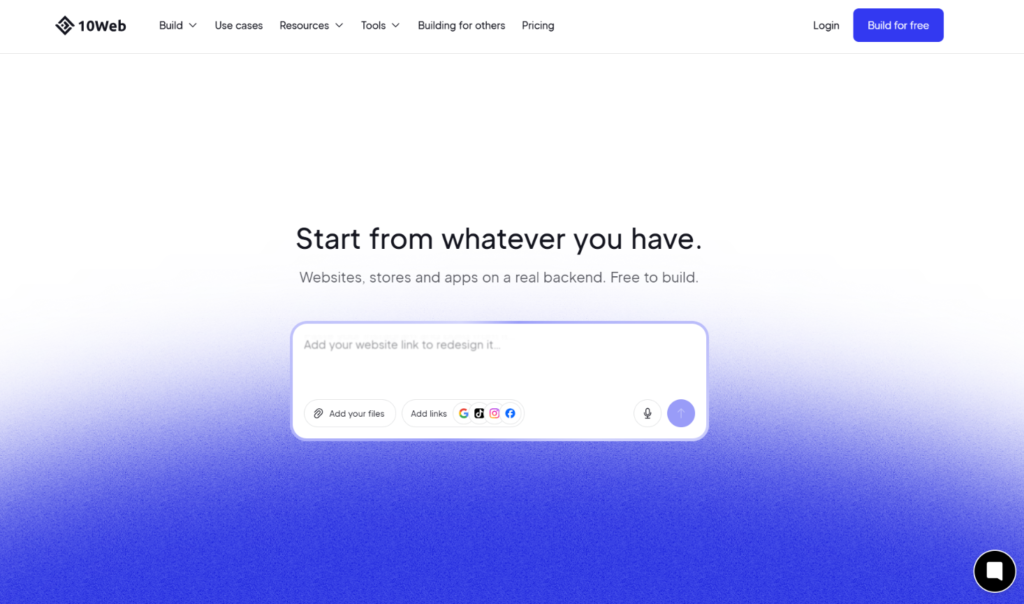
10Web is an AI-powered website builder and hosting platform built around WordPress. You describe your business, and the AI generates a complete site with pages, layouts, copy, and images. You can also point it at an existing website and ask it to recreate that site on WordPress. The result is a standard WordPress installation running on managed hosting on Google Cloud, with an Elementor-based editor for visual changes.
The platform adds several extras on top of the usual WordPress setup. It offers a PageSpeed Booster that aims for 90-plus performance scores, an AI e-commerce builder, a WordPress AI assistant, and marketing tools. Reviewers describe it as managed WordPress with an AI layer on top, rather than a replacement for WordPress.
That last point matters. Because the output is real WordPress, you inherit everything good about the platform, including its huge plugin library and large community, and everything that comes with it, including updates, plugin compatibility, and security considerations.
The Core Difference: A Closed Platform vs. an Open One
A simple way to think about it: Framer is like buying a well-designed apartment in a managed building. The layout is thoughtful, the maintenance is handled, and everything works together. You cannot knock down walls, and you cannot take the apartment with you when you leave. 10Web is like buying a house on land you own, with a property manager looking after the heavy work. You have more freedom to build and change things, and you can sell or move the property, but it is a larger system with more moving parts.
Neither is better in every case. If you want simplicity and a high-end look with minimal fuss, the apartment wins. If you want flexibility, ownership, and an ecosystem of add-ons, the house wins.
The real question is, “Do I value simplicity and design polish, or flexibility and ownership?”
Ease of Use and Learning Curve
Framer has a moderate learning curve. Concepts like stacks, breakpoints, and component variants take a little time, but designers pick them up quickly, and beginners can start from templates. Because the editor is visual and self-contained, you rarely need to leave it.
10Web is easy to start. You answer a few questions, and the AI builds a draft site within minutes. The ease starts to taper off when you want to customize. You will work in an Elementor-style editor, manage WordPress settings, and possibly install plugins. Reviewers note that people with some WordPress knowledge get the most from the platform, and that the AI output is a starting point rather than a finished product.
Verdict: 10Web is faster to a first draft. Framer is simpler to live with day to day.
Design Quality and Customization
Framer gives you fine control over typography, spacing, layout, and motion. You can build scroll animations, hover effects, page transitions, and interactive components without code, then reuse them across the site. The result tends to look distinctive and modern, which is why design-minded teams favor it.
10Web’s design quality depends on the theme, the AI output, and the effort you put into the editor. Elementor is a capable page builder, and WordPress offers thousands of themes. You can reach a very polished result, but doing so usually takes more work than with Framer, and animations and fine spacing are harder to control. AI-generated layouts can also look similar to each other unless you customize them.
Verdict: Framer for distinctive, brand-led design. 10Web for flexibility within the WordPress world.
Features and Functionality
Framer is excellent for pages, content, and marketing features. You get a CMS for blogs and case studies, localization, redirects, forms, and A/B testing. It connects to outside tools for more advanced needs, but it does not run custom server logic.
10Web inherits WordPress’s depth. You can add membership systems, booking tools, forums, learning platforms, directories, SEO plugins, and thousands of other extensions. Almost any feature a website could need exists as a WordPress plugin. That breadth is the main reason WordPress powers a large share of the web.
The trade-off is complexity. More plugins mean more updates to manage, more chances for conflicts, and more ways for performance to slip.
Verdict: Framer for focused, polished sites. 10Web for feature-rich sites that need extensions.
CMS, Blogging, and Content Management
Framer’s built-in CMS is clean and easy to use. Marketers can create collections for blog posts, case studies, or resources, then design templates that display each entry. Editing content does not touch layout, and new entries turn into new pages automatically.
WordPress was built as a publishing platform, and it remains one of the best for content. Categories, tags, authors, scheduled posts, revisions, comments, and a huge range of editorial plugins come standard or as add-ons. For a large blog, a news site, or a content business, this depth is a real advantage.
Verdict: A tie for small blogs. 10Web for large, content-heavy publishing operations.
SEO and Performance
Google does not favor a site because of the tool that built it. It rewards crawlable, fast, mobile-friendly pages with helpful, original content. Both platforms can support that goal.
Framer gives you direct control over page titles, meta descriptions, clean URLs, headings, alt text, redirects, sitemaps, and structured data through custom code. It publishes pages on a lean foundation that helps with Core Web Vitals, and marketers can manage everything themselves.
WordPress has a mature SEO ecosystem. Popular SEO plugins add guided optimization, schema markup, sitemap control, and content analysis. 10Web layers speed work on top, including managed hosting on Google Cloud and a PageSpeed Booster that advertises 90-plus scores. Those claims are worth testing on your own pages, since real results depend on your theme, images, and plugins.
One caution applies to 10Web. Its speed tools work best while you stay on its hosting. If you later move the site elsewhere, you will have to rebuild the optimization and caching setup yourself.
Verdict: A tie in capability. Framer is leaner by default. 10Web offers deeper SEO tooling through plugins.
E-Commerce
This is a clear win for 10Web.
Framer has no native e-commerce system. You can connect services such as Shopify, Stripe, or Lemon Squeezy to sell a handful of products or digital goods, but it is not built for a full store.
10Web builds on WooCommerce, the most widely used WordPress store plugin, and adds AI tools for product pages and descriptions. You get inventory, variants, shipping rules, taxes, coupons, and a large library of payment and shipping extensions. For a small or medium-sized store, that is a complete solution. For a very large or complex store, dedicated platforms like Shopify may still be a better fit.
Verdict: 10Web, by a wide margin.
Hosting, Security, and Maintenance
Framer handles hosting, SSL certificates, and updates. Since there are no plugins and no server software to manage, the maintenance burden is very small, and the platform is mature.
10Web includes managed WordPress hosting, along with automatic backups, security features, and update handling. That removes much of the usual WordPress work. Even so, WordPress is a larger system. Themes and plugins still need to be chosen carefully, kept current, and trusted, because an outdated or poorly built plugin can cause errors or open security gaps. A managed host reduces that risk, but it does not remove it.
Verdict: Framer for the lowest maintenance. 10Web for managed WordPress with more freedom.
Site Ownership and Portability
This is a major difference.
Framer does not let you export your site as standalone code. Your site lives on Framer’s platform, so a future move means rebuilding pages and setting up redirects.
With 10Web, you get a standard WordPress site, which can be exported and moved to another host. That is a real advantage for anyone who worries about being locked in. The practical caveat is that the speed optimizations and CDN setup tied to 10Web’s hosting will not move with you automatically.
Verdict: 10Web, clearly, for portability and ownership.
AI Features
Both tools use AI, but in different ways.
10Web’s AI is central to its offer. It generates full sites from a description, writes content, creates images, recreates existing sites, and assists inside WordPress. Plans include AI credits that meter generation and editing work, and reviewers note that paid plans include generous image generation.
Framer’s AI helps you draft pages and layouts inside the editor, which you then refine visually and publish. In 2026 it introduced AI credits as part of its pricing.
In both cases, AI output is a starting point. Generated copy needs rewriting to sound like your brand, and layouts need editing to stand out.
Verdict: 10Web for whole-site generation. Framer for AI help inside a design workflow.
Collaboration and Team Workflows
Framer supports real-time collaboration, comments, and quick publishing, which suits small teams of designers, marketers, and developers. Extra editors are billed separately from site plans.
10Web leans toward agencies and freelancers. It offers agency plans for managing multiple client sites, along with tools for white-labeling and managing WordPress at scale. WordPress itself supports user roles and editorial workflows through plugins.
Verdict: Framer for design teams. 10Web for agencies managing many WordPress sites.
Pricing: Framer vs. 10Web
Both companies change plans often, so treat the figures below as approximate and confirm them on each official pricing page.
Framer pricing
- Free: A framer.website subdomain with a Framer badge.
- Basic: Around $10 per month per site, billed annually.
- Pro: Around $30 per month per site, billed annually.
- Enterprise: Custom pricing.
Framer charges per site, and extra editors are billed on top. Hosting and the CMS are included.
10Web pricing
Based on pricing guides verified in mid-2026, 10Web’s individual AI builder plans were listed at roughly:
- AI Starter: About $10 per month on a 12-month term.
- AI Premium: About $15 per month on a 12-month term.
- AI Ultimate: About $23 per month on a 12-month term.
- Agency plans: Starting around $112 per month.
Plans include managed hosting, SSL, and AI tools. Some reviews mention a free plan or trial for one site, but details vary by source, so confirm what is currently offered.
What the sticker price leaves out
Introductory prices and annual terms can make costs look lower than they are. Check renewal pricing, which often rises after the first term, and the limits on AI credits, websites, and storage. With WordPress, you may also pay for premium themes, plugins, or SEO tools. With Framer, you may pay for extra editors and AI credits.
Some reviewers also point out that 10Web costs more than basic shared WordPress hosting, though you are paying for managed hosting and AI tools in return.
Verdict: Similar entry prices. Framer for simple, predictable sites. 10Web for value when you need WordPress features.
Limitations to Know Before You Choose
Framer limitations
- No native e-commerce
- No code export, so your site stays on Framer’s platform
- Smaller plugin and extension ecosystem
- Editors are billed separately
10Web limitations
- WordPress knowledge helps, and the learning curve grows with customization
- Plugin updates and compatibility still need attention
- Design polish takes more effort than in a design-first editor
- Speed optimizations are tied to its hosting
- AI credits can limit heavy use
- Pricing can rise at renewal
Can You Use Framer and 10Web Together?
Yes, though it takes planning. Some businesses use Framer for a high-impact marketing site and WordPress for a blog or store on a subdomain. For example, your main site might live at your primary domain on Framer, while a WooCommerce shop runs at a subdomain hosted on 10Web. Keep branding consistent, link between the two clearly, and set up analytics so you can see the whole customer journey.
This split works best when the two parts have different needs. For most small sites, choosing one platform keeps things simpler.
Who Should Choose Framer?
Framer is the better choice if you:
- Want a beautifully designed marketing site, portfolio, or landing page
- Prefer a visual editor with strong animation control
- Want hosting, CMS, and SEO controls in a single product
- Do not want to manage plugins, themes, or updates
- Value speed and simplicity over flexibility
- Do not need a full online store
Who Should Choose 10Web?
10Web is the better choice if you:
- Want a WordPress site without the usual setup work
- Need e-commerce, memberships, bookings, or other plugin-based features
- Plan to publish a lot of content
- Care about owning your site and being able to move it
- Manage multiple client sites as an agency or freelancer
- Are comfortable with some WordPress concepts
Real-World Scenarios
A freelance designer building a portfolio. Framer. Design control and a clean, fast result fit the job.
A small business that wants to sell 100 products online. 10Web. WooCommerce gives you a real store with inventory and shipping.
A SaaS startup launching a marketing site. Framer. The design, CMS, and A/B testing suit a growth team.
A blogger planning to publish daily. 10Web. WordPress’s editorial tools and plugin ecosystem are built for it.
An agency managing 30 client sites. 10Web, for its agency plans and WordPress tooling, or Framer for design-led client work.
A local restaurant that wants a menu and contact form. Either. Framer will look sharper. 10Web may be easier to extend with reservations.
How to Decide: A Short Checklist
- Do you need a store, memberships, or many plugins? If yes, lean 10Web.
- Is design polish your top priority? If yes, lean Framer.
- Do you want to own and move your site files? If yes, lean 10Web.
- Do you want the lowest possible maintenance? If yes, lean Framer.
- Will you publish lots of content? If yes, lean 10Web.
Try Framer’s free plan and a 10Web trial or plan, build the same simple page in each, and see which workflow feels natural.
Frequently Asked Questions
Is 10Web a website builder?
Yes. 10Web is an AI website builder that generates WordPress sites and hosts them on managed cloud infrastructure. It combines site creation, hosting, and performance tools.
Is Framer better than 10Web?
It depends on your goals. Framer is better for design-led sites with minimal maintenance. 10Web is better for WordPress features, e-commerce, content-heavy sites, and ownership.
Is 10Web a WordPress site?
Yes. Sites built with 10Web run on WordPress, so you can use WordPress plugins and themes and export the site if you want to move it.
Does Framer use WordPress?
No. Framer is its own platform with its own editor, CMS, and hosting.
How much does 10Web cost?
Reported individual plans run from about $10 to $23 per month on annual terms, with agency plans starting higher. Confirm current prices and renewal rates on 10Web’s website.
Does Framer have a free plan?
Yes. You can publish on a framer.website subdomain for free. Paid plans add a custom domain and higher limits.
Which is better for SEO, Framer or 10Web?
Both can rank well. Framer provides strong built-in controls and lean pages. WordPress, which powers 10Web, adds a mature SEO plugin ecosystem. Rankings depend more on content quality and authority than on the platform.
Can I sell products with Framer?
Only through integrations such as Shopify, Stripe, or Lemon Squeezy. For a full online store, 10Web with WooCommerce or a dedicated e-commerce platform is a better fit.
Can I export my site from Framer?
No. Framer sites are hosted on Framer’s platform and cannot be exported as standalone code.
Can I move my 10Web site to another host?
Yes, since it is a standard WordPress site. Keep in mind that speed optimizations tied to 10Web’s hosting may need to be rebuilt elsewhere.
What are the best alternatives to Framer and 10Web?
For Framer, common alternatives are Webflow, Wix, and Squarespace. For 10Web, alternatives include Hostinger’s AI builder, WordPress.com, Elementor, and other managed WordPress hosts.
Final Verdict: Framer or 10Web?
Framer and 10Web both help you launch a professional site quickly, but they reflect two different ideas about what a website should be.
Choose Framer if you want a polished, fast, design-led website with a built-in CMS, simple pricing, and almost no maintenance. It is the better tool for marketing sites, portfolios, landing pages, and brands that care about how their site looks and feels.
Choose 10Web if you want the flexibility and ownership of WordPress, with AI handling the setup and managed hosting handling the technical work. It is the better tool for online stores, content-heavy sites, and businesses that need plugins and the freedom to move.
If you are still unsure, let the project decide. A site that needs to look exceptional points to Framer. A site that needs to do many things, sell products, or grow into something larger points to 10Web. Start with the free or trial options, test your real use case, and confirm current features and prices on each company’s official pages before you commit.
