
You are looking at two tools that regularly appear side-by-side in CRO research, yet they are solving fundamentally different problems. Convert is a dedicated A/B testing and experimentation platform. Crazy Egg is a behavioral analytics tool that also offers A/B testing.
Both have legitimate roles in a conversion optimization workflow, but choosing the wrong one as your primary CRO platform means either paying for capabilities you cannot fully use or running experiments on an engine that was not built to carry that load.
This comparison does not hedge. It gives you a direct, accurate breakdown of Convert vs Crazy Egg across every category that matters in 2026, from testing depth and statistical rigor to pricing, privacy, support, and the type of team each tool actually serves. By the time you finish reading, you will know exactly which platform belongs in your stack, and why.
Quick Comparison: Convert vs Crazy Egg at a Glance
| Feature / Category | Convert | Crazy Egg |
|---|---|---|
| Primary Focus | A/B testing and full-stack experimentation | Behavioral analytics, heatmaps, and basic A/B testing |
| Best For | CRO teams, agencies, ecommerce, mid-market SaaS | Beginners, small businesses, UX research teams |
| Pricing Model | Tested user-based, starts at $399/mo | Pageview-based, starts at $29/mo (billed annually) |
| Free Trial | 15-day free trial, no credit card required | 30-day free trial available |
| A/B Testing | Core product, advanced capability | Available on Plus plan ($99/mo) and above |
| Multivariate Testing | Yes (Pro and Enterprise plans) | No |
| Full-Stack / Server-Side Testing | Yes (Pro and Enterprise plans) | No |
| Feature Flags | Yes | No |
| Heatmaps | Experimental heatmaps included | Core feature, 5 heatmap types |
| Session Recordings | No native recording tool | Yes, available on all paid plans |
| Stats Engine | Frequentist and Bayesian (both included) | Basic, no published statistical methodology |
| SRM Checks | Yes, included on all plans | No |
| Collision Prevention | Yes | No |
| Flicker-Free Technology | Yes, SmartInsert™ since 2016 | Flicker issues reported by users |
| Surveys | No native surveys | Yes, unlimited surveys on all plans |
| CTAs / Popups | Yes (Pro and Enterprise, Custom Pop-ups) | Yes, CTA and popup builder included |
| Sequential Testing | Yes (Pro and Enterprise) | No |
| API Access | Yes, included | No API available |
| Integrations | 90+ native integrations | Third-party script-based integrations |
| Privacy Compliance | GDPR, CCPA, HIPAA, SOC 2 Type 2, ISO 27001 | Basic compliance, no published certifications |
| First-Party Cookies | Yes, exclusively | Pageview tracking, cookie-dependent |
| EU Data Storage | Yes, Frankfurt, Germany | No |
| SAML SSO | Yes (Pro and Enterprise) | Enterprise plan only |
| Support Speed | Avg. first response under 12 minutes | Email, chat, and phone support |
| Mobile / App Testing | Full-stack SDK-based | Website only |
| Carbon-Neutral Servers | Yes | Not stated |
What Is Convert?
Convert has been one of the most quietly respected platforms in the A/B testing and experimentation space since it launched in 2009.
The company is self-funded and has spent 15 years doing one thing very well: helping businesses run better experiments, faster, with more statistical integrity, and without the budget shock that most enterprise testing tools create.
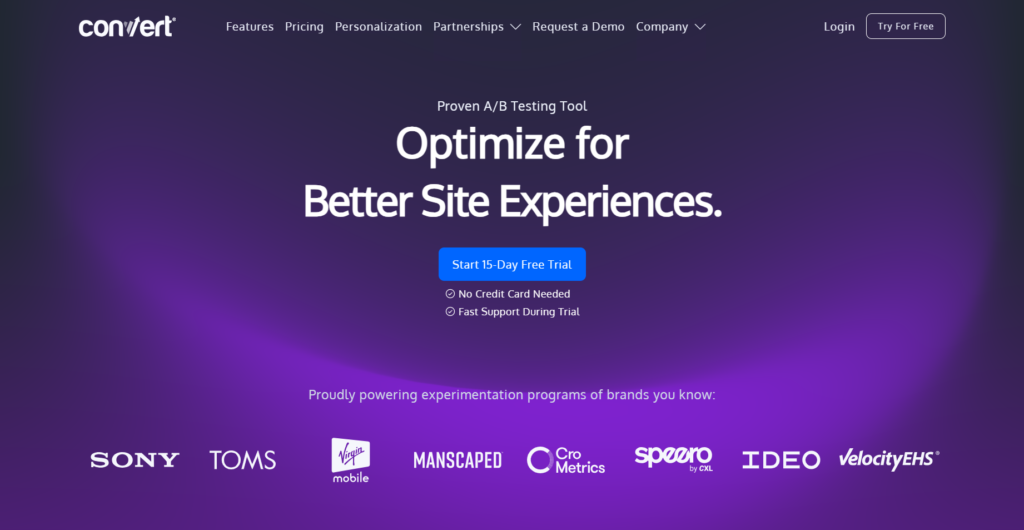
The platform sits firmly in the experimentation category. It supports A/B testing, split URL testing, multivariate testing, multi-page testing, full-stack server-side experimentation, and feature flags, all within a single unified interface. There is no separate “experimentation module” to purchase and no add-on required to unlock the core features your program actually needs.
In 2026, Convert has expanded its capabilities with three notable additions. Convert Signals is a behavioral intelligence layer that surfaces data-backed observations from your experiment results, helping teams form stronger follow-up hypotheses without manual analysis.
Multi-Arm Bandit (Auto-Allocate) testing automatically shifts traffic toward better-performing variations during a live experiment, reducing the revenue cost of running underperformers. And Custom Pop-ups bring on-site messaging directly into the experimentation workflow, so you can test pop-up copy, timing, and targeting variations with the same rigor you apply to page-level tests.
Convert has optimized over 40,000 sites across its history and consistently earns G2 badges for Easiest Setup and High Performer in both small business and mid-market categories. The platform’s user base spans CRO agencies running programs for multiple clients, e-commerce brands serious about conversion growth, and mid-market SaaS companies that need rigorous experimentation without the complexity or cost of an enterprise DXP.
What Is Crazy Egg?
Crazy Egg launched in 2006 as one of the first heatmap tools on the market, and it has earned a legitimate reputation as an accessible, affordable entry point into understanding user behavior on websites.
The platform’s core value proposition is visual clarity: it shows you where people click, how far they scroll, where they lose interest, and how they navigate through your pages.
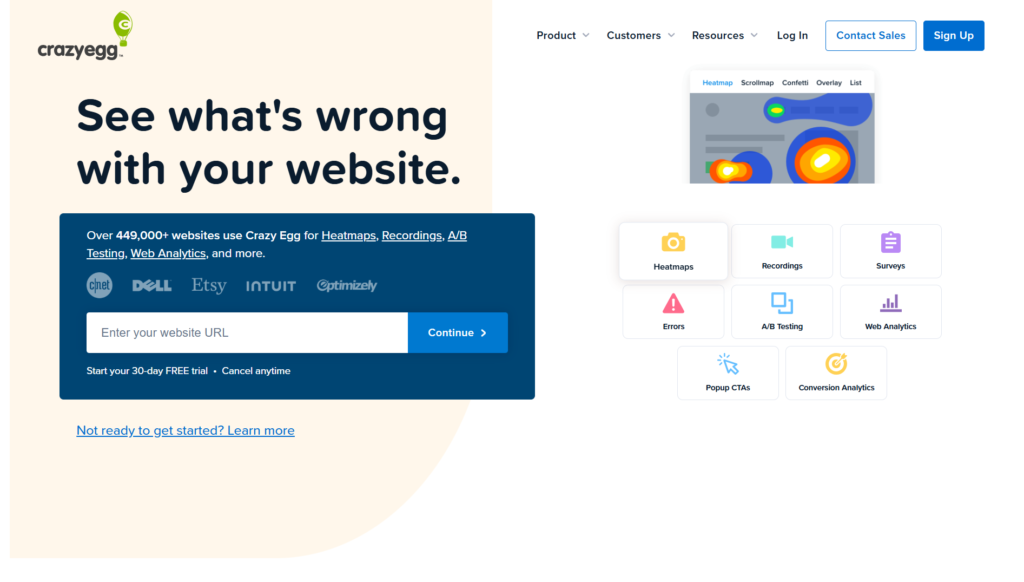
Over the years, Crazy Egg has added A/B testing, session recordings, surveys, CTAs, conversion funnels, error tracking, and web analytics to its feature set. In 2026, it positions itself as a broader CRO platform rather than a pure heatmap tool, and for early-stage teams or small businesses just beginning to think about optimization, that positioning makes sense.
The five heatmap types Crazy Egg offers are its genuine standout feature. The standard click heatmap, scroll map, confetti map (which shows individual clicks by source), overlay report (click percentages per element), and list report (raw click data per page element) together give a thorough picture of how users physically interact with a specific page.
Each Heatmap Report includes AI-assisted trend interpretation, helping less-experienced optimizers extract meaning from the data without being analysts themselves.
Where Crazy Egg starts to show its limitations is when you move past observation and into rigorous experimentation. Its A/B testing functionality is accessible and useful for simple tests, but it lacks the statistical depth, targeting precision, and quality controls that conversion optimization programs need as they scale.
It has no published statistical methodology for its testing engine, no SRM checks, no collision prevention between simultaneous tests, and no full-stack or server-side testing capability. These are not minor omissions; they are fundamental gaps for any team running more than a handful of tests at a time.
Convert vs Crazy Egg: A/B Testing Capabilities
This is the section that will matter most to most people researching this comparison, and the gap between these two platforms in testing depth is substantial.
Testing Types and Scope
Convert supports A/B testing, split URL testing, multivariate testing (on Pro and Enterprise plans), multi-page testing (testing elements consistently across multiple pages in a funnel), and full-stack server-side testing with feature flags. This covers every testing scenario from a simple headline test on a landing page to a complex, multi-variant funnel experiment that spans your checkout flow.
Crazy Egg’s A/B testing is limited to client-side, visual-layer page testing. You can test different versions of a page by modifying elements with the visual editor, but there is no multivariate testing, no multi-page testing, no server-side testing, and no feature flag support. This is adequate for testing individual page layouts or copy changes, but it cannot support a mature, high-velocity experimentation program.
Statistical Rigor
This is arguably the most important technical differentiator between any two testing tools, and it is where the gap between Convert and Crazy Egg becomes most pronounced.
Convert offers both a Frequentist stats engine and a Bayesian stats engine, giving your team the methodological flexibility to match the stats approach to the experimental design.
On Pro and Enterprise plans, Sequential Testing is included, which lets you monitor experiment results continuously without inflating your false-positive rate. This means you can make informed decisions faster without waiting for a predetermined sample size, while still maintaining statistical validity.
Crazy Egg does not publish the statistical methodology behind its A/B testing results. There is no documentation on confidence interval calculation, no choice of stats engine, and no sequential testing capability. For small, simple tests on low-stakes pages, this may be acceptable. For any decision that meaningfully affects revenue, relying on a testing engine with no transparent statistical framework is a genuine risk.
Sample Ratio Mismatch (SRM) Checks
Convert includes automatic SRM checks on all plans. An SRM occurs when the actual traffic distribution between test variants differs meaningfully from the intended split, and it can silently invalidate an entire experiment’s results. Detecting SRMs automatically is a mark of a platform that takes the integrity of experimental data seriously.
Crazy Egg does not offer SRM detection. Multiple user reviews have also reported visible flicker in Crazy Egg’s A/B tests, where users can briefly see the original page before the variant loads. Convert’s SmartInsert™ technology, which has been delivering flicker-free A/B tests since 2016, eliminates this issue entirely.
A test that shows the variant swap to a user before it loads does not just create a bad experience; it introduces bias into the test itself, because the user’s behavior is influenced by what they just saw change.
Collision Prevention
When you run multiple simultaneous experiments on the same website, there is a real risk that a visitor bucketed into Experiment A will also be bucketed into Experiment B, and the interaction between those two experiments can corrupt both datasets. Convert includes collision prevention natively, allowing you to define mutually exclusive groups and ensure clean experimental populations.
Crazy Egg has no collision prevention. For a team running one or two tests at a time, this is rarely a problem. For any team maintaining a high-velocity testing roadmap with multiple concurrent experiments, the absence of collision prevention means your data quality is always at risk.
Convert vs Crazy Egg: Heatmaps and Behavioral Analytics
This is where the comparison reverses direction in Crazy Egg’s favor, and it is important to be honest about it.
Crazy Egg’s heatmap capabilities are deeper, more varied, and more mature than Convert’s. The five Snapshot report types give genuinely useful visual data about how users interact with specific pages. The session recording feature, available across paid plans, lets you watch individual user sessions as video replays, which is a powerful qualitative research tool. Surveys are included on all plans and are useful for gathering direct visitor feedback alongside behavioral data.
Convert includes experimental heatmaps, but this is clearly not the platform’s primary strength. Convert’s value is in the testing layer, not the observation layer. Most Convert users pair the platform with a dedicated behavioral analytics or session recording tool like Hotjar, Microsoft Clarity, or Heap to cover the qualitative research side of their optimization workflow.
What this means practically is that if your primary need is understanding user behavior visually before you form test hypotheses, Crazy Egg does that job well and at a very accessible price point. If your primary need is running rigorous, statistically valid experiments based on hypotheses you have already formed, Convert is the better platform.
Many sophisticated CRO teams actually use both categories of tool together. Behavioral analytics tools like Crazy Egg help identify problems. Dedicated experimentation platforms like Convert solve them. Understanding this workflow distinction is more useful than trying to pick one tool that does both adequately.
Convert vs Crazy Egg: Pricing and Value
Both platforms publish transparent pricing, which is a point in favor of both. But the pricing structures are built around fundamentally different usage models, so direct comparison requires some context.
Crazy Egg’s Pricing
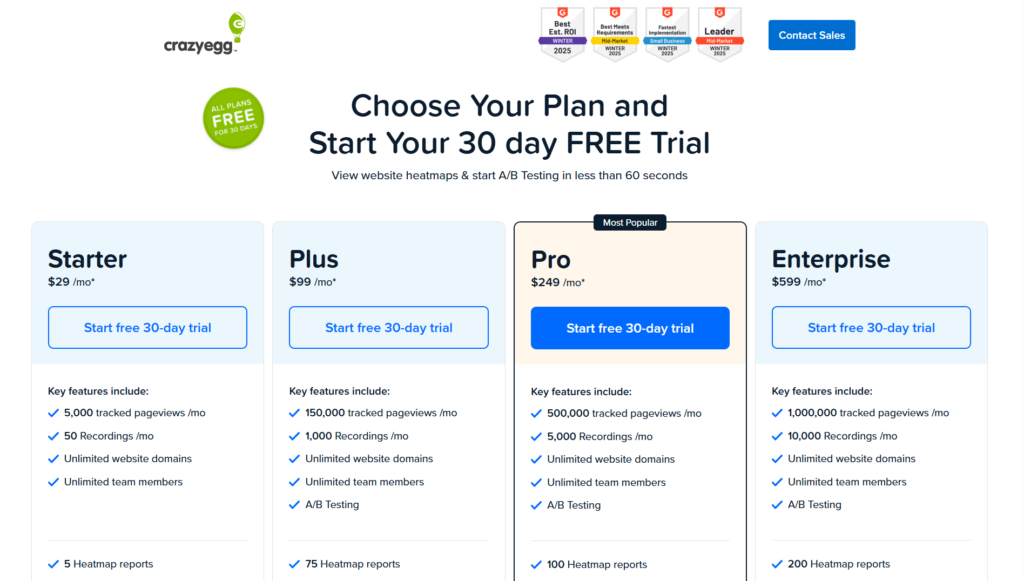
Crazy Egg prices by pageviews per month, and all plans require annual billing.
Starter: $29/month (billed annually). Includes 5,000 tracked pageviews, 5 Heatmap Reports, 50 session recordings per month, and 6 months of recording storage. No A/B testing is included at this tier.
Plus: $99/month (billed annually). Includes 150,000 tracked pageviews, 75 Heatmap Reports, 1,000 session recordings per month, and 2 years of recording storage. A/B testing and CTA tools are unlocked at this tier.
Pro: $249/month (billed annually). Includes 500,000 tracked pageviews, 100 Heatmap Reports, 5,000 session recordings per month, unlimited A/B testing, unlimited error tracking, unlimited surveys, and priority support.
Enterprise: $499/month (billed annually). Includes 1,000,000 tracked pageviews, 200 Heatmap Reports, 10,000 session recordings per month, all unlimited features, SAML Single Sign-On, and dedicated onboarding and training.
The 30-day free trial is a genuine advantage, giving new users real access to the platform before committing to annual billing.
However, the annual-only billing model means there is no month-to-month flexibility. If your testing program has seasonal traffic patterns, you are committing to a full year regardless of how active your program is in slower months.
One important nuance in Crazy Egg’s pageview model: it counts tracked pageviews, not all pageviews. You only consume your monthly allowance on pages where you have active Heatmap Reports or A/B tests running. This is actually a smart design that lets you focus your tracking budget on high-priority pages and exclude irrelevant pages like terms of service or thank-you confirmation screens.
Convert’s Pricing
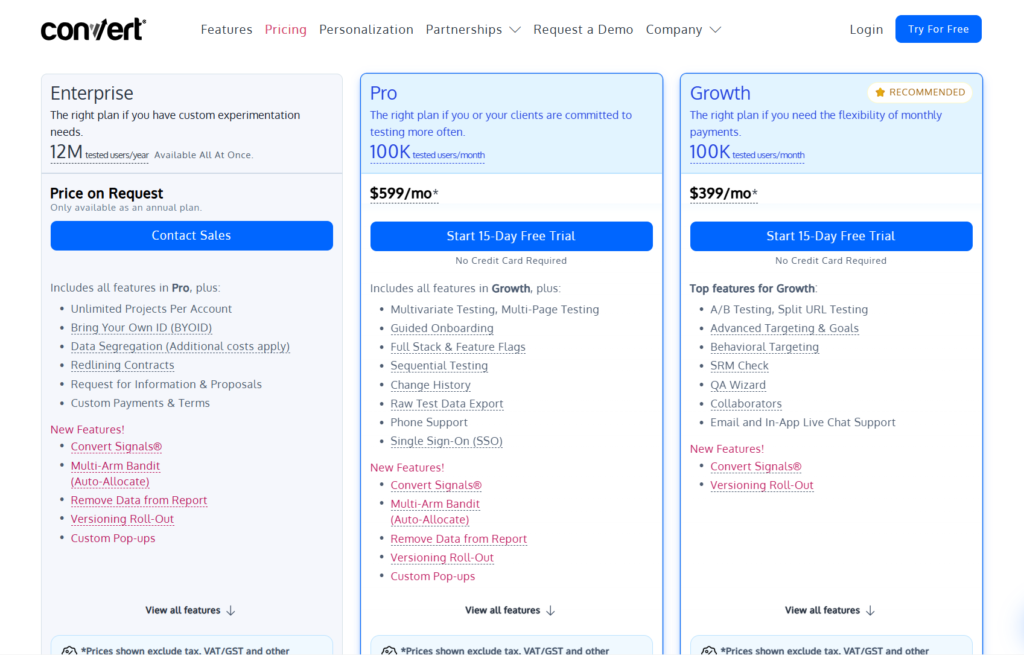
Convert prices by Monthly Tested Users (MTUs), which are the unique visitors bucketed into your active experiments. This is a fundamentally different pricing dimension than pageviews, and for most growing businesses, it is a more accurate reflection of how much value you are actually getting from the platform.
Growth: $399/month (or $299/month billed annually at $3,588/year). Supports 100,000 Monthly Tested Users. Includes A/B testing, split URL testing, advanced targeting with 40+ filters, behavioral targeting, SRM checks, QA Wizard, and email and live chat support. The Growth plan also offers monthly payment flexibility, which no Crazy Egg plan provides.
Pro: $599/month (or $420/month billed annually at $5,040/year). Supports 250,000 Monthly Tested Users. Adds multivariate testing, multi-page testing, full-stack experimentation with feature flags, sequential testing, raw data export, phone support, Single Sign-On, change history, guided onboarding, Multi-Arm Bandit testing, and Custom Pop-ups.
Enterprise: Custom pricing for programs needing over 1 million Monthly Tested Users. Includes everything in Pro plus Bring Your Own ID (BYOID), data segregation, unlimited projects, dedicated account management, weekly check-ins, custom payment terms, and contract redlining. Convert scales to 1.2 billion Monthly Tested Users at the enterprise level.
Convert also offers meaningful pricing flexibility that Crazy Egg does not. Monthly billing is available on the Growth plan. Convert never forces upgrades and honors legacy pricing for existing customers. Overuse is handled gracefully with notifications at 90% and 100% of your MTU cap rather than a hard cutoff mid-experiment.
The Real Value Comparison
At first glance, Crazy Egg looks significantly cheaper, and for a small business that primarily needs heatmaps and session recordings with occasional split testing, it is. But the comparison shifts considerably when you are evaluating both tools as your primary testing platform.
A growing ecommerce brand running a serious experimentation program needs statistical rigor, collision prevention, SRM checks, full-stack testing capability, and the kind of support that keeps tests live and accurate.
Crazy Egg’s lower price reflects a platform that does not provide these things. Convert’s higher starting price reflects a purpose-built platform to provide all of them.
Convert vs Crazy Egg: Targeting and Personalization
Convert’s targeting engine is one of its most powerful differentiators in this comparison. With over 40 audience filters, you can build test segments based on behavior, geography, device type, traffic source, time of day, language, weather, custom JavaScript logic, cookie values, custom tags, and more.
Collision prevention ensures that segments remain clean across simultaneous experiments. The Deploy feature also lets you activate personalized experiences for specific audience segments without requiring a developer every time you need to update content.
Crazy Egg’s targeting is more limited. You can run A/B tests on specific pages and filter heatmap data by traffic source, device type, or date range, but the audience segmentation for experiments is basic.
There is no behavioral targeting engine, no cookie-based audience building for tests, and no equivalent of Convert’s rule-based audience composer for creating complex experiment populations.
For teams that want to go beyond simple page-level tests and begin personalizing experiences for defined audience cohorts, Convert provides the infrastructure to do that. Crazy Egg does not.
Convert vs Crazy Egg: Privacy, Compliance, and Data Security
Privacy is not an optional consideration for any tool that touches your website visitors in 2026. Browser policies continue to tighten around third-party tracking, data residency regulations are increasingly enforced, and businesses in healthcare, financial services, and any sector handling sensitive user data face real legal exposure from non-compliant tools in their stack.
Convert is built from the ground up around a privacy-first architecture. It uses first-party cookies exclusively, which means it is not affected by third-party cookie deprecation across browsers. Your visitor data is stored on carbon-neutral EU servers in Frankfurt, Germany, which satisfies GDPR data residency requirements for businesses handling European user data without complex data transfer agreements.
Convert holds ISO 27001 certification and SOC 2 Type 2 compliance, both of which represent independently audited information security standards. The platform is also certified compliant with GDPR, CCPA, HIPAA, and Germany’s TTDSG and BDSG regulations. For any business operating in a regulated industry or serving European customers, this compliance stack is not a nice-to-have; it is a procurement requirement.
Crazy Egg does not publish equivalent compliance certifications. It uses pageview tracking that relies on cookie-based identification, and it does not offer EU-based data storage or the same level of independently audited privacy compliance.
For small businesses with limited privacy exposure, this difference may be manageable. For businesses operating in healthcare, finance, or any sector with formal compliance requirements, Convert’s privacy architecture is meaningfully superior.
Convert vs Crazy Egg: Integrations and Ecosystem
Convert supports 90+ native integrations that activate with a single tag, no middleware or Zapier connections required. This list covers analytics platforms like Google Analytics 4, Mixpanel, Heap, and Amplitude; customer data platforms like Segment; marketing automation tools like HubSpot and Klaviyo; ecommerce platforms including Shopify and BigCommerce; heat mapping and session recording tools like Hotjar; and dozens more. The platform also exposes a full API, which allows custom integrations with any tool that your engineering team needs to connect.
For Shopify merchants in particular, Convert’s A/B testing support in the Shopify environment is deep and reliable, covering product page testing, theme variation testing, and checkout flow optimization without the technical workarounds that many testing tools require on Shopify’s infrastructure.
Crazy Egg does not have a public API. Its integrations work by adding a script to any application that accepts third-party scripts, which covers most website platforms but provides no programmatic access to your data or results. Native integrations are available for Shopify, WordPress, Wix, AWeber, and a handful of other popular platforms, but the integration ecosystem is far shallower than Convert’s.
For teams that want their experimentation data to flow automatically into their analytics stack, CRM, or product intelligence tools, Convert’s API and native integration library make that workflow seamless. With Crazy Egg, this data portability is limited.
Convert vs Crazy Egg: Support Quality
Convert’s support has become something of a competitive calling card in the A/B testing market, and the numbers back it up. The platform’s average first-response time, based on Zendesk performance data, is 11 minutes and 34 seconds, which the company describes as up to 4x faster than competing tools.
Support is available via in-app live chat, email, and phone on Pro and Enterprise plans, and the team is staffed by people with deep platform knowledge rather than first-line agents working from a help center script.
The quality of that support matters especially during experiments. When a test is live, traffic is running, and something is not behaving as expected, the difference between a 12-minute response from someone who can actually diagnose the issue and a 48-hour email queue is a meaningful cost to your program velocity.
Convert’s G2 reviews repeatedly call out support responsiveness as one of the primary reasons customers stay on the platform long-term.
Crazy Egg offers email, chat, and phone support. User reviews are generally positive about the responsiveness of Crazy Egg’s support team, particularly for onboarding questions.
The platform’s setup is simple enough that most users do not encounter complex support scenarios, which means the bar for support is also lower. For the occasional question about adding a Heatmap Report or reading confetti data, Crazy Egg’s support performs well.
Convert vs Crazy Egg: Full-Stack and Server-Side Experimentation
This is perhaps the starkest capability gap in this entire comparison, and it matters increasingly in 2026 as more businesses move testing beyond the front end.
Convert’s full-stack experimentation supports server-side A/B testing, feature flags, and feature rollouts through its Pro and Enterprise plans. This means you can run experiments in your backend code, on mobile applications, in APIs, and across any environment where you deploy software.
Feature flags let engineering teams deploy code to production and control its visibility independently, enabling safer releases, gradual rollouts, and the ability to instantly kill a feature without a new deployment. This is not a marketing feature; it is a fundamental capability for any product team running a serious experimentation program.
Crazy Egg has no server-side testing capability, no feature flags, and no support for mobile app experimentation. It is a website-only tool. For companies testing on mobile apps, running experiments that require backend logic, or using feature flags to manage product releases, Crazy Egg simply cannot participate in that part of the program.
Who Should Choose Convert?
Convert is the right choice for you if your situation matches any of these profiles.
You are running or building a serious experimentation program where statistical validity, clean data, and test quality matter. You need SRM checks, collision prevention, a transparent stats engine, and sequential testing, and you cannot afford to make large business decisions based on results from a testing engine that does not document its methodology.
You are a CRO agency managing testing programs for multiple clients. Convert’s project structure, role-based permissions, and flat-rate pricing model are purpose-built for agency workflows. Some of the most respected optimization agencies in the world rely on Convert precisely because it scales across client accounts without requiring a separate enterprise contract for each one.
You are an ecommerce brand or SaaS company that has moved past the “occasional split test” stage and is running a structured, high-velocity testing program. You need full-stack capability, sophisticated audience targeting, and integrations with your analytics and marketing stack.
You operate in a regulated industry or handle European customer data, and you need a tool that is genuinely GDPR, CCPA, and HIPAA compliant, stores data in the EU, and can satisfy the privacy and compliance requirements that come up in procurement reviews.
You want a vendor relationship built on transparency and stability. Convert’s self-funded model means prices are not subject to sudden increases driven by investor pressure, and the company’s policy of honoring legacy pricing means you can plan your budget with confidence.
Who Should Choose Crazy Egg?
Crazy Egg makes sense for a specific type of user, and being clear about that is more useful than dismissing the tool entirely.
You are a small business or solo marketer in the early stages of website optimization. You want to understand how users interact with your pages visually before you start running tests. Crazy Egg’s heatmaps, confetti maps, and scroll maps give you that foundational understanding quickly and at a price point that matches an early-stage budget.
You primarily need behavioral observation tools rather than a dedicated experimentation platform. If your optimization workflow is centered on identifying UX problems through visual data and session recordings, with only occasional simple A/B tests, Crazy Egg gives you everything you need at a fraction of the cost of a full experimentation platform.
You are looking for a complementary tool to pair with a dedicated testing platform. Many experienced CRO practitioners use Crazy Egg or a similar behavioral analytics tool alongside Convert. Crazy Egg surfaces the qualitative “what” and “where” of user problems. Convert tests the solutions with statistical rigor. Together, these tools form a more complete optimization workflow than either delivers alone.
Convert vs Crazy Egg: Final Verdict
If you are evaluating these two platforms as your primary CRO and A/B testing tool, Convert is the clear choice for any team that is serious about experimentation.
Crazy Egg is a good behavioral analytics tool with a useful A/B testing layer added on top. It is accessible, affordable, and perfectly adequate for small businesses doing visual optimization research and running simple page tests. It is not, and has never been designed to be, a rigorous experimentation platform.
Convert is built from the ground up to run experiments that produce reliable, actionable data. The statistical depth, targeting precision, data quality controls, full-stack capability, and privacy architecture that Convert provides are not luxury features available only to enterprise customers. They are included at accessible prices starting at $399/month, with monthly payment flexibility on the Growth plan.
If you are a growing ecommerce brand, a CRO agency, or a product or marketing team trying to build a mature experimentation program, the capabilities that Crazy Egg lacks are exactly the capabilities you will miss most as your program scales. Starting on the right platform is significantly less expensive than migrating your entire testing program 18 months from now after you have outgrown the tool you started with.
The best next step with Convert is their 15-day free trial at convert.com, which requires no credit card and includes full access to the platform’s feature set from day one. If you are exploring Crazy Egg, their 30-day free trial at crazyegg.com is a practical way to evaluate whether its behavioral analytics features fit your workflow before committing to an annual plan.
Frequently Asked Questions: Convert vs Crazy Egg
Is Crazy Egg a good A/B testing tool?
Crazy Egg offers basic client-side A/B testing on its Plus plan and above, and it is useful for simple page-level tests. However, it lacks a published statistical methodology, SRM checks, collision prevention, multivariate testing, and full-stack capability, which limits its usefulness as your primary experimentation platform as your program grows.
How does Convert’s pricing compare to Crazy Egg?
Crazy Egg starts at $29/month for heatmaps only (A/B testing requires the $99/month Plus plan). Convert starts at $399/month for a full-featured A/B testing platform with advanced targeting, SRM checks, and 100,000 Monthly Tested Users. The price difference reflects a fundamental difference in the depth and purpose of each platform.
Can I use both Convert and Crazy Egg together?
Yes, and many experienced CRO teams do. Crazy Egg’s heatmaps and session recordings help identify where users are struggling and why. Convert’s experimentation platform helps you test solutions to those problems with statistical rigor. These tools occupy different parts of the optimization workflow and complement each other well.
Does Crazy Egg have an API?
No. Crazy Egg does not offer a public API. Convert includes full API access on all plans, which allows programmatic integration with your analytics stack, CRM, and other tools.
Which tool is better for CRO agencies?
Convert is the stronger choice for agencies. Its project structure, role-based permissions, agency account management features, and flat-rate pricing scale cleanly across multiple client programs without the per-client pricing complexity that many tools create.
Does Crazy Egg work for server-side or mobile app testing?
No. Crazy Egg is a website-only tool with no server-side testing, no feature flags, and no mobile app support. Convert’s full-stack experimentation on Pro and Enterprise plans supports server-side testing, feature flags, and SDK-based testing across 10+ environments.
Which platform is more privacy-friendly?
Convert uses first-party cookies exclusively, stores data on EU-based servers in Frankfurt, and holds ISO 27001 and SOC 2 Type 2 certifications alongside GDPR, CCPA, and HIPAA compliance. Crazy Egg does not publish equivalent privacy certifications or EU data residency options, making Convert the significantly stronger choice for businesses with formal privacy requirements.
Does Convert offer a free trial?
Yes. Convert offers a 15-day free trial with no credit card required and full access to the platform’s features. Crazy Egg offers a 30-day free trial across all its plans.
