
Choosing the right cold email platform can make or break your outreach results. You might be burning through your marketing budget on a tool that limits your growth, charges you per inbox, or lacks the deliverability features that keep your emails out of spam folders.
Both Saleshandy and Lemlist promise to solve these problems, but they take completely different approaches to cold email automation.
If you’re spending hours comparing pricing pages, reading conflicting reviews, or wondering which tool actually delivers on its promises, you’re in the right place. I’ve tested both platforms extensively with real campaigns, analyzed their features side by side, and broken down the real costs beyond what their pricing pages show you.
This comparison will help you understand exactly what you’re getting with each platform, where they excel, where they fall short, and most importantly, which one fits your specific outreach needs and budget in 2026.
Quick Comparison Table
| Feature | Saleshandy | Lemlist |
|---|---|---|
| Starting Price | $25/month (annual) | $55/month per user (annual) |
| Email Accounts | Unlimited (all plans) | 3-5 per user (depends on plan) |
| Monthly Email Volume | 6,000 (Starter plan) | Unlimited with credits |
| Lead Database | 700M+ contacts | 600M+ contacts |
| Email Verification Cost | 1 credit per email | 5 credits per email |
| Multichannel Outreach | Manual tasks (all plans) | Automated (Pro plan+) |
| Inbox Placement Testing | Yes (included) | No |
| AI Sequence Generator | Yes (10-50 sequences) | Yes (unlimited) |
| Team Members | Unlimited (all plans) | Per user pricing |
| Client Management | Free (unlimited) | Separate workspace ($) |
| CRM Integrations | HubSpot, Salesforce, Pipedrive | HubSpot, Salesforce, Pipedrive |
| Email Warm-up | Unlimited (free via TrulyInbox) | Unlimited (Lemwarm) |
| A/B Testing | Up to 26 variants | Yes (multiple variants) |
| Image Personalization | Basic merge tags | Advanced (custom images) |
| Video Personalization | Integration support | Native support |
| Free Trial | 7 days | 14 days |
| Best For | Agencies, high-volume senders, budget-conscious teams | Teams prioritizing visual personalization, multichannel automation |
What Is Saleshandy?
Saleshandy is an AI-powered cold email outreach platform designed for businesses that need to scale their email campaigns without breaking the bank. The platform focuses on delivering three core strengths: affordability, deliverability, and unlimited scalability.
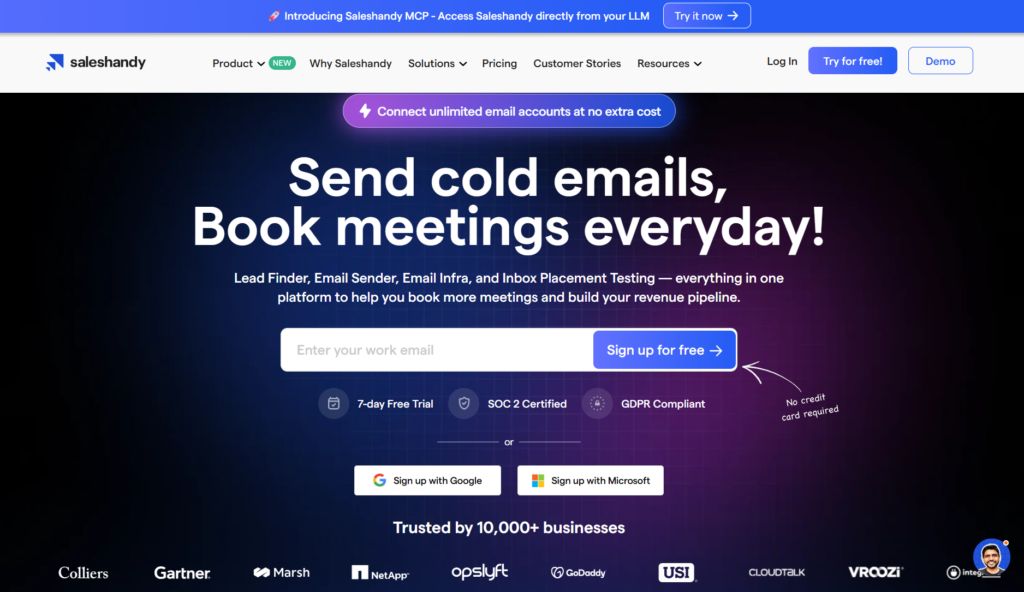
What sets Saleshandy apart in 2026 is its flat-rate pricing model. Unlike competitors that charge per user or per email account, Saleshandy lets you connect unlimited email accounts and add unlimited team members from day one. This makes it particularly attractive for agencies managing multiple clients or sales teams that need to scale quickly.
The platform includes a B2B lead database with over 700 million verified contacts, real-time email verification, AI-powered sequence generation, and a comprehensive deliverability suite. You can also purchase domains and set up email accounts directly within Saleshandy, which streamlines your entire cold email infrastructure.
Saleshandy works best for businesses that prioritize volume, cost efficiency, and inbox placement over fancy visual personalization features.
What Is Lemlist?
Lemlist started as a cold email personalization tool in 2018 and has evolved into a full-fledged multichannel outreach platform. The platform built its reputation on advanced personalization capabilities, particularly custom image personalization, dynamic landing pages, and video integration.
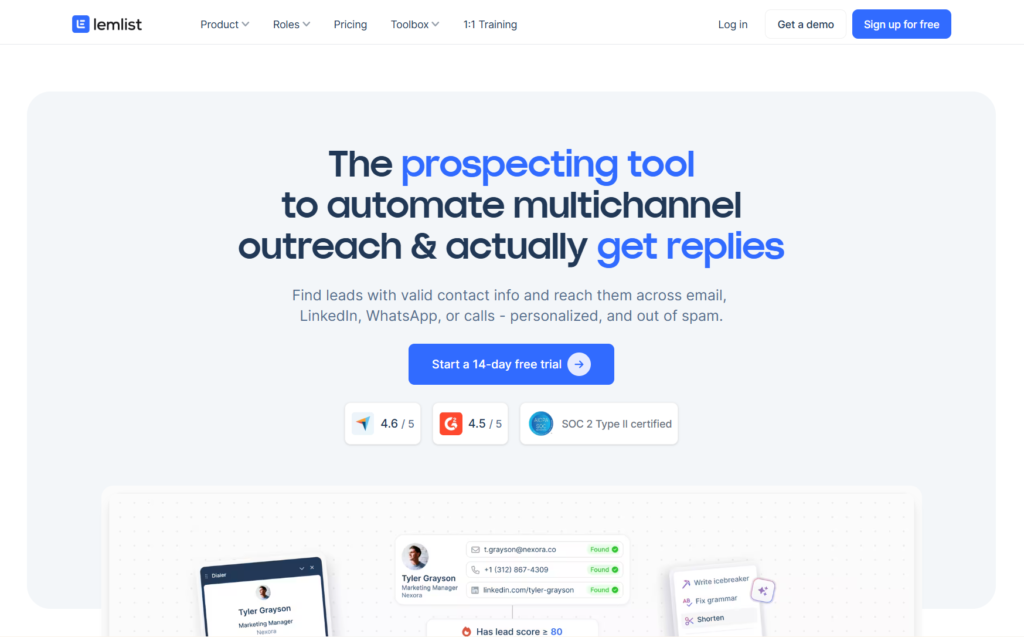
In 2026, Lemlist positions itself as an all-in-one prospecting workspace where you can find leads, personalize messages at scale, and run automated sequences across email, LinkedIn, WhatsApp, and phone calls. The platform uses a visual flowchart-style sequence builder that shows exactly how your campaign flows across different channels.
Lemlist includes AI-powered features for generating sequences, writing email copy, and creating personalized icebreakers. The platform also offers Lemwarm, its built-in email warm-up tool, and a lead database with 600 million contacts.
The tool works best for sales teams and agencies that want sophisticated visual personalization, prefer a per-user pricing model, and need native multichannel automation built into their sequences.
Pricing Comparison: The Real Cost Breakdown
Price matters, especially when you’re scaling cold outreach. But the advertised price rarely tells the full story. Here’s what you actually pay with each platform.
Saleshandy Pricing Structure
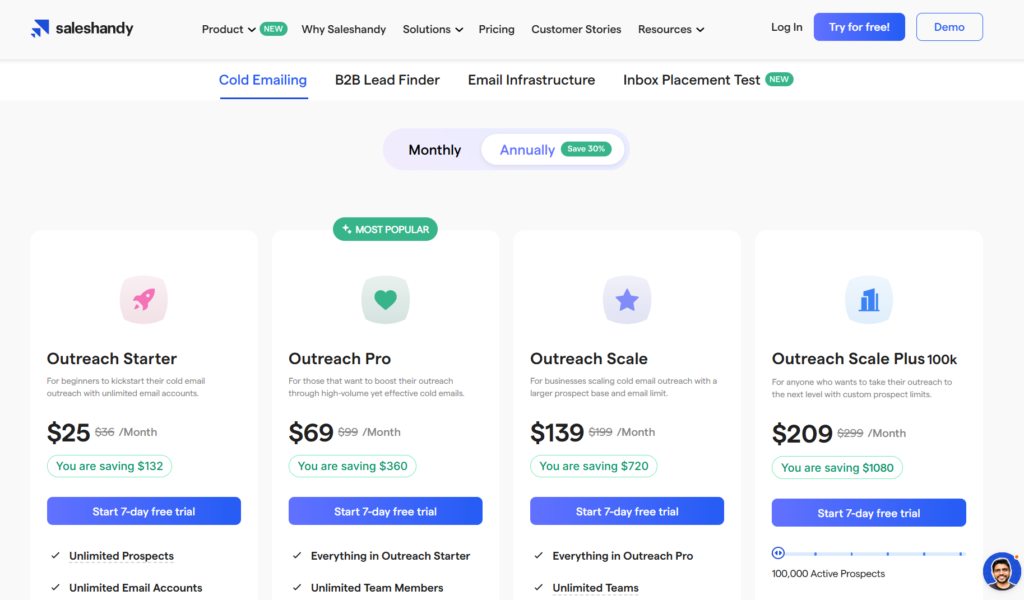
Saleshandy uses a flat-rate pricing model with four main tiers for cold email outreach:
Outreach Starter – $25/month (annual billing)
- 6,000 monthly emails
- 2,000 active prospects
- Unlimited email accounts
- Unlimited team members
- AI sequence generation (10 sequences)
- 2,500 email verification credits (one-time)
- Sender rotation and unlimited warm-up
Outreach Pro – $69/month (annual billing)
- 150,000 monthly emails
- 30,000 active prospects
- Unlimited email accounts
- Unlimited team members
- AI sequence generation (20 sequences)
- 10,000 email verification credits (one-time)
- A/Z testing and advanced warm-up settings
Outreach Scale – $149/month (annual billing)
- 250,000 monthly emails
- 50,000 active prospects
- All Pro features
- AI sequence generation (30 sequences)
- 15,000 email verification credits (one-time)
- White-label options available
Outreach Scale Plus – Custom pricing
- Custom email volume
- Custom prospect limits
- All Scale features
- AI sequence generation (50 sequences)
- Agency-level features on request
The key advantage here is predictability. You pay one price regardless of how many email accounts you connect or team members you add. For agencies, this is huge. You can manage 10 clients or 100 clients without your costs multiplying.
Lemlist Pricing Structure
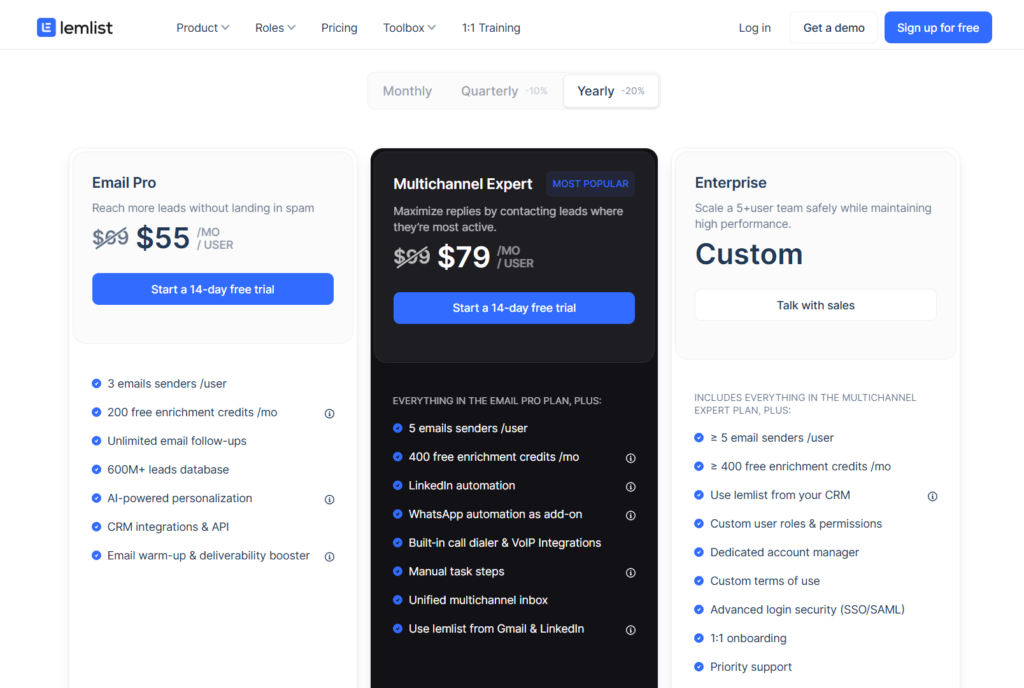
Lemlist uses per-user pricing with three main tiers:
Email Pro – $55/month per user (annual billing)
- 1,000 lead credits monthly
- 3 email accounts per user
- Email sequences only
- AI email writer
- Basic personalization
- Lemwarm included
- CRM integrations
Multichannel Expert – $79/month per user (annual billing)
- 1,500 lead credits monthly
- 5 email accounts per user
- Multichannel sequences (email, LinkedIn, WhatsApp, calls)
- Advanced personalization
- Image and video customization
- AI icebreaker generator
- All Email Pro features
Enterprise – Custom pricing (minimum 5 seats)
- 2,500 lead credits monthly
- Custom email accounts
- Dedicated account manager
- VIP support
- Custom onboarding
- All Multichannel Expert features
Here’s where the costs add up: if you need more than 3-5 email accounts per user, Lemlist charges $9/month for each additional account. For a team of three people needing 10 email accounts each, you’re looking at an additional $135/month just for extra inboxes.
Real-World Cost Comparison
Let’s break down what three common scenarios actually cost:
Scenario 1: Solo Founder (3 email accounts, 10,000 emails/month)
- Saleshandy: $25/month (Starter plan covers it)
- Lemlist: $55/month (Email Pro)
- Winner: Saleshandy saves $360/year
Scenario 2: Small Agency (3 clients, 15 email accounts, 50,000 emails/month)
- Saleshandy: $69/month (Pro plan)
- Lemlist: $165/month ($55 x 3 users) + potential extra inbox fees
- Winner: Saleshandy saves $1,152/year
Scenario 3: Growing Sales Team (5 team members, 25 email accounts, 150,000 emails/month)
- Saleshandy: $69/month (Pro plan covers everyone)
- Lemlist: $275/month ($55 x 5 users) + $90/month (extra inboxes) = $365/month
- Winner: Saleshandy saves $3,552/year
The pattern is clear: Saleshandy becomes dramatically more cost-effective as you scale. Lemlist’s per-user model works fine for individual users or very small teams, but costs escalate quickly once you add people or need more email accounts.
Lead Database and Prospecting Features
Finding the right prospects is half the battle in cold outreach. Both platforms include built-in lead databases, but they approach prospecting differently.
Saleshandy’s B2B Lead Finder
Saleshandy gives you access to 700 million professional contacts from 60 million companies. The database includes verified emails, phone numbers, and enriched company data.
The search filters are comprehensive. You can narrow prospects by job title, company size, industry, location, technology stack, and more. What stands out is the LinkedIn Chrome extension, which lets you find and save prospects directly while browsing LinkedIn profiles.
Email verification happens in real-time. When you search for prospects, Saleshandy shows only A-grade email addresses, which means they’re verified and deliverable. This saves you from wasting credits on bad emails.
The pricing is separate from cold outreach plans. The Lead Starter plan costs $29/month and gives you 500 monthly credits. Unlike Lemlist, these credits roll over, so unused credits don’t disappear at the end of the month.
One credit gets you one verified email address. This is straightforward and cost-effective for most teams.
Lemlist’s Lead Database
Lemlist provides 600 million verified contacts with similar filtering options. You can search by job title, company size, industry, location, and even intent signals like recent funding or hiring activity.
The waterfall enrichment feature is interesting. Lemlist checks multiple data sources to find the most accurate contact information, which improves data quality.
However, the credit system is less favorable. Finding one email address costs 5 credits, and finding a phone number costs 20 credits. With the Email Pro plan giving you 1,000 monthly credits, you can find 200 verified emails per month.
The bigger issue is that credits don’t roll over. If you only use 400 credits in January, the remaining 600 vanish. This forces you to either use them immediately or lose them, which isn’t ideal for teams with variable prospecting needs.
Which Database Wins?
For pure prospecting capability, both databases are comparable. They both offer extensive contact data with good filtering options.
The real difference is cost efficiency. Saleshandy charges 1 credit per email versus Lemlist’s 5 credits per email. Saleshandy also lets unused credits roll over, while Lemlist credits expire monthly.
If prospecting is a major part of your workflow and you need hundreds or thousands of new leads every month, Saleshandy offers better value. If you only need occasional lead enrichment and value the waterfall approach, Lemlist’s quality-focused method might justify the higher credit cost.
Email Sequence Automation and Campaign Management
Creating effective email sequences separates good outreach from great outreach. Let’s compare how each platform handles automation.
Saleshandy’s Sequence Builder
Saleshandy offers three sequence types: multi-step, conditional, and AI-powered.
Multi-step sequences are straightforward. You create an initial email and add unlimited follow-ups that send automatically based on time delays. The interface is clean and linear, making it easy to see the entire sequence at a glance.
Conditional sequences respond to prospect behavior. If someone opens your email but doesn’t reply, they get one follow-up path. If they don’t open at all, they get a different path. This behavior-based automation helps you tailor messages without manual intervention.
The AI Sequence Copilot generates entire sequences based on your business information. You input your website URL or describe your offer, and the AI creates a complete sequence with subject lines, body copy, and follow-ups. The quality is solid, though you’ll want to personalize the output before sending.
Sender rotation is built into all sequences. If you’ve connected multiple email accounts, Saleshandy automatically rotates which account sends each email. This protects your sender reputation by distributing volume across multiple domains.
You can also test up to 26 variants of your email copy simultaneously. This goes beyond basic A/B testing and lets you test different subject lines, opening lines, and CTAs to find what resonates with your audience.
Lemlist’s Sequence Builder
Lemlist takes a visual approach with a flowchart-style sequence builder. You can see how emails, LinkedIn steps, WhatsApp messages, and call tasks connect in a branching diagram. This visual interface looks impressive and makes complex multichannel sequences easy to understand. However, it can become overwhelming once you’re managing multiple campaigns with many branches.
Lemlist also offers AI sequence generation. The AI analyzes your prospect data and creates personalized icebreakers and follow-up messages. The AI email writer helps improve copy with real-time suggestions.
The platform includes a template library with high-performing campaigns you can customize. This gives you proven starting points instead of building from scratch.
For multichannel sequences, Lemlist excels. You can automate LinkedIn profile visits, connection requests, and messages within the same sequence as your emails. This native multichannel automation is more seamless than Saleshandy’s manual task approach.
Automation Winner
If you need native multichannel automation with LinkedIn, WhatsApp, and calls integrated directly into your sequences, Lemlist delivers better out-of-the-box functionality.
If you prefer a simpler, more linear approach focused primarily on email with the option to add manual multichannel tasks, Saleshandy provides better clarity and easier campaign management at scale.
For teams managing dozens of campaigns simultaneously, Saleshandy’s straightforward interface makes it faster to duplicate, edit, and monitor performance. Lemlist’s visual builder is great for individual campaigns but can become cluttered with high campaign volumes.
Personalization Capabilities
Personalization directly impacts reply rates. The more tailored your emails feel, the better your engagement.
Saleshandy’s Personalization Features
Saleshandy covers the fundamentals well. You can use merge tags for first name, last name, company name, job title, and any custom fields you import.
Variable tags let you personalize content dynamically based on prospect attributes. You can show different paragraphs to prospects in different industries or job roles.
Spintax randomizes text to make each email unique. This helps avoid spam filters that flag identical messages sent to multiple recipients.
For visual personalization, Saleshandy integrates with tools like Hyperise. While not as seamless as Lemlist’s native image personalization, it works well if you need custom screenshots or personalized graphics.
Video integration is supported through embeds and links. You can connect with platforms like Vidyard or Loom to add personalized videos to your sequences.
The AI Variants feature generates multiple versions of your email copy automatically. You can test different angles, tones, and messaging approaches without writing each version manually.
Lemlist’s Personalization Features
This is where Lemlist truly shines. The platform offers advanced personalization that goes beyond basic merge tags.
Custom image personalization lets you create templates where prospect information dynamically populates within images. You can show their company logo on a mock browser screenshot, their name on a coffee cup, or any creative visual you design.
This feature has a learning curve, but the visual impact is undeniable. Personalized images grab attention in crowded inboxes and demonstrate effort, which often improves reply rates.
Video personalization is built in natively. You can record personalized video messages or create AI-generated voice messages for prospects. The platform handles hosting and embedding automatically.
Dynamic landing pages are another unique feature. You can create custom landing pages that change based on who clicks your email. Each prospect sees content tailored to their industry, company size, or other attributes.
Liquid syntax allows advanced conditional personalization. You can change entire sections of your email based on time of day, day of week, lead attributes, or previous interactions.
The AI icebreaker generator analyzes prospect LinkedIn profiles and websites to create personalized opening lines. The quality is generally better than generic AI tools because it pulls specific information about each prospect.
Personalization Winner
Lemlist wins on personalization depth and creativity. If your outreach strategy depends on highly customized visuals, videos, and dynamic content, Lemlist provides tools that Saleshandy simply doesn’t match.
However, most cold email campaigns don’t need this level of personalization. Basic merge tags, variable content, and spintax deliver strong results when combined with good targeting and copy.
For the majority of users focused on scalable, effective outreach, Saleshandy’s personalization features are more than sufficient. For teams where personalization is the primary differentiator in their outreach strategy, Lemlist’s advanced features justify the extra cost.
Email Deliverability and Inbox Placement
The best email in the world is worthless if it lands in spam. Deliverability features determine whether your carefully crafted messages reach the primary inbox.
Saleshandy’s Deliverability Suite
Saleshandy takes deliverability seriously with a comprehensive suite of tools designed to maximize inbox placement.
Unlimited email warm-up is included through TrulyInbox, Saleshandy’s partner platform. Your email accounts gradually build sending reputation through automated warm-up conversations that mimic natural email patterns.
Sender rotation distributes your emails across multiple accounts automatically. Instead of sending 1,000 emails from one account in a day, Saleshandy might send 100 from each of 10 accounts. This protects individual sender reputations and improves overall deliverability.
Inbox placement testing is a standout feature. You can send test emails to real B2B email accounts and see exactly where they land: primary inbox, promotions tab, or spam folder. This gives you real data about deliverability before launching full campaigns.
The sequence score feature analyzes your email content and warns you about potential spam triggers. It checks for problematic words, link density, image-to-text ratio, and other factors that affect deliverability.
ESP (Email Service Provider) matching ensures your emails route through the best servers for each recipient’s email provider. Different ESPs have different filtering rules, and this feature optimizes delivery paths.
The AI bounce detector identifies and removes invalid email addresses automatically. This protects your sender reputation by preventing bounces that could flag your domain as low-quality.
Email verification happens in real-time before sending. Saleshandy checks each email address right before it goes out, catching addresses that may have become invalid since you added them to your list.
Lemlist’s Deliverability Features
Lemlist includes Lemwarm, its native email warm-up tool that works across all plans. The warm-up process simulates human-like email behavior to build sender reputation gradually.
Inbox rotation is available, allowing you to send from multiple accounts within the same campaign. This distributes volume and protects individual email reputations.
The platform lets you purchase domains and set up email accounts directly, which streamlines infrastructure setup for teams that don’t want to handle technical configuration.
However, Lemlist lacks inbox placement testing. You can’t see where your emails are actually landing before sending to your full list. This is a significant gap in 2026, when understanding deliverability in real-time is crucial.
There’s no dedicated spam score checker or content analysis tool. You’re relying primarily on warm-up and sender rotation without the additional safety nets that other platforms provide.
Email verification uses the standard 5-credit system mentioned earlier, but there’s no real-time verification right before sending.
Deliverability Winner
Saleshandy provides a more complete deliverability solution. The combination of warm-up, sender rotation, inbox placement testing, sequence scoring, ESP matching, and bounce detection gives you multiple layers of protection.
Lemlist covers the basics with warm-up and rotation, but the lack of inbox placement testing is a notable weakness. Without this feature, you’re sending emails blind, hoping they reach the inbox without concrete data to confirm it.
For businesses where deliverability is critical and email volume is high, Saleshandy’s comprehensive approach offers better peace of mind and more tools to troubleshoot issues before they impact campaigns.
Team Collaboration and Client Management
How well a platform supports multiple users and clients matters significantly for agencies and sales teams.
Saleshandy’s Team Features
Saleshandy includes unlimited team members across all paid plans. This is rare in the cold email space and particularly valuable for growing teams.
You can assign specific roles and permissions to team members, controlling who can create sequences, manage prospects, or view analytics.
Client management is built in without extra fees. Agencies can add unlimited clients, each with their own workspace, campaigns, and reporting. You’re not paying per client, which makes the platform extremely cost-effective for agencies.
The unified inbox consolidates all prospect conversations in one place. Team members can see email threads, reply to prospects, and collaborate on responses without switching between multiple inboxes.
Analytics dashboards show performance at the campaign, team member, and client level. You can easily track which team members are performing well and which clients are getting the best results.
White-label options are available on higher plans, allowing agencies to remove Saleshandy branding and present the platform as their own tool.
Lemlist’s Team Features
Lemlist uses per-user pricing, so each team member requires a separate license. For a team of five, you’re paying for five users at $55-$79 each per month.
The Cockpit feature allows agency client management, but it requires buying separate workspaces. Each client essentially needs their own plan, which makes agency pricing prohibitively expensive compared to alternatives.
On the Enterprise plan, you get unlimited guest seats. This means you can invite team members without paying for full licenses, but you need to be on the highest-priced tier to access this benefit.
Collaboration tools let you assign roles and distribute lead finder credits to specific team members. The unified inbox shows all prospect interactions in one place.
Performance tracking is solid, with dashboards showing results by campaign, team member, and channel.
Team Management Winner
Saleshandy wins decisively for agencies and larger teams. Unlimited team members and unlimited client management from the base plan make it far more scalable and affordable.
Lemlist’s per-user pricing works fine for solo users or very small teams, but becomes impractical as you grow. The requirement to pay for separate workspaces for each client is particularly expensive for agencies.
Integration Ecosystem
Modern outreach tools need to connect with your existing stack. Both platforms offer integrations, but with different approaches.
Saleshandy Integrations
Saleshandy integrates with major CRMs, including HubSpot, Salesforce, and Pipedrive. These integrations sync contacts, update deal stages, and track campaign activity within your CRM.
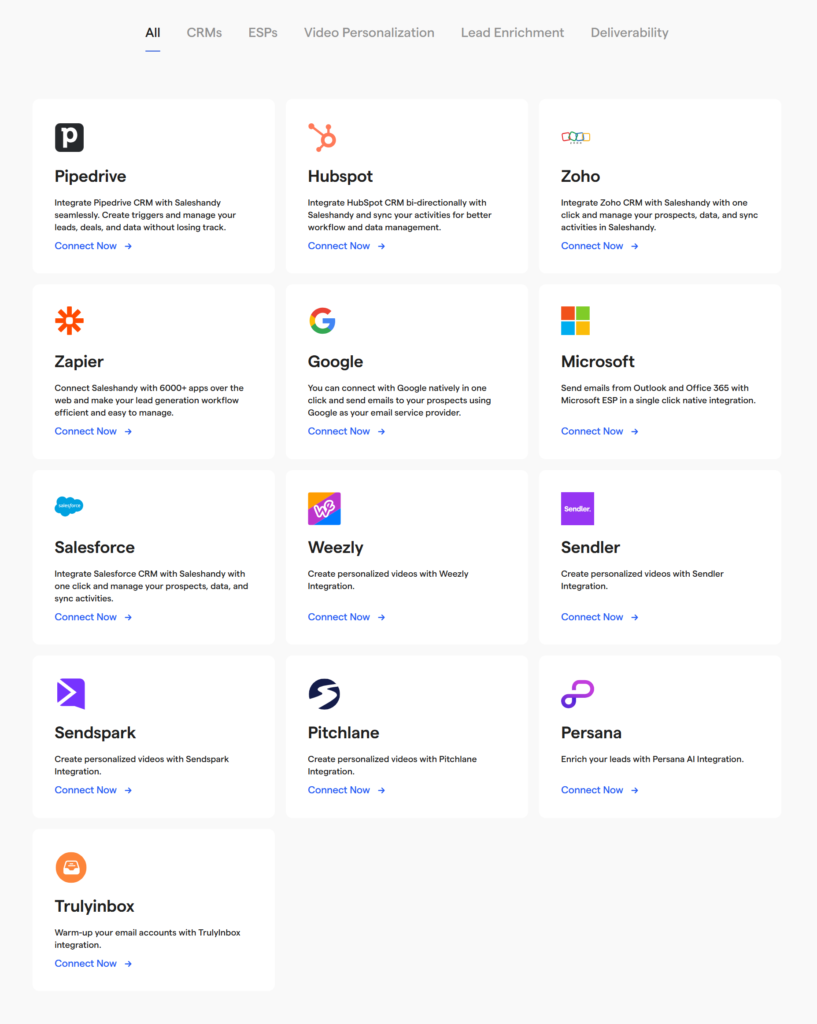
Zapier connectivity opens up thousands of additional integrations. You can connect Saleshandy to Slack for notifications, Google Sheets for data management, or virtually any other tool in your workflow.
The platform also offers webhook support and API access for custom integrations. This is valuable for teams with specific workflow requirements or custom-built tools.
Calendar integrations work with Google Calendar and Outlook, allowing prospects to book meetings directly from your outreach.
Lemlist Integrations
Lemlist offers similar CRM integrations with HubSpot, Salesforce, and Pipedrive. The connections are robust and handle bi-directional syncing well. API access and webhook support are available for custom workflows. Zapier, Make, and n8n integrations provide automation possibilities across thousands of apps.
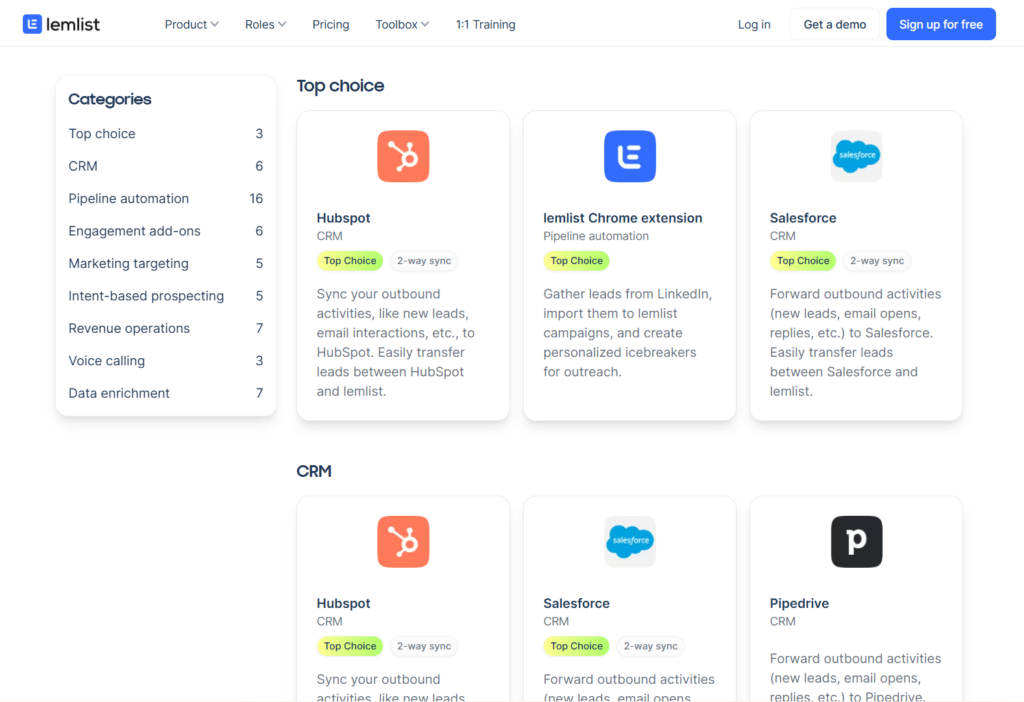
VoIP integrations with Aircall and Ringover enable in-app calling, which is useful for teams using phone outreach as part of their multichannel strategy.
Clay integration allows for advanced data enrichment workflows, and Phantombuster connection helps with LinkedIn automation beyond what Lemlist offers natively.
Integration Winner
Both platforms offer solid integration ecosystems. The core CRM connections work well on both, and Zapier/Make support fills most gaps.
Lemlist has slightly more native integrations for specific use cases like calling and advanced LinkedIn automation. Saleshandy keeps things simpler with fewer native integrations but provides the necessary API and webhook access for custom needs.
For most users, both platforms will integrate fine with existing tools. The decision here shouldn’t be a primary factor unless you have very specific integration requirements.
User Experience and Learning Curve
How quickly can you get up and running? How intuitive is the daily workflow?
Saleshandy’s Interface
Saleshandy uses a clean, straightforward interface organized around core functions: sequences, prospects, analytics, and settings. The sequence builder is linear and easy to understand. You see your emails in order from top to bottom, making it simple to edit steps, adjust timing, or add follow-ups.
Campaign setup is fast. Most users can create their first sequence and start sending within 30 minutes of signing up. The dashboard provides clear metrics without overwhelming you with data. You can see open rates, reply rates, click rates, and bounce rates at a glance.
Navigation is logical. Finding specific features or settings rarely requires searching through multiple menus.
The platform occasionally feels basic compared to more visually polished competitors. Some users prefer simpler interfaces; others want more visual flair.
Lemlist’s Interface
Lemlist invests heavily in interface design. The visual flowchart sequence builder looks impressive and makes complex multichannel campaigns easy to visualize.
The campaign creation process guides you through each step with helpful prompts and suggestions. The AI features feel seamlessly integrated rather than tacked on. However, this polish comes with a steeper learning curve. New users often spend 1-2 hours learning the interface before feeling comfortable creating sequences.
The visual builder can become cluttered when managing many campaigns. Finding specific sequences or understanding branch logic requires more mental overhead than Saleshandy’s linear approach.
Power users appreciate the depth once they master the platform. Casual users sometimes feel overwhelmed by the options and complexity.
User Experience Winner
Saleshandy wins for ease of use and speed to value. You can start sending effective campaigns faster with less training required.
Lemlist wins for visual appeal and depth of functionality. Once you invest time learning the platform, you unlock more sophisticated campaign possibilities.
For teams that want to minimize onboarding time and focus on execution, Saleshandy is the better choice. For teams that value design, want native multichannel sophistication, and don’t mind a learning investment, Lemlist delivers a more polished experience.
AI Features and Automation Intelligence
AI capabilities increasingly differentiate cold email platforms. Both tools offer AI features, but they serve different purposes.
Saleshandy’s AI Capabilities
The AI Sequence Copilot generates complete email sequences based on minimal input. You provide your website URL or describe your offer, and it creates subject lines, body copy, and follow-ups.
The quality is good enough for starting points but requires editing for best results. The AI understands basic value propositions and creates logical sequence flows.
AI Variants automatically generate multiple versions of your email copy. Instead of writing 26 different versions for A/Z testing, the AI creates variations with different angles, tones, and structures.
The AI Lead Finder uses AI to search the B2B database more intelligently. Instead of just filtering by job title, it can find prospects matching complex criteria based on natural language descriptions.
AI Reply Management categorizes incoming replies automatically. The system identifies interested prospects, not interested responses, out-of-office messages, and unsubscribe requests without manual sorting.
AI Prospect Enrichment fills in missing data points about prospects using AI analysis of available information.
Lemlist’s AI Capabilities
The AI Icebreaker Generator creates personalized opening lines by analyzing prospect LinkedIn profiles and websites. It pulls specific details about their company, role, or recent activities to craft relevant introductions.
AI-powered sequence generation creates complete multichannel campaigns. The AI suggests which channels to use, when to use them, and what messages to send across email, LinkedIn, and other touchpoints.
The Gmail Email Coach provides real-time tips while you write emails. It suggests improvements to subject lines, body copy, and calls to action.
AI voice message generation creates personalized audio messages without recording. This is useful for LinkedIn voice notes or voicemail drops.
The copywriting assistant helps improve email content with AI suggestions for better clarity, engagement, and persuasiveness.
AI Winner
Both platforms offer solid AI features that save time and improve results. Lemlist’s AI icebreakers stand out for quality and relevance when pulling prospect-specific information.
Saleshandy’s AI features focus more on scale and efficiency, helping you create many variations and manage high volumes intelligently.
Neither platform’s AI replaces good copywriting and strategy. The AI features work best as tools to accelerate what skilled users already know how to do.
Support and Resources
When you encounter issues or have questions, quality support matters.
Saleshandy Support
Saleshandy offers live chat support with generally quick response times. Most users report getting answers within a few minutes during business hours.
The knowledge base includes detailed articles covering setup, features, troubleshooting, and best practices. Video tutorials walk through common tasks.
Email support handles more complex issues that require deeper investigation. Response times are typically within 24 hours.
Some users on higher plans report receiving personalized onboarding calls and dedicated support from account managers.
The community resources are more limited compared to Lemlist. There’s less user-generated content and fewer public forums for discussion.
Lemlist Support
Lemlist provides chat support with very responsive teams. Many reviews highlight support quality as a standout feature.
The knowledge base is extensive, with hundreds of articles, video tutorials, and playbooks covering not just how to use Lemlist but cold email strategy in general. An active Facebook community and Slack channel connect users. People share templates, strategies, and success stories regularly.
Webinars and educational content are frequent. Lemlist invests heavily in teaching users about effective outreach beyond just platform mechanics.
Enterprise customers get dedicated account managers and VIP support with faster response times and personalized assistance.
Support Winner
Lemlist provides better support resources overall. The combination of responsive direct support, extensive educational content, and active community makes it easier to solve problems and improve your outreach skills.
Saleshandy’s support is solid and responsive, but the ecosystem around it is smaller. For users who value learning from a community and accessing rich educational resources, Lemlist has the advantage.
Use Cases: Which Tool for Which Situation?
Different businesses have different needs. Here’s who should choose each platform.
Choose Saleshandy If You:
- Are an agency managing multiple clients. The unlimited client management without per-client fees makes Saleshandy dramatically more affordable for agencies. You can onboard new clients without worrying about costs multiplying.
- Need to connect many email accounts. With unlimited email accounts from the base plan, you can scale email infrastructure without limitations or extra fees.
- Want the most affordable option for high-volume sending. Saleshandy’s flat-rate pricing and high email limits make it the most cost-effective choice for sending tens or hundreds of thousands of emails monthly.
- Prioritize deliverability. The inbox placement testing, sequence scoring, and comprehensive deliverability suite give you better tools to ensure emails reach the inbox.
- Prefer simple, straightforward workflows. If you want to create sequences quickly without complex branching or flowcharts, Saleshandy’s linear approach is faster and easier.
- Have a growing team. Unlimited team members mean you can hire without worrying about per-user costs increasing your software budget.
- Value predictable pricing. You know exactly what you’ll pay regardless of how your team or client base grows.
Choose Lemlist If You:
- Depend on visual personalization. If custom images, personalized videos, and dynamic landing pages are core to your outreach strategy, Lemlist’s native features are superior.
- Need native multichannel automation. Lemlist’s ability to automate LinkedIn actions, WhatsApp messages, and call tasks within the same sequence as emails provides seamless multichannel orchestration.
- Are you a solo user or a very small team. For 1-2 people, Lemlist’s per-user pricing isn’t prohibitively expensive, and you get access to sophisticated features.
- Value interface design and visual workflows. If you prefer seeing your campaigns as branching flowcharts and appreciate polished UI design, Lemlist provides a more visually appealing experience.
- Want advanced personalization depth. Liquid syntax, dynamic content, and AI icebreakers that pull prospect-specific information give you more personalization options.
- Are willing to pay for premium features. If budget isn’t the primary concern and you want the most feature-rich platform regardless of cost, Lemlist delivers more bells and whistles.
- Appreciate extensive educational resources. The community, webinars, playbooks, and educational content help you become better at cold outreach beyond just using the tool.
The Verdict: Which Platform Wins in 2026?
After extensive testing and comparison, here’s the bottom line: Saleshandy offers better value for most businesses in 2026, particularly for agencies, growing teams, and anyone focused on scalable, cost-effective outreach.
The pricing difference is substantial and becomes more dramatic as you scale. Unlimited email accounts, unlimited team members, and unlimited client management from the base plan make Saleshandy dramatically more affordable for growth-focused businesses.
The deliverability suite is more comprehensive. Inbox placement testing, sequence scoring, ESP matching, and other features give you better tools to ensure your emails actually reach prospects.
The interface is simpler and faster to use. While Lemlist looks prettier, Saleshandy helps you execute campaigns more quickly with less complexity.
For agencies specifically, there’s no comparison. The ability to add unlimited clients without multiplying costs makes Saleshandy the obvious choice. Lemlist’s model of paying per workspace per client becomes prohibitively expensive at scale.
However, Lemlist wins in specific scenarios. If visual personalization with custom images and videos is central to your outreach strategy, Lemlist’s native features are superior. If you need sophisticated native multichannel automation with LinkedIn and WhatsApp built directly into email sequences, Lemlist provides better out-of-the-box functionality.
For solo entrepreneurs or very small teams (1-2 people) who prioritize design and don’t need many email accounts, Lemlist’s higher price might be justified by the polish and advanced personalization features.
Final Recommendation
For most businesses in 2026, Saleshandy is the better choice. It delivers excellent features, superior deliverability tools, and unlimited scalability at a fraction of Lemlist’s cost.
Start with Saleshandy’s 7-day free trial if you:
- Run an agency managing multiple clients
- Need to connect more than 3-5 email accounts
- Have a team of more than 2 people
- Send high email volumes (50,000+ monthly)
- Want the most affordable option without sacrificing essential features
- Prioritize deliverability and inbox placement
Consider Lemlist’s 14-day free trial if you:
- Are a solo founder or 2-person team
- Depend heavily on visual personalization (custom images, videos)
- Need native multichannel automation as a core workflow
- Prefer polished UI and visual campaign builders
- Budget isn’t the primary concern
- Value extensive educational resources and community
Both platforms work well for cold email outreach. Your choice depends on what matters most: affordability and scalability (Saleshandy) or visual polish and advanced personalization (Lemlist).
The good news? Both offer free trials, so you can test them with real campaigns before committing. Take advantage of this to see which platform fits your workflow, team, and budget best.
Frequently Asked Questions
Is Saleshandy better than Lemlist?
For most businesses, yes. Saleshandy offers better value with unlimited email accounts, unlimited team members, more affordable pricing, and superior deliverability features. However, Lemlist excels at visual personalization and native multichannel automation, which some teams prioritize.
What is the main difference between Saleshandy and Lemlist?
Pricing model and personalization depth. Saleshandy uses flat-rate pricing with unlimited scaling, while Lemlist charges per user. Saleshandy focuses on affordability and deliverability; Lemlist emphasizes visual personalization and multichannel sophistication.
Can I use both platforms together?
Technically yes, but it’s inefficient. Both platforms serve the same core purpose. Most businesses should choose one and commit to maximizing its capabilities rather than paying for overlapping functionality.
Which platform is easier to learn?
Saleshandy has a shorter learning curve with its straightforward interface. Most users can create effective sequences within 30 minutes. Lemlist’s visual flowchart builder and advanced features require 1-2 hours to master but unlock more sophisticated capabilities.
Do both platforms offer free trials?
Yes. Saleshandy offers a 7-day free trial with no credit card required. Lemlist provides a 14-day free trial, also without requiring payment information upfront.
Which platform has better deliverability?
Saleshandy provides more comprehensive deliverability tools, including inbox placement testing, sequence scoring, ESP matching, and bounce detection. Lemlist covers the basics with warm-up and sender rotation but lacks advanced testing features.
Can agencies use these platforms to manage clients?
Yes, but Saleshandy is dramatically more cost-effective for agencies. It includes unlimited client management at no extra cost, while Lemlist requires purchasing separate workspaces for each client.
Which tool is better for high-volume sending?
Saleshandy is better for high volume. Unlimited email accounts, flat-rate pricing, and higher email limits make it more scalable and affordable when sending hundreds of thousands of emails monthly.
Does Lemlist’s advanced personalization justify the higher price?
It depends on your strategy. If custom images, personalized videos, and dynamic landing pages are central to your outreach success and generate measurably better results, the higher price might be justified. For most businesses, Saleshandy’s standard personalization features deliver strong results at lower cost.
Which platform has better customer support?
Lemlist provides more extensive support resources, including an active community, frequent webinars, and comprehensive educational content. Saleshandy offers responsive direct support but a smaller ecosystem around it.
Can I switch from one platform to another?
Yes, both platforms allow you to export prospect data and import contact lists. However, sequence templates and campaign structures don’t transfer directly, so you’ll need to rebuild campaigns when switching.
Which platform is better for LinkedIn outreach?
Lemlist offers native LinkedIn automation within sequences, making it more seamless for multichannel campaigns. Saleshandy supports LinkedIn through manual tasks and Chrome extension features but requires more hands-on management.
The choice between Saleshandy and Lemlist ultimately depends on your specific needs, budget, and outreach strategy. Test both platforms during their free trial periods to experience the differences firsthand and make an informed decision based on your actual workflow requirements.