
Building software used to require months of development, expensive engineering teams, and deep technical knowledge. Not anymore.
Welcome to the vibe coding revolution, where you describe what you want in plain English, and AI builds your entire application for you. However, with numerous options flooding the market, selecting the right platform is more crucial than ever.
Today, we’re diving deep into two heavyweights in the vibe coding space: Emergent and Rocket. Both promise to transform your ideas into production-ready apps without writing code. Both have raised millions in funding and attracted hundreds of thousands of users. But they take fundamentally different approaches to the same problem.
If you’re trying to decide between Emergent and Rocket, this comprehensive comparison will give you everything you need to make the right choice. We’ll break down their features, pricing, performance, real-world use cases, and which one actually delivers on its promises.
What Exactly Is Vibe Coding?
Before we jump into the Emergent.sh vs Rocket.new showdown, let’s get clear on what vibe coding actually means. The term was coined by Andrej Karpathy in February 2025, and it represents a fundamental shift in how software gets built.
Traditional coding requires you to write every line of syntax, manage dependencies, configure databases, handle authentication, and debug errors. It’s time-consuming and technical. Vibe coding flips this entirely. You describe what you want to build in natural language, and AI agents handle all the technical implementation. You’re no longer writing code. You’re vibing with AI to get the outcome you need.
Think of it as the difference between telling a contractor exactly how to frame each wall versus describing your dream kitchen and letting them handle the construction details. The result is the same, but the path to get there is radically different.
Vibe coding platforms use large language models and specialized AI agents to interpret your requirements, plan the architecture, write the code, set up databases, configure authentication, handle deployment, and even fix bugs automatically. The best platforms deliver production-ready applications, not just prototypes.
Both Emergent.sh and Rocket.new are full-stack vibe coding platforms, meaning they handle everything from frontend design to backend logic to cloud deployment. But how they approach this challenge differs significantly.
Emergent.sh: The Y Combinator Speed Machine
Emergent burst onto the scene with impressive credentials and even more impressive growth. Founded by twin brothers Mukund Jha and Madhav Jha, both with deep tech backgrounds from Google, Amazon, and Dunzo, Emergent quickly became one of the fastest-growing vibe coding platforms in the world.
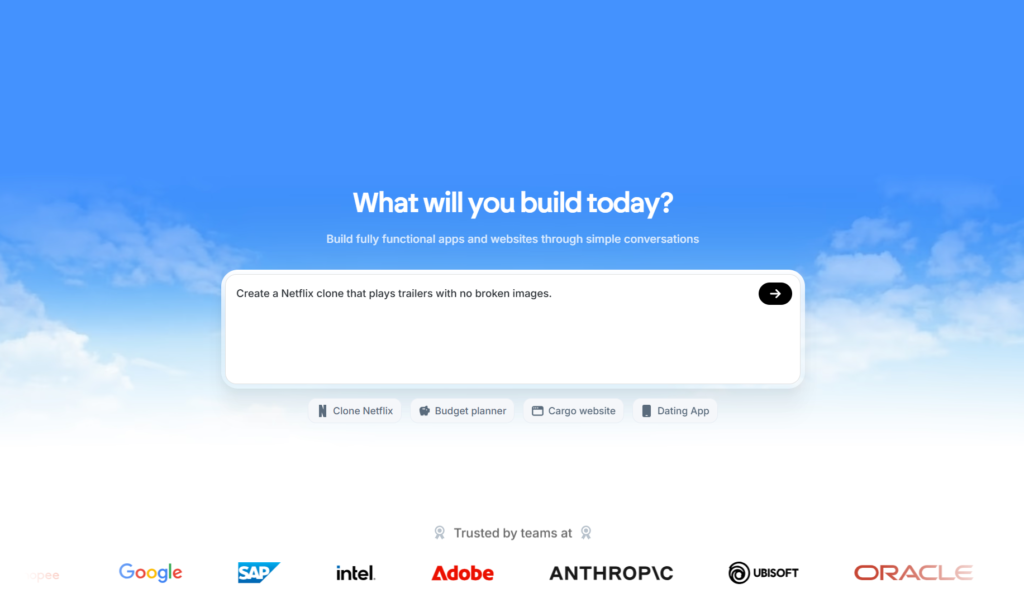
The numbers tell a remarkable story. Emergent reached $10 million in annual recurring revenue within just two months of launch and now serves over 700,000 users worldwide. That kind of explosive growth doesn’t happen by accident. Emergent clearly struck a chord with builders who were tired of slow, expensive development cycles.
How Emergent.sh Works
Emergent takes a multi-agent architecture approach. Instead of relying on a single AI model to do everything, Emergent deploys specialized agents that collaborate on your project. One agent handles planning and architecture.
Another writes the frontend code. A third manages backend logic and database design. A fourth handles testing and debugging. A fifth manages deployment.
This division of labor creates surprisingly sophisticated results. When you describe your app idea to Emergent, these agents work together to deliver a complete, functional application in minutes. The platform supports building everything from simple landing pages to complex SaaS products with user authentication, payment processing, and database integration.
Emergent shines in its speed. You can go from an initial prompt to a live, deployed application faster than almost any competing platform. That rapid iteration cycle makes it perfect for testing ideas, building MVPs, and getting feedback from real users as quickly as possible.
The platform handles full-stack development across multiple frameworks. It supports React for frontend development, Python with FastAPI or Node.js for backend work, and integrates with databases like MongoDB and PostgreSQL. Authentication, payment gateways like Stripe, and third-party integrations with tools like Google Sheets and Airtable come built in.
One standout feature is Emergent’s self-healing code capability. If an error pops up during the build process, the testing agents can often detect the problem, debug it, and deploy a fix without you even noticing. This reduces the frustrating back-and-forth that can drain your credits and patience on other platforms.
Emergent also includes GitHub integration, allowing you to export your code, version control your projects, and collaborate with team members. For solo founders and small teams, this flexibility means you’re never locked into the platform. You own your code and can take it elsewhere if needed.
Emergent Pricing Structure
Emergent uses a credit-based pricing model, where every action consumes credits. Planning, coding, testing, deploying, and making changes all deduct credits from your balance. This pay-as-you-go approach offers flexibility but requires careful management.
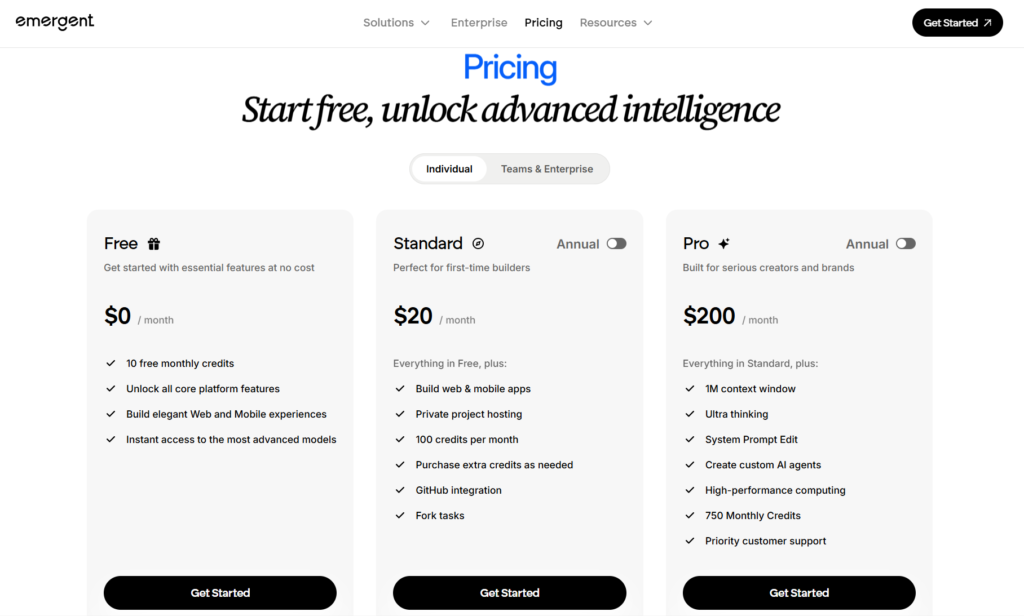
Here’s the breakdown of Emergent’s pricing plans as of early 2026:
Free Plan ($0/month): You get 10 credits to test the platform and explore its capabilities. This is enough to understand how Emergent works and build a very simple proof of concept, but not enough to complete a real project. You can’t deploy apps on the free plan since deployment alone costs 50 credits per month.
Standard Plan ($20/month or $204/year): This plan provides 100 monthly credits, which works out to roughly $0.20 per credit when you do the math. It includes unlimited small projects, popular integrations like Google Sheets and Airtable, mobile app building capabilities, GitHub integration, and 10 daily credits. This plan works well for solo builders working on one or two projects per month, but deployment costs eat up half your monthly allocation.
Pro Plan ($200/month or $2,004/year): The Pro plan gives you 750 monthly credits, premium integrations including Stripe for payments, early access to beta features, a 1 million token context window, custom agent creation tools, priority support, and faster performance on more powerful infrastructure. This plan targets serious builders, agencies, and teams working on multiple client projects simultaneously.
Enterprise Plan (Custom Pricing): For large organizations with specific needs around security, compliance, and dedicated support, Emergent offers custom enterprise solutions with tailored credit allocations.
The biggest gotcha with Emergent’s pricing is deployment. Keeping your app live costs 50 credits per month. On the Standard plan, that’s half your monthly allocation gone before you write a single new feature. Many users don’t discover this until they click the deploy button, which can feel frustrating if you’re not prepared for it.
Credits don’t expire, and unused credits roll over from month to month, which provides some flexibility. If you run out mid-project, you can purchase additional credits at $10 for 50 credits.
Emergent.sh Strengths
Speed defines Emergent’s biggest advantage. If your priority is getting from idea to deployed application as fast as possible, Emergent excels. The multi-agent system works efficiently, and you can often have a working prototype in minutes rather than hours or days.
The self-healing code feature reduces debugging headaches significantly. Other vibe coding platforms can trap you in frustrating loops where the AI makes mistakes, you spend credits trying to fix them, and you end up burning through your budget on error corrections. Emergent’s testing agents catch many of these issues automatically.
GitHub integration gives you real ownership and portability. You’re not locked into Emergent’s ecosystem. You can export your code, bring in developers to customize it further, or migrate to traditional hosting if your needs evolve beyond what the platform offers.
The user interface feels intuitive and modern. Even if you’ve never built software before, Emergent’s chat-based workflow feels natural. You describe what you want, review the results in real-time, and refine through conversation.
Emergent Weaknesses
The credit system causes confusion and frustration for many users. Unlike subscription models where you know exactly what you’re getting each month, Emergent’s consumption-based pricing makes cost prediction difficult. Complex projects can burn through credits faster than you expect, and there’s no clear menu showing how much different actions will cost.
Deployment pricing catches users by surprise. Spending 50 credits per month just to keep an app live feels expensive when that represents $10 of your $20 Standard plan. Many competing platforms include hosting at no extra cost within their subscription tiers.
Credit consumption can be unpredictable. If the AI makes mistakes or needs multiple iterations to get something right, you’re paying for every attempt. Some users report burning through their monthly allocation in a single day when working on complex features.
The platform works best for speed over depth. If you need highly customized, complex logic or specialized functionality, you may hit limitations. The AI agents excel at standard patterns and common use cases but struggle with edge cases or unconventional requirements.
Customer support relies heavily on community-driven resources rather than dedicated support teams for lower-tier plans. The documentation is solid, but getting personalized help when you’re stuck can take time unless you’re on the Pro or Enterprise plans.
Rocket.new: The Production-Ready Perfectionist
Rocket.new takes a different philosophy to vibe coding. While Emergent optimizes for speed, Rocket optimizes for completeness and production readiness. The platform launched more recently but comes from experienced founders with a strong technical foundation.
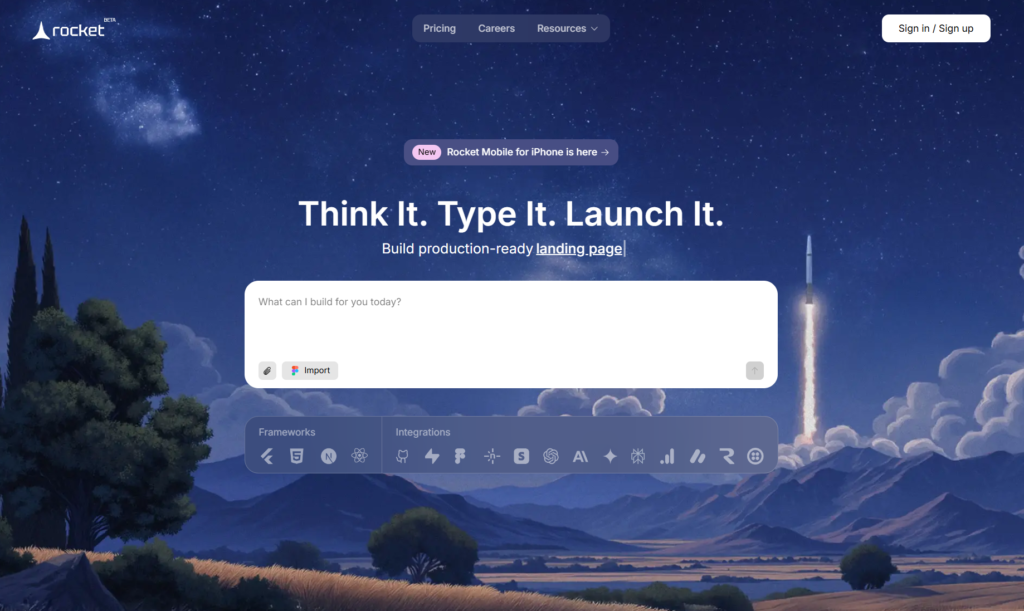
Founded by Vishal Virani, Rahul Shingala, and Deepak Dhanak, who previously built DhiWise (a developer workflow tool), Rocket.new raised $15 million in seed funding from heavy hitters including Salesforce Ventures, Accel, and Together Fund.
The company operates from Surat, India, a city better known for diamonds than tech startups, but don’t let the location fool you. Rocket.new is building something serious.
The platform has attracted 400,000 users across 180 countries since its launch in June 2025 and has already generated over half a million applications. More impressively, 80% of users are building substantial applications rather than basic websites, suggesting the platform attracts serious builders with real project requirements.
How Rocket.new Works
Rocket.new deliberately chooses to be slower but more thorough than most vibe coding tools. When you submit a prompt, the platform doesn’t immediately start generating code. Instead, it asks clarifying questions.
Are you building a mobile app or a web app? What’s the target persona? What’s the core functionality? Should it prioritize speed or feature completeness? These questions might seem like extra steps, but they dramatically improve the final output quality.
Once Rocket understands your requirements, it suggests a technology stack. Unlike many vibe coding platforms with fixed tech stacks, Rocket offers flexibility. You can accept the recommendations or choose alternatives based on your preferences or future scalability needs.
The platform then outlines a complete list of features, pages, and workflows required for your application to actually function. You review and approve this plan before any code gets written. This planning phase prevents the common vibe coding problem where you get 80% of the way to a finished app only to discover critical functionality is missing.
After approval, Rocket moves through copywriting, design system creation, and code generation before compiling everything into a functional preview. The entire process takes approximately 25 minutes for a first application, much slower than Emergent’s few-minute generation time. But that slowness is intentional.
Rocket integrates large language models from multiple providers, including OpenAI, Anthropic, and Google Gemini, combined with proprietary deep learning systems trained on datasets from DhiWise. This multi-model approach allows Rocket to choose the best AI for each specific task rather than relying on a single model for everything.
The output is typically a multi-page application with proper navigation, realistic data structures, complete workflows, and usable interfaces. It’s not just a demo. It’s something you can actually deploy and use.
Rocket excels at Figma-to-code conversion. If you’ve already designed your app in Figma, you can import those designs and Rocket will convert them into responsive code for web and mobile, maintaining your design vision while adding functional logic.
The platform supports cross-platform development, generating web applications and native mobile apps for both iOS and Android from a single project. This saves enormous time if you need presence across multiple platforms.
One-click deployment makes going live painless. Rocket handles hosting, connects custom domains, and manages SSL certificates. You can also export your code to GitHub, deploy to Netlify, or package as installable mobile apps.
Rocket.new Pricing Structure
Rocket.new uses a token-based pricing model similar to Emergent’s credits, but with better transparency and more predictable costs. Tokens are consumed when you generate apps, import Figma designs, or make iterations. Every plan includes token rollover, so unused tokens carry forward to the next month on monthly plans and within your annual term on yearly subscriptions.
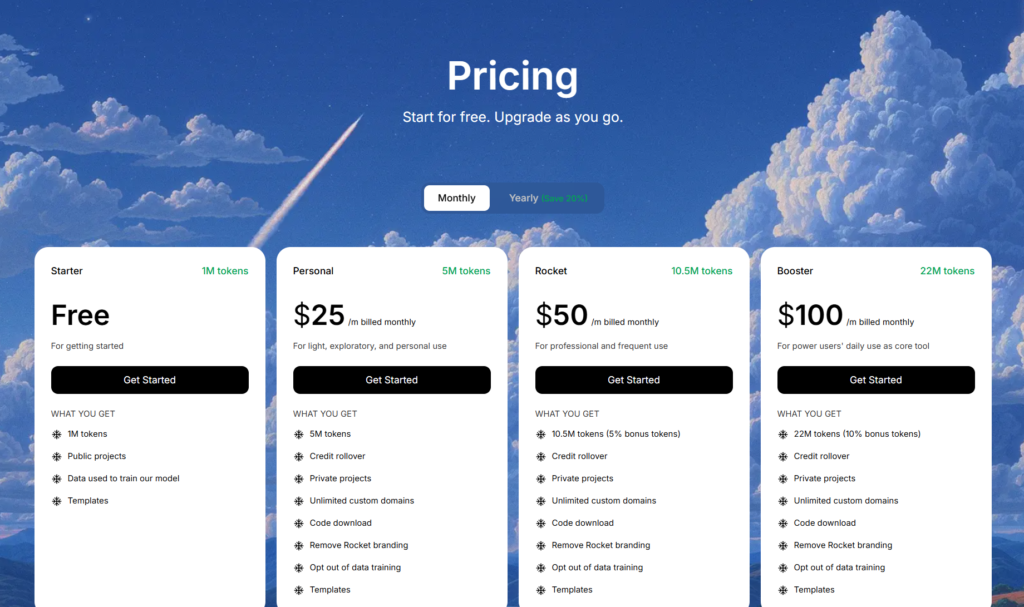
Here’s Rocket.new’s pricing:
Starter Plan (Free): The free plan includes 1 million tokens to test the platform. This gives you enough capacity to build a few features, import a couple of Figma screens, and understand Rocket’s workflow. It’s genuinely useful for exploration, not just a marketing gimmick.
Personal Plan ($25/month or $240/year): This plan provides 5 million monthly tokens, which is enough to create 2-3 complete websites or apps per month depending on complexity. It includes Figma-to-code conversion, GitHub integration, one-click deployment, and code export. This hits the sweet spot for solo builders, freelancers, and side project enthusiasts.
Rocket Plan ($50/month or $480/year): The Rocket plan offers 10.5 million monthly tokens plus bonus tokens. It’s designed for professionals who use Rocket weekly to build client projects or iterate on their own products. At this tier, you can comfortably handle 4-5 client projects monthly. Annual billing saves $120 per year.
Booster Plan ($100/month or $960/year): Built for high-volume users, agencies, and teams, the Booster plan provides 20 million monthly tokens with additional bonuses. This level supports multiple simultaneous projects, complex applications with many screens, and continuous iteration without token anxiety. Agencies find this plan cost-effective when spread across team members.
Refuel Packs: If you exhaust your monthly token allocation, you can purchase additional tokens at $20 for 5 million tokens. These refuel tokens don’t expire unless you cancel your subscription, providing flexibility for high-demand months.
The critical difference between Rocket and Emergent pricing is transparency. Token consumption is more predictable because Rocket performs upfront planning, giving you a clearer sense of project scope before burning tokens. The platform also offers free error fixes for issues it detects, so you’re not paying repeatedly to correct AI mistakes.
Rocket.new Strengths
Production readiness is Rocket’s defining characteristic. The deliberate, methodical approach produces applications that actually work in the real world, not just impressive demos. The upfront planning phase catches requirements gaps early, preventing costly iterations later.
Figma-to-code conversion is exceptionally smooth. Designers love this feature because they can create pixel-perfect mockups in Figma and trust that Rocket will translate their vision into functional code accurately. This bridges the traditional designer-developer gap.
Token economics favor serious builders. Because Rocket asks questions upfront and plans thoroughly, you waste fewer tokens on trial and error. The free error fixing for Rocket-detected issues further improves cost efficiency.
Cross-platform support delivers genuine value. Building web and mobile versions simultaneously from one project saves massive amounts of time and money compared to developing separately for each platform.
The quality of generated code consistently impresses users. Multiple reviewers note that Rocket produces cleaner, more maintainable code than competing platforms. If you plan to hand off the code to developers for customization later, this matters significantly.
User testimonials highlight Rocket’s ability to “one-shot” working applications from complex prompts. While Emergent might require multiple refinement cycles, Rocket often nails requirements on the first attempt because of its clarifying questions and planning process.
Rocket.new Weaknesses
Speed is the obvious tradeoff. If you need to test ten different ideas in an afternoon, waiting 25 minutes for each generation feels slow compared to Emergent’s rapid iterations. Rocket optimizes for quality over velocity.
The upfront questioning process, while valuable for quality, can feel tedious if you already have clear requirements. Experienced builders sometimes want to skip the interrogation and just get their app built.
Token consumption varies significantly based on project complexity in ways that aren’t always predictable. A simple landing page might use 1-2 million tokens, while a complex multi-feature application could consume 3-5 million. Estimating costs before starting a project requires experience with the platform.
The platform is relatively new compared to some competitors. While rapid growth and strong funding signal confidence, you’re working with a younger platform that’s still refining its feature set and fixing edge cases.
Enterprise features lag behind more established platforms. If you need advanced security controls, compliance certifications, or dedicated support, Rocket’s enterprise offerings are less mature than some alternatives.
Head-to-Head Comparison: Emergent.sh vs Rocket.new
Now that we’ve examined each platform individually, let’s directly compare them across the dimensions that matter most when choosing a vibe coding tool.
Speed and Iteration Velocity
Winner: Emergent.sh
If your priority is moving fast, Emergent dominates. The multi-agent system generates working applications in minutes. For rapid prototyping, testing multiple ideas, or getting quick feedback from potential users, Emergent’s velocity is unmatched.
Rocket.new deliberately trades speed for completeness. The 25-minute generation time feels glacial compared to Emergent’s few-minute turnaround. However, Rocket often produces more complete results that require fewer subsequent iterations.
The real question is whether you value speed per iteration or speed to production-ready. Emergent wins the first metric. Rocket often wins the second because its thorough approach reduces total iteration count.
Code Quality and Production Readiness
Winner: Rocket.new
Multiple independent reviews and user testimonials consistently praise Rocket for producing cleaner, more maintainable, production-grade code. The deliberate planning phase and multi-model AI approach result in more thoughtful architecture and fewer bugs.
Emergent produces functional code quickly, but users sometimes report needing additional refinement to reach production quality. The self-healing features help, but they can’t eliminate the quality gap created by rapid generation.
If you’re building a proof of concept or internal tool where code quality matters less, the difference is negligible. If you’re shipping to real customers or plan to maintain and scale the application long-term, Rocket’s quality advantage becomes significant.
Feature Completeness
Winner: Tie (with different strengths)
Emergent excels at rapid full-stack application generation with strong integration support for common tools like Google Sheets, Airtable, and Stripe. The GitHub integration and mobile app building capabilities are solid.
Rocket shines at Figma-to-code conversion, cross-platform development, and producing feature-complete applications from complex prompts. The multi-model AI approach allows it to handle diverse requirements effectively.
Both platforms support authentication, databases, API creation, and deployment. Your choice depends on whether Figma integration and cross-platform mobile apps (Rocket) or rapid iteration and self-healing code (Emergent) matter more for your use case.
Learning Curve and User Experience
Winner: Emergent.sh
Emergent’s conversational interface feels more natural and requires less upfront knowledge. You start chatting about your idea, and the platform guides you through the process. The self-healing features reduce technical frustration.
Rocket’s questioning process, while valuable for output quality, creates more friction for beginners. You need to understand concepts like technology stacks, user personas, and feature scoping to make informed decisions during the planning phase.
Both platforms are accessible to non-developers, but Emergent has a gentler onboarding curve. You can start building immediately without deep technical knowledge.
Scalability and Enterprise Features
Winner: Emergent.sh
Emergent offers more mature enterprise options with custom agent creation, priority support, powerful infrastructure, and flexible credit allocations. The platform has been operational longer and has refined its enterprise offering through actual large-customer deployments.
Rocket.new is growing rapidly and improving enterprise features, but it’s playing catch-up in this category. If you’re a large organization requiring advanced security, compliance, or dedicated support, Emergent has a current advantage.
For individual builders and small teams, this difference doesn’t matter much. The gap only becomes relevant at enterprise scale.
Community and Support
Winner: Tie
Emergent has a larger user base (700,000+ vs 400,000) and more established community resources, documentation, and third-party content. Finding tutorials and getting community help is easier.
Rocket.new has strong backing from Salesforce Ventures and other major investors, suggesting robust long-term support. User testimonials praise the team’s responsiveness and proactive customer service.
Neither platform offers unlimited direct support on lower tiers, relying instead on documentation and community resources. Both have responsive teams when you do reach out.
Real-World Use Cases: Which Tool Wins?
Different scenarios favor different platforms. Here’s guidance based on specific use cases:
For Quick MVPs and Idea Validation
Choose: Emergent.sh
If you’re a startup founder who needs to test three different product concepts this week, Emergent’s speed is invaluable. Generate each MVP in minutes, deploy quickly, gather user feedback, and iterate based on what you learn. The rapid cycle time helps you find product-market fit faster.
For Client Projects and Freelance Work
Choose: Rocket.new
Freelancers and agencies benefit from Rocket’s production-ready output and clear project scoping. The upfront planning helps you set accurate client expectations. The Figma-to-code conversion means you can show clients designs, get approval, and deliver functional applications that match the mockups precisely.
The higher code quality also reduces embarrassing bugs when clients start using the application. Professional reputation matters in client work, and Rocket’s thoroughness protects yours.
For Complex SaaS Applications
Choose: Rocket.new
Building a multi-feature SaaS product with complex workflows, multiple user roles, and sophisticated logic benefits from Rocket’s methodical approach. The planning phase helps you think through the complete feature set, and the production-ready code provides a solid foundation for long-term development.
Emergent can certainly build complex applications, but you’ll likely spend more time iterating to get all the details right. Rocket’s one-shot accuracy for complex prompts gives it the edge here.
For Internal Tools and Side Projects
Choose: Emergent.sh
If you need to build a quick internal dashboard for your team, a workflow automation tool, or a side project you’re exploring for fun, Emergent’s speed and simplicity win. These use cases don’t require perfect code quality or extensive planning. You just need something that works, and you need it fast.
For Mobile-First Applications
Choose: Rocket.new
Rocket’s native mobile app generation for iOS and Android from a single project makes it the clear choice for mobile-focused applications. Cross-platform development saves enormous time and money compared to building separately for each platform.
Emergent supports mobile apps but doesn’t match Rocket’s cross-platform capabilities or mobile-specific optimizations.
For Non-Technical Founders
Choose: Emergent.sh
Complete beginners benefit from Emergent’s gentler learning curve and more conversational interface. You can start building without understanding technical concepts. The self-healing code reduces frustration when things go wrong.
Rocket asks technical questions during planning that might confuse non-technical users. While the outcomes are often better, the process requires more technical literacy.
For Design-First Teams
Choose: Rocket.new
If your workflow starts with designers creating Figma mockups that developers then implement, Rocket’s Figma-to-code feature is transformative. Import your designs, and Rocket generates responsive code that matches your vision while adding functional logic.
This workflow dramatically reduces the traditional design-to-development handoff friction and ensures the final product matches the original design intent.
The Verdict: Emergent vs Rocket
After extensively analyzing both platforms, here’s the bottom line: there’s no universal winner. The right choice depends entirely on your specific needs, priorities, and use case.
Choose Emergent if:
- Speed is your top priority
- You’re testing multiple ideas and need rapid iteration
- You’re a non-technical founder getting started with Vibe coding
- You value self-healing code and automatic bug fixes
- You need mature enterprise features
- You prefer the fastest path from idea to deployed application
Choose Rocket if:
- Code quality and production readiness matter most
- You’re building complex applications for real customers
- You need Figma-to-code conversion capabilities
- You’re developing cross-platform mobile applications
- You want more predictable pricing and token consumption
- You prefer thorough planning over rapid iteration
- You’re willing to trade speed for completeness
Both platforms represent the cutting edge of vibe coding technology. Both will help you build applications faster than traditional development. Both are well-funded, rapidly improving, and backed by impressive teams.
The competition between Emergent.sh and Rocket.new ultimately benefits you as a builder. As these platforms compete and innovate, they push each other to improve features, reduce costs, and deliver better results.
Frequently Asked Questions
Can I switch between Emergent and Rocket easily?
Both platforms allow code export, so you’re not permanently locked in. However, switching mid-project creates friction because each platform structures code differently. Choose wisely upfront based on your project requirements.
Which platform is better for e-commerce sites?
Both support Stripe integration for payments, but Rocket’s thoroughness in setting up complete workflows gives it a slight edge for complex e-commerce with inventory management, order tracking, and multi-step checkouts. For simple online stores, either works fine.
Do these platforms replace developers entirely?
Not yet, and probably not ever completely. Vibe coding platforms dramatically reduce the need for developers during initial building and standard features. But complex customizations, performance optimization, and sophisticated integrations still benefit from developer expertise. Think of these tools as accelerating development rather than eliminating it.
How do these compare to other vibe coding tools like Lovable or Bolt?
Lovable optimizes for beautiful UI and rapid prototyping but produces less complete backend logic. Bolt focuses on speed like Emergent but with less production readiness. Emergent and Rocket both target the production-ready full-stack application space, making them more directly comparable to each other than to UI-focused competitors.
Can I use my own infrastructure and hosting?
Yes, both platforms allow code export. You can download your application and deploy it on your own infrastructure if you prefer. This provides an exit strategy and prevents vendor lock-in.
Which platform has better AI models?
Rocket.new uses multiple models from OpenAI, Anthropic, and Google Gemini, choosing the best one for each task. Emergent primarily uses Claude Sonnet 4 from Anthropic with its multi-agent system. Both approaches work well. Rocket’s multi-model flexibility provides more options, while Emergent’s specialized agents create efficient workflows.
What about data security and privacy?
Both platforms implement standard security practices including encryption, secure authentication, and privacy policies compliant with major regulations. For highly sensitive applications or regulated industries, review each platform’s security documentation and consider their enterprise tiers with additional controls.
How do costs compare for a typical project?
A moderately complex application might consume 100-150 credits on Emergent (including deployment), fitting within the $20 Standard plan but leaving little room for iteration. The same application on Rocket.new might use 3-5 million tokens, fitting comfortably within the $25 Personal plan with room to spare. Rocket’s pricing tends to be more economical for serious projects once you account for Emergent’s deployment costs and potential iteration expenses.
Final Thoughts
The vibe coding revolution is fundamentally changing who can build software and how quickly they can do it. Just a few years ago, turning an idea into a functional application required months of work and tens of thousands of dollars. Today, you can do it in an afternoon for less than a monthly gym membership.
Both Emergent.sh and Rocket.new represent the state of the art in this transformation. Neither is perfect. Both have tradeoffs. But both are genuinely remarkable tools that would have seemed like science fiction not long ago.
My advice? Try both platforms on their free tiers. Build a simple version of your actual project on each. See which workflow feels more natural. Compare the output quality. Check which one produces results closer to your vision.
The best vibe coding platform isn’t determined by features and pricing alone. It’s the one that matches your specific workflow, technical comfort level, and project requirements. For some builders, that’s Emergent’s rapid iteration. For others, it’s Rocket’s methodical completeness.
The future of software development is conversational, accessible, and AI-powered. Whether you choose Emergent.sh, Rocket.new, or explore alternatives, you’re participating in one of the most exciting technological shifts of our generation. The barriers to building are falling, and that means more ideas become reality.
Stop reading comparisons and start building. Your next great application is just a conversation away.
