
Your first customer just placed an order. Three weeks later, they’re emailing asking where their package is. You check the tracking, it’s still in customs. Another one-star review incoming. This is how most dropshipping stores die before they ever get started.
The platform you choose determines whether your customers wait 3 days or 30 days for their orders. Spocket and Zendrop both claim to solve the slow-shipping problem, but they take completely opposite approaches. One focuses on premium US/EU suppliers with blazing-fast delivery. The other offers massive product selection with automation tools that scale to thousands of orders.
Choose wrong, and you’ll spend months fighting the wrong battles, either bleeding money on a plan that’s overkill for your needs, or hitting frustrating limitations right when your store starts gaining traction.
I’ve spent weeks testing both platforms, analyzing their actual shipping times, comparing real wholesale prices, and digging through hundreds of user complaints to find the patterns most reviews miss. This isn’t another surface-level comparison regurgitating feature lists.
By the end of this post, you’ll know exactly which platform fits your business model, and more importantly, which one will cost you customers if you pick it.
What Makes Spocket and Zendrop Different?
Before we dive into the nitty-gritty, let’s establish what each platform actually does.
Spocket focuses on curated, high-quality products from US and European suppliers.

Think of it as the “premium” option; you’re paying more for better product quality, faster domestic shipping, and a marketplace designed for sellers who want to compete on brand value rather than rock-bottom prices.
Zendrop takes a different approach. It’s built for automation and scalability, offering a massive product catalog (over 1 million items) with AI-powered tools to help you find winning products.
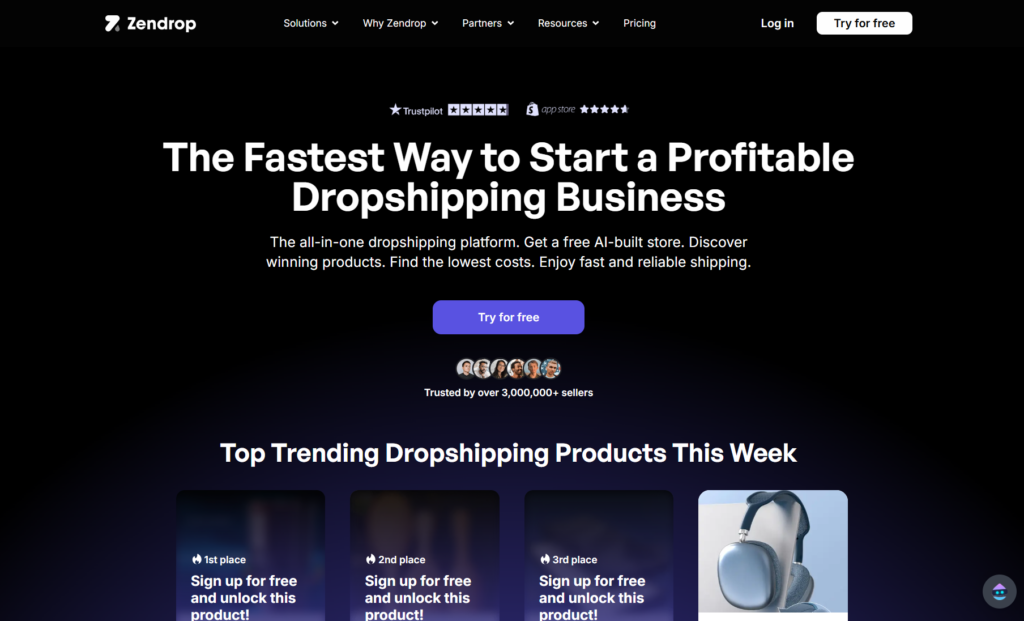
Zendrop also provides custom branding options and handles more of the fulfillment process in-house, which means better quality control than traditional AliExpress dropshipping.
The core difference? Spocket prioritizes supplier quality and regional sourcing. Zendrop prioritizes automation and growth features.
Breaking Down the Pricing: What You Actually Get
Let’s talk money. Pricing is where most dropshippers make their first mistake; they go for the cheapest option without understanding what they’re giving up.
Spocket Pricing Plans
Spocket offers four tiers after a 14-day free trial:
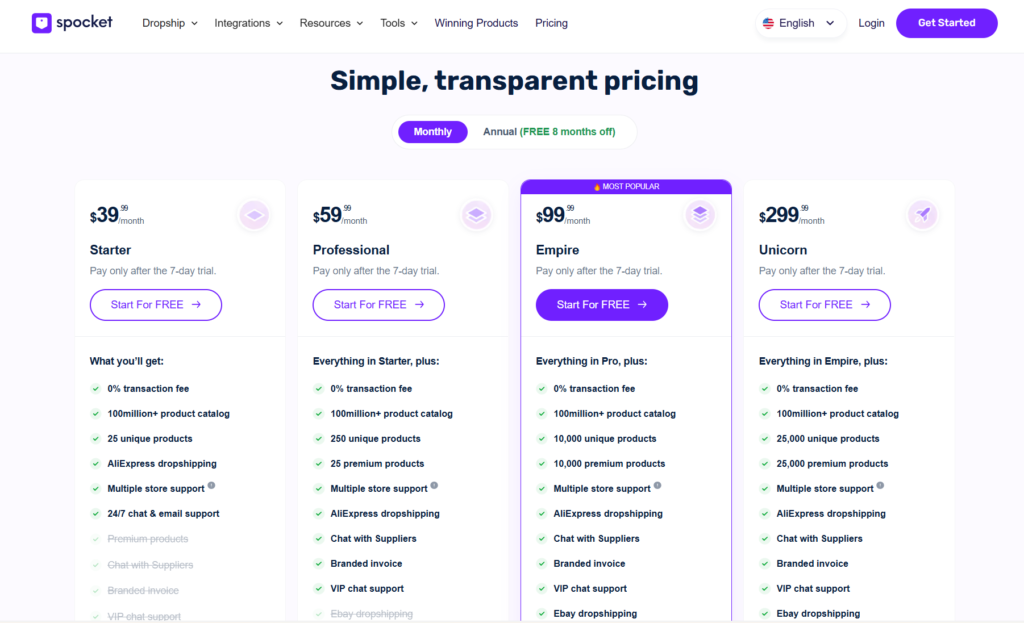
Starter Plan – $39.99/month
- 25 unique products
- Branded invoicing
- Email support
- Access to US/EU suppliers
Pro Plan – $59.99/month
- 250 unique products
- 25 premium products
- Winning product recommendations
- Premium chat support
Empire Plan – $99.99/month
- 10,000 unique products
- 10,000 premium products
- Supplier chat feature
- Priority support
Unicorn Plan – $299.99/month
- 25,000 unique products
- 25,000 premium products
- Bulk checkout
- VIP support
Zendrop Pricing Plans
Zendrop offers more flexibility with these options:

Free Plan – $0/month
- Access to 1M+ products
- Basic order processing
- Standard shipping
- 24/7 support
Pro Plan – $49/month ($399 annually)
- Unlimited orders
- Automated fulfillment
- US warehouse products
- Custom branding
- Product sourcing requests
Plus Plan – $79/month ($549 annually)
- Everything in Pro
- Live weekly coaching calls
- Zendrop Academy access
- Product bundles & subscription boxes
- Trending product finder
Usage-Based Plan (Shopify only)
- 0 linked products: Free
- 1-20 products: $29/month
- 21-100 products: $49/month
- 101+ products: $79/month
Price Comparison: The Real Story
Zendrop wins on affordability, especially for beginners. That free plan actually lets you process orders (unlike most “free” plans that just let you browse products). You can literally test dropshipping without spending a dime.
Spocket’s entry point is higher at $39.99/month, but you’re immediately getting access to vetted US/EU suppliers. If you’re targeting customers who expect fast shipping and won’t tolerate 2-3 week delivery times, that extra cost pays for itself in customer satisfaction.
For scaling businesses, Zendrop’s Pro plan at $49/month offers better value than Spocket’s comparable tier. You get unlimited orders and automation features that Spocket locks behind higher plans.
Supplier Networks: Quality vs. Quantity
This is where the Spocket versus Zendrop debate gets interesting.
Spocket’s Supplier Approach
Spocket curates its supplier network heavily. About 80% of suppliers are based in the US or Europe, which translates to:
- 2-5 day shipping for most orders
- Higher product quality standards
- Better communication with suppliers
- Products that actually match their descriptions
The downside? Smaller product selection and higher wholesale prices. You’ll pay more per unit, which means your profit margins need to come from premium pricing and strong branding.
Zendrop’s Supplier Network
Zendrop offers access to over 1 million products from global suppliers, including both China-based and US warehouse options. They’ve built their own fulfillment network, which gives them more control over:
- Quality checks before shipping
- Custom packaging options
- Order processing speed
- Issue resolution
Zendrop’s sourcing team can also find products for you if they’re not in the catalog. Submit a request, and they’ll track down suppliers—often within 24 hours.
The practical difference? If you’re dropshipping phone accessories or trending gadgets, Zendrop’s variety wins. If you’re building a boutique brand selling home decor or fashion items where origin matters to customers, Spocket’s US/EU focus is crucial.
Shipping Speed: What Your Customers Actually Experience
Fast shipping isn’t just nice to have, it’s essential for your store’s survival. One-star reviews about slow delivery will tank your conversion rates faster than anything else.
Spocket Shipping Performance
Spocket’s US and European suppliers typically deliver in 2-5 business days domestically. This is competitive with Amazon Prime in many cases, which fundamentally changes your customer experience.
Real-world advantage: Your customers don’t realize they’re buying from a dropshipping store. That perception of legitimacy is worth gold when you’re trying to build trust.
Zendrop Shipping Performance
Zendrop offers multiple fulfillment options:
- US warehouse products: 2-5 business days
- Express shipping: 7-14 days
- Standard shipping (China): 15-30 days
Zendrop’s US warehouse inventory has grown substantially, providing you with more options for fast fulfillment. They also provide real-time tracking updates, so customers aren’t left wondering where their order is.
The key insight: Both platforms can deliver fast when you choose the right products. Spocket makes it easier by default since most suppliers are regional. Zendrop requires more intentional product selection; filter by “US warehouse” or “fast shipping” to get similar results.
Automation Features: Time Is Money
If you’re manually processing orders in 2025, you’re doing dropshipping wrong. Automation is what separates struggling stores from profitable ones.
Spocket’s Automation Capabilities
Spocket handles:
- Automatic order forwarding to suppliers
- Real-time inventory syncing
- Price change notifications
- Tracking number updates
The system works reliably, but it’s relatively basic. You get automated fulfillment, but you’re still managing many aspects of your store manually.
One standout feature: Spocket’s real-time inventory updates prevent overselling, which saves you from angry customers and refund headaches.
Zendrop’s Automation Superiority
Zendrop was built by dropshippers who understood the pain points, and it shows:
- Full order automation from purchase to delivery
- AI-powered product research tools
- Automatic tracking number generation
- Bulk order processing
- Automated returns handling
Zendrop’s automation extends further into customer service. They’ll handle refunds automatically if there’s an issue, removing that administrative burden from your plate.
Winner: Zendrop takes this category decisively. If you’re planning to scale beyond a few orders per day, Zendrop’s automation tools will save you hours every week.
Branding and Customization: Building Something That Lasts
Generic dropshipping stores die quickly. For longevity, you need branding options that convey a sense of legitimacy to your store.
Spocket’s Branding Features
Spocket offers:
- Branded invoicing (your logo and company details)
- Ability to edit product descriptions and images
- Supplier negotiation tools
- Custom pricing control
These features let you create a cohesive brand experience, but the customization is mostly cosmetic. You can’t add custom packaging or create private-label products easily.
Zendrop’s Branding Advantage
Zendrop goes deeper:
- Custom thank-you cards (included in paid plans)
- Private-label packaging with your branding
- Custom product sourcing
- White-label fulfillment
The private labeling capability is huge for serious sellers. You can take a generic product, add your logo and custom packaging, and sell it at premium prices. This transforms you from “just another dropshipper” to an actual brand.
Zendrop also lets you work directly with suppliers on product modifications, which Spocket doesn’t facilitate as easily.
Platform Integrations: Does It Work With Your Stack?
Your dropshipping platform needs to play nice with your existing tools.
Spocket Integrations
Spocket connects with:
That’s 10+ platform integrations, covering most popular ecommerce solutions. Spocket also integrates with marketing tools like Facebook Pixel and Google Analytics for better tracking.
Zendrop Integrations
Zendrop focuses on:
- Shopify (with deep integration)
- WooCommerce
That’s it. The Shopify integration is excellent—arguably better than Spocket’s—but if you’re on Wix or Squarespace, you’re out of luck.
Zendrop’s Shopify-first approach means features like automatic variant creation, advanced order routing, and seamless inventory management work flawlessly. But this narrow focus limits your platform options.
User Experience: Which Is Actually Easier to Use?
Software can have all the features in the world, but if it’s confusing to navigate, those features don’t matter.
Spocket’s Interface
Spocket’s dashboard is clean and intuitive. Finding products is straightforward—use filters for shipping origin, price range, processing time, and category. The supplier rating system helps you avoid problematic vendors.
The product import process works smoothly: find a product, customize it, push it to your store in a few clicks.
One weakness: The sheer number of filtering options can feel overwhelming initially. You’ll spend time learning which filters actually matter for your niche.
Zendrop’s Interface
Zendrop’s platform is equally user-friendly, with a more modern design aesthetic. The AI-powered product recommendations surface trending items automatically, which saves research time.
The order dashboard provides a clearer overview of fulfillment status, and Zendrop’s Academy offers educational resources directly in the platform—helpful for beginners.
Both platforms are beginner-friendly. Zendrop edges ahead slightly with better onboarding and educational content integrated into the experience.
Customer Support: When Things Go Wrong
Dropshipping involves lots of moving parts, which means things will occasionally go wrong. How platforms handle issues separates good from great.
Spocket Support
Spocket offers:
- 24/7 email support (all plans)
- Priority chat support (Pro and above)
- VIP support (Unicorn plan)
Response times are generally good, though some users report slower resolution for complex supplier issues. The supplier chat feature on higher plans is useful for negotiating directly.
Zendrop Support
Zendrop provides:
- 24/7 chat support (all plans, including free)
- Email support
- Live coaching calls (Plus plan)
- Dedicated account manager (for high-volume sellers)
User feedback consistently praises Zendrop’s support team for being responsive and actually solving problems. The live coaching aspect is particularly valuable for beginners who need strategic guidance, not just technical support.
The Verdict: Spocket vs Zendrop for Different Business Types
After analyzing everything, here’s who should choose which platform:
Choose Spocket If You…
- Need regional suppliers for fast delivery: If your target market is primarily US, Canada, or Europe, and customers expect Amazon-speed shipping, Spocket’s supplier network is perfect.
- Want higher-quality products: The curated marketplace means less risk of selling junk that generates returns and bad reviews.
- Value simplicity over scalability: Spocket is straightforward—find products, import them, sell them. If you’re not planning to scale beyond a few hundred orders monthly, this simplicity is a strength.
- Use multiple platforms: Selling on Shopify and Wix? Spocket integrates with both.
- Are building a premium brand: The US/EU sourcing lets you justify higher prices and better positions your store as legitimate.
Choose Zendrop If You…
- Want maximum automation: If you’re planning to scale quickly or already process dozens of orders daily, Zendrop’s automation saves substantial time.
- Need branding flexibility: Custom packaging, private labeling, and white-label fulfillment are essential for building a recognizable brand.
- Require a massive product selection: With 1M+ products, you can test different niches and pivot quickly based on what sells.
- Are starting with zero budget: The genuinely free plan lets you validate your business model before committing money.
- Plan to scale aggressively: Zendrop’s infrastructure supports high-volume operations better, with features like bulk checkout and AI product research.
- Use Shopify: Zendrop’s Shopify integration is exceptional—if that’s your platform, take advantage of it.
The Hybrid Approach: Using Both Platforms
Here’s an advanced strategy most dropshippers miss: you don’t have to choose just one.
Many successful sellers use both:
- Start with Zendrop’s free plan to test products and validate your niche
- Once you identify winning products, source US/EU alternatives on Spocket
- Use Zendrop for high-volume, lower-margin products
- Use Spocket for premium, branded items with better margins
This approach maximizes both platforms’ strengths while minimizing their weaknesses.
Common Pitfalls to Avoid
With Spocket:
- Don’t assume all suppliers are fast: Even US suppliers have different processing times. Check each supplier’s details.
- Watch your margins: Higher wholesale prices mean you need strong marketing to justify retail prices.
- Test products first: Order samples before committing to a product line—quality varies by supplier.
With Zendrop:
- Filter religiously: With 1M+ products, you’ll waste time browsing. Use filters to narrow to US warehouse or fast shipping immediately.
- Verify MOQs for custom packaging: Private labeling requires minimum order quantities that might not work for testing.
- Don’t neglect the Academy: Zendrop’s educational resources are valuable—use them.
Frequently Asked Questions
Is Spocket good for dropshipping?
Yes, Spocket is good for dropshipping if you prioritize fast shipping and product quality over catalog size. Spocket specializes in connecting dropshippers with US and European suppliers, which means your customers receive orders in 2-5 days instead of the typical 2-3 weeks from overseas suppliers.
Spocket works best for stores targeting North American and European customers who expect Amazon-like delivery speeds. The platform’s curated supplier network reduces the risk of selling low-quality products that generate returns and negative reviews. However, you’ll pay higher wholesale prices compared to platforms focused on Chinese suppliers, which means your profit margins depend on premium pricing and strong branding rather than volume sales.
The main limitation is product selection, Spocket offers fewer products than competitors like Zendrop. If you need access to trending gadgets or want to test dozens of niches quickly, Spocket’s smaller catalog becomes restrictive.
Which dropshipping supplier is best?
The best dropshipping supplier depends on your target market, product niche, and shipping expectations. No single supplier platform works for every business model.
Spocket is best for US and European-focused stores that need fast domestic shipping and premium product quality. Their vetted supplier network delivers in 2-5 days, which helps maintain high customer satisfaction and reduces refund requests.
Zendrop is best for scaling operations that require automation, custom branding, and access to over 1 million products. Their AI-powered tools help identify trending products, and their fulfillment network provides more control over quality and shipping than traditional dropshipping.
For beginners testing the market, Zendrop’s free plan offers the lowest risk entry point. For established stores with proven products, Spocket’s regional suppliers justify the higher cost through improved customer experience. Many successful dropshippers use both platforms—Zendrop for testing and volume products, Spocket for premium items where origin and delivery speed matter.
Should I use Zendrop for dropshipping?
Yes, you should use Zendrop for dropshipping if you plan to scale beyond basic order fulfillment and need automation tools that save time. Zendrop offers a genuinely free plan that lets you process orders without upfront costs, making it ideal for validating your business model before investing money.
Zendrop excels in three key areas: automation (full order processing from purchase to delivery), branding (custom packaging and private labeling), and product variety (access to 1 million+ products with AI-powered trend analysis). These features support serious sellers who treat dropshipping as a real business rather than a side project.
The platform works particularly well if you’re using Shopify, as their integration is more robust than competitors. Zendrop’s 24/7 support and live coaching calls (on Plus plan) also provide valuable guidance for beginners navigating their first sales.
The main consideration is shipping speed—while Zendrop offers US warehouse products with 2-5 day delivery, many items still ship from overseas in 15-30 days. You’ll need to carefully filter products by fulfillment location to meet customer expectations for fast delivery.
How much does Spocket cost monthly?
Spocket costs between $0 and $299.99 per month depending on which plan you choose, though the free trial is limited to 14 days with restricted features.
The paid plans are: Starter at $39.99/month (25 products, branded invoicing, US/EU supplier access), Pro at $59.99/month (250 products, premium chat support, winning product recommendations), Empire at $99.99/month (10,000 products, supplier chat, priority support), and Unicorn at $299.99/month (25,000 products, bulk checkout, VIP support).
For most dropshippers starting out, the Starter plan at $39.99/month provides sufficient product limits and features. However, this plan restricts you to only 25 unique products, which can be limiting if you’re testing multiple niches or building a diverse catalog. The Pro plan at $59.99/month offers better value by increasing your product limit to 250 and adding premium support.
Keep in mind that Spocket’s pricing is higher than competitors like Zendrop (which starts at free and charges $49/month for Pro features). You’re paying extra for curated US and European suppliers rather than global sourcing, which translates to faster shipping and better product quality but requires higher retail prices to maintain profitable margins.
Can I switch between Spocket and Zendrop later?
Yes, but it requires work. You’ll need to manually migrate products, update supplier connections, and reconfigure automation workflows. Start with the platform that best matches your long-term vision to avoid this hassle.
Do either platform work with AliExpress?
Spocket integrates with AliExpress through a partnership, allowing you to import products. Zendrop doesn’t fulfill through AliExpress directly, they source from their own supplier network, which includes many AliExpress vendors but with better quality control.
Which platform has better profit margins?
Neither platform inherently provides better margins, it depends on your product selection and pricing strategy. Zendrop’s lower costs can mean better margins on high-volume items. Spocket’s quality lets you charge premium prices, potentially creating better margins on lower volume.
Is dropshipping still profitable in 2026?
Dropshipping remains profitable for sellers who differentiate through branding, customer service, and smart product selection. Generic stores copying AliExpress products struggle. Platforms like Spocket and Zendrop exist specifically to help you avoid the generic trap.
Can I use my own suppliers with these platforms?
Zendrop allows custom supplier integration through its sourcing team. Spocket is more closed, you work with their vetted supplier network. If you already have supplier relationships, Zendrop offers more flexibility.
Which platform is better for print-on-demand?
Neither specializes in print-on-demand, but Zendrop offers POD services as part of their Plus plan. For dedicated POD, consider platforms like Printful alongside your dropshipping platform.
Final Thoughts: Making Your Decision
Choosing between Spocket and Zendrop isn’t about finding the “best” platform—it’s about finding the right fit for your business model, budget, and growth plans.
Spocket excels when product quality and shipping speed are non-negotiable. If you’re targeting markets that expect fast delivery and can’t afford negative reviews about slow shipping or poor quality, the premium you pay for Spocket’s curated suppliers is worthwhile.
Zendrop dominates when automation, scalability, and branding matter most. If you’re treating dropshipping as a real business (not a side hustle), Zendrop’s tools support professional operations better. The ability to add custom branding and handle high order volumes efficiently makes it the smarter long-term investment.
My recommendation for most dropshippers: start with Zendrop’s free plan to test your concept. Once you’re processing 50+ orders monthly, evaluate whether Spocket’s regional suppliers would improve your customer experience enough to justify the cost.
The dropshipping platform you choose today doesn’t lock you in forever. But choosing strategically from the start saves time, money, and headaches down the road.
Now stop researching and start selling. The perfect platform is the one you actually use to build your business.